














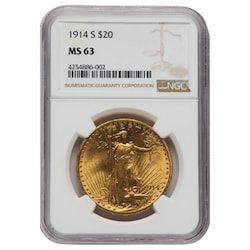


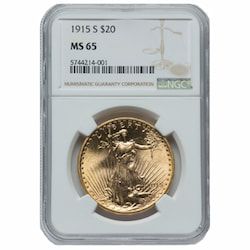


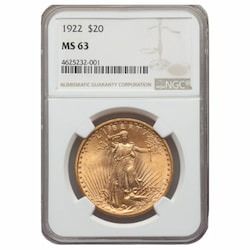

$20 Saint-Gaudens Double Eagle Gold Coins
The United States Mint introduced $20 Saint-Gaudens Double Eagle Gold Coins in 1907. Designed by renowned sculptor Augustus Saint-Gaudens at the request of President Theodore Roosevelt, these historic American gold coins feature Lady Liberty on the obverse and a flying eagle on the reverse.
Minted through 1933, each coin contains 0.9675 troy ounces of pure gold and has a 90% gold composition. Their substantial gold content, distinctive design, and place in American history make them appealing to both gold investors and coin collectors.
SD Bullion offers Saint-Gaudens Double Eagles for buyers interested in adding historic Pre-1933 U.S. gold coins to their collections or precious metals holdings.
Key Takeaways
-
Gold Content: Each $20 Saint-Gaudens Double Eagle contains 0.9675 troy ounces of pure gold and has a 90% gold composition.
-
Historical Significance: Introduced in 1907, the coin was designed by Augustus Saint-Gaudens at the request of President Theodore Roosevelt.
-
Distinctive Design: The obverse depicts Lady Liberty holding a torch and olive branch, while the reverse features a flying eagle.
-
Coin Varieties: Notable issues include the 1907 Ultra High Relief patterns, High Relief coins, and No Motto and With Motto varieties.
-
Market Value: A coin's value depends on its gold content, date, mint mark, condition, rarity, and collector demand.
What are $20 Saint-Gaudens Double Eagle Gold Coins?
The $20 Saint-Gaudens Double Eagle is a historic United States gold coin with a face value of $20. Minted from 1907 to 1933, it was part of the country's circulating gold coinage. The term "Double Eagle" refers to its denomination: an Eagle was a $10 gold coin, making the Double Eagle worth twice that amount.
Each coin has a 90% gold composition, with the remaining 10% consisting of copper. This alloy provides greater durability than pure gold while preserving a substantial amount of precious metal.
The main specifications of the coin are:
|
Specification |
Details |
|---|---|
|
Face Value |
$20 USD |
|
Gold Purity |
90% |
|
Alloy |
10% copper |
|
Actual Gold Weight |
0.9675 troy oz |
|
Total Weight |
33.436 grams |
|
Diameter |
34 mm |
|
Designer |
Augustus Saint-Gaudens |
|
Issuing Authority |
United States Mint |
|
Minting Period |
1907–1933 |
What is the history behind the Saint-Gaudens Double Eagle?
The Saint-Gaudens Double Eagle was created following President Theodore Roosevelt's efforts to improve the artistic quality of American coinage. In 1905, Roosevelt invited renowned sculptor Augustus Saint-Gaudens to redesign U.S. gold coins. The resulting $20 Double Eagle, introduced in 1907, featured a classical design that became one of the most recognized in American numismatics.
The original design presented technical challenges for the United States Mint. Saint-Gaudens envisioned an ultra-high-relief coin with deeply sculpted details, but the striking process required multiple impressions and was impractical for mass production. The Mint therefore reduced the relief, first producing High Relief coins with Roman numerals for the date and later adopting a lower-relief version with Arabic numerals.
Another design change came in 1908, when the inscription IN GOD WE TRUST was added to the reverse following congressional approval. This created the No Motto and With Motto varieties that collectors recognize today.
The coin's production came to an end during the Great Depression. The Philadelphia Mint struck 445,500 Double Eagles dated 1933 between March 15 and May 19 of that year. However, none was officially released into circulation. President Roosevelt launched gold policies restricting the circulation and private ownership of gold. On December 28, 1933, the Secretary of the Treasury, with Roosevelt's approval, issued an executive order requiring the delivery of gold coins, bullion, and certificates to the government, subject to certain exceptions. The remaining 1933 Double Eagles held by the government were subsequently ordered melted under the Gold Reserve Act of 1934.
Only two 1933 Double Eagles were lawfully transferred to the Smithsonian Institution for preservation. Ten additional examples recovered by the government in 2004 were held at Fort Knox; following the later recovery of another specimen, the U.S. Mint reported holding 11 examples in 2026. One 1933 Double Eagle was authorized for private ownership and became the subject of record-breaking auctions, selling for approximately $7.59 million in 2002 and $18.9 million in 2021. These events made the 1933 issue one of the most historically significant and valuable coins in American numismatics.
What does the Saint-Gaudens Double Eagle Gold Coin look like?
The Double Eagle design features a classical design inspired by American ideals and ancient Greek coinage. Sculptor Augustus Saint-Gaudens created its artwork, beautifying American coinage combining detailed imagery, symbolic elements, and distinctive inscriptions on both sides of the coin.
What appears on the Obverse?
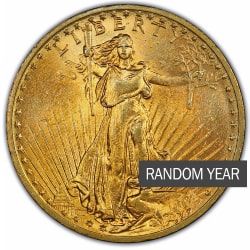
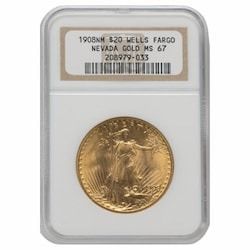
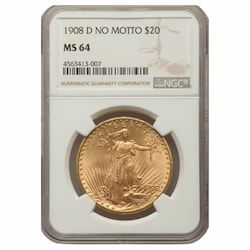
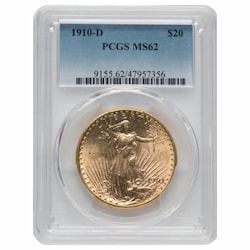
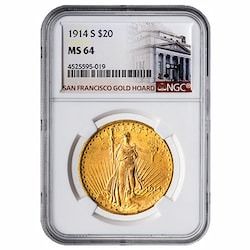
The obverse design features Lady Liberty striding forward with a torch in her right hand and an olive branch in her left hand. Behind her, rays of sunlight rise above the U.S. Capitol building. Surrounding the art figure are 46 six-pointed stars, representing the 46 states in the Union when the coin was first issued in 1907. The word LIBERTY appears above her, while the designer's initials, ASG, are placed near the date.
What appears on the Reverse?
The reverse features a flying eagle above a rising sun, symbolizing strength and freedom. The inscriptions UNITED STATES OF AMERICA and TWENTY DOLLARS identify the issuing country and denomination. On the With Motto varieties, IN GOD WE TRUST appears above the rising sun. All Saint-Gaudens Double Eagles also feature the Latin inscription E PLURIBUS UNUM on their lettered edges.
What are the different types of Saint-Gaudens Double Eagle Coins?
Saint-Gaudens Double Eagles were produced in several design variations between 1907 and 1933. The main differences regarding design elements involve the coin's relief, date format, and reverse inscriptions. Understanding these varieties helps collectors identify specific issues and evaluate their historical and numismatic significance. These classifications are not mutually exclusive: the 1907 High Relief issues are also No Motto coins.
What were the 1907 Ultra High Relief Double Eagles?
The 1907 Ultra High Relief Double Eagle was an experimental version of Saint-Gaudens's original design. Its deeply sculpted details created an appearance similar to a three-dimensional sculpture, but the high relief required multiple strikes and made large-scale production impractical. Only a small number of pattern pieces were produced, making them highly sought-after rarities.
What are the 1907 High Relief Double Eagles?
The 1907 High Relief Double Eagle was the first regular-issue version of Saint-Gaudens's design. Although its relief was lower than the earlier double eagles, it retained considerable depth and detail. The high relief designed coins are also distinguished by their date in Roman numerals, an unusual feature in U.S. coinage. High Relief examples include Wire Rim and Flat Rim varieties.
What are No Motto Double Eagles (1907–1908)?
The No Motto variety does not display the inscription IN GOD WE TRUST on the reverse. The words detracted reflected President Theodore Roosevelt's objection to placing the name of God on coinage. These coins were produced before the motto was added in 1908, making them an important early variety of the series.
What are With Motto Double Eagles (1908–1933)?
The With Motto variety features the inscription IN GOD WE TRUST above the rising sun on the reverse. The Congress intervened in the previous wording detraction and, in 1908, the motto remained part of the design through the final year of production in 1933. Most Saint-Gaudens Double Eagles available to collectors belong to this variety.
Which mint marks appear on Saint-Gaudens Double Eagle Coins?
Saint-Gaudens Double Eagles were struck at three United States Mint facilities: Philadelphia, Denver, and San Francisco. Each coin's mint of origin is identified by a small letter, known as a mint mark, located on the obverse just above the date.
Philadelphia issues have no mint mark, while Denver coins display a D and San Francisco coins an S. These marks help collectors distinguish coins produced in different facilities and identify specific date and mint combinations.
Mint marks can also influence a coin's rarity and market value. Some issues have lower original mintages or fewer surviving examples, making them more desirable to collectors. However, rarity depends on more than the number of coins initially produced; surviving population, condition, and collector demand also play important roles.
Which Saint-Gaudens Double Eagle dates are the most valuable?
Certain Saint-Gaudens Double Eagles command higher prices because of their low surviving populations, historical significance, and collector demand. Although original mintage figures provide useful context, the number of coins that survived around the world is often a more important factor in determining a coin's rarity and numismatic value.
The 1927-D is widely recognized as the rarest collectible regular-issue Saint-Gaudens Double Eagle. Although the Denver Mint produced 180,000 coins, most were melted following the 1933 gold recall. PCGS estimates that approximately 18 examples survive across all grades, making this date one of the most significant rarities in American gold coinage.
The 1930-S is another highly sought-after issue. With an original mintage of just 74,000 coins, it is considered one of the rarest regular-issue dates in the series, particularly in higher grades. Other notable issues include the 1921, whose surviving population is exceptionally small, and the 1931-D, a scarce late-date issue.
The 1933 Saint Gaudens Double Eagle is an exceptional case. Although 445,500 coins were struck, they were never officially released into circulation, and nearly all were melted. Only two examples were lawfully transferred to the Smithsonian Institution. The U.S. government holds another 11 recovered specimens, while a single coin was authorized to be maintained in private hands. This privately owned example sold for $7.59 million in 2002 and achieved $18.87 million at auction in 2021, setting a record for a coin sale.
The ownership of other surviving 1933 Double Eagles has also been the subject of significant legal disputes. In 2004, the heirs of Philadelphia jeweler Israel Switt surrendered ten examples to the U.S. Mint, but the federal government retained them as property of the United States. A jury ruled in favor of the government in 2011, and the Third Circuit Court of Appeals affirmed its ownership in 2016.
When evaluating a potentially valuable Saint-Gaudens Double Eagle, buyers should consider its date, mint mark, surviving population, condition, and professional certification. Even coins from the same year and mint can have substantially different values depending on their grade and collector demand.
How does coin condition affect Saint-Gaudens Double Eagle value?
The condition of a Saint-Gaudens Double Eagle can significantly influence its market value. Coins with little to no circulation wear, well-preserved details, and original surface luster generally command higher prices than heavily circulated examples. For scarce dates and mint marks, even small differences in condition can result in substantial price variations.
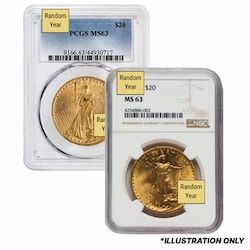
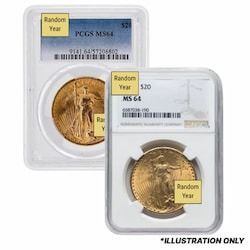
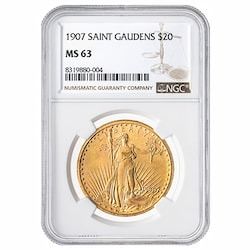
Professional grading services such as the Professional Coin Grading Service (PCGS) and Numismatic Guaranty Company (NGC) authenticate and evaluate coins using standardized grading scales. Their assessments help buyers compare condition, verify authenticity, and make more informed purchasing decisions.
Certified coins are typically accompanied by protective holders displaying their assigned grades. However, certification alone does not guarantee a higher resale price. A coin's value still depends on its date, rarity, condition, and demand among collectors.
How much is a $20 Saint-Gaudens Double Eagle Gold Coin worth?
The value of a $20 Saint-Gaudens Double Eagle depends on its gold content, current gold spot price, condition, date, mint mark, and collector demand. Common-date examples are often priced primarily according to their precious metal content, while rare dates, scarce mint-mark combinations, and higher-grade coins can command significant numismatic premiums.
Each coin contains 0.9675 troy ounces of pure gold. To estimate its melt value, multiply this amount by the current gold spot price per troy ounce. The coin's actual market price may be higher because of dealer premiums and collectible value. When comparing options, buyers should consider both the underlying gold value and any additional premium associated with the coin's rarity, condition, and certification.
Are Saint-Gaudens Double Eagle Gold Coins a good investment?
Saint-Gaudens Double Eagles can appeal to investors seeking physical gold with additional historical and numismatic value. Their gold content provides exposure to changes in the precious metals market, while scarce dates and well-preserved examples may attract collector demand beyond their intrinsic metal value.
However, their investment potential depends on the purchase price, gold market conditions, coin condition, and demand for specific issues. Common-date examples are generally valued more closely to their gold content, while rare or certified coins may carry higher numismatic premiums. These additional premiums can fluctuate independently of gold prices and may not be fully recovered when reselling.
Buyers should consider their primary objective before purchasing. Those seeking gold exposure may prioritize the coin's actual gold weight and premium over spot price or compare them to modern gold bullion bars and coins, while collectors may place greater importance on rarity, condition, and historical significance. As with other physical precious metals, Saint-Gaudens Double Eagles do not guarantee profits or appreciation.
How do Saint-Gaudens Double Eagles compare to other gold coins?
Saint-Gaudens Double Eagles share several characteristics with other historic and modern gold coins, but they differ in gold purity, actual gold weight, and historical background. Investors who prefer smaller, modern bullion denominations often compare them with 1/10 oz American Gold Eagle coins and 1/2 oz American Gold Eagle coins when deciding how to allocate their budgets across different gold products. Comparing these specifications helps buyers understand how they fit into the broader gold coin market.
|
Gold Coin |
Gold Purity |
Actual Gold Weight |
Face Value |
|---|---|---|---|
|
Saint-Gaudens Double Eagle |
90% |
0.9675 troy oz |
$20 |
|
Liberty Double Eagle |
90% |
0.9675 troy oz |
$20 |
|
91.67% |
1 troy oz |
$50 |
|
|
99.99% |
1 troy oz |
$50 |
Unlike modern American Gold Eagles and Gold Buffaloes, Saint-Gaudens and Liberty Double Eagles were issued as circulating gold currency. Their historical significance and collectible appeal distinguish them from modern bullion coins.
Although they contain slightly less pure gold than the one-ounce American Gold Eagle and Gold Buffalo, their value also reflects their condition, rarity, and demand among collectors. Investors seeking modern bullion options at different price points may also look at 1/4 oz American Gold Eagles to complement or contrast with historic Double Eagles in a diversified precious metals portfolio.
How should you store and protect Pre-1933 Gold Coins?
Proper storage helps preserve the condition and value of Pre-1933 gold coins. Keep Saint-Gaudens Double Eagles in protective, non-PVC coin holders or certified coin slabs. When handling an unprotected coin, hold it by the edges to avoid fingerprints, scratches, and surface damage.
Store coins in a secure location with stable temperature and humidity. Avoid cleaning, polishing, or using abrasive materials, as these practices can damage the original surfaces and reduce numismatic value. For rare or high-value examples, consider using a secure storage solution and obtaining appropriate insurance coverage.
Where can you buy $20 Saint-Gaudens Double Eagle Gold Coins?
Saint-Gaudens Double Eagles are available through established precious metals dealers and specialized coin retailers. Before purchasing, buyers should compare available coins based on date, mint mark, condition, authentication, and asking price. These factors can affect both the gold value and the numismatic premium.
SD Bullion offers a selection of Saint-Gaudens Double Eagles, with available listings varying by date, condition, and certification. Buyers can explore different options, compare pricing, and review individual coin details to find examples that align with their collecting interests or precious metals goals.
Browse the available Saint-Gaudens Double Eagle Gold Coins at SD Bullion to compare current listings and find an option that meets your purchasing criteria.
How much gold is in a $20 Saint-Gaudens Double Eagle?
Each $20 Saint-Gaudens Double Eagle contains 0.9675 troy ounces of pure gold. The coin weighs approximately 33.436 grams and has a gold purity of 90%, with the remaining 10% consisting of copper. Its gold content contributes to its intrinsic value, while the coin's date, mint mark, condition, and collector demand can influence its overall market price.
Are Saint-Gaudens Double Eagles made of pure gold?
Saint-Gaudens Double Eagles are not made of pure gold. They contain 90% gold and 10% copper, an alloy that improves durability and makes the coins suitable for circulation. Each coin contains 0.9675 troy ounces of pure gold. This composition is shared with historic U.S. Liberty Double Eagles and contrasts with the 22-karat fineness of American Gold Eagle bullion coins, although the two series feature different designs and historical backgrounds.
Why are Saint-Gaudens coins called Double Eagles?
The name Double Eagle refers to the coin's $20 face value. In U.S. monetary terminology, an Eagle was a $10 gold coin, making the Double Eagle worth twice that amount. The name distinguishes it from other historic U.S. gold denominations, including the $5 Half Eagle and the $2.50 Quarter Eagle, which represented smaller fractions of the Eagle denomination.
What is the difference between Saint-Gaudens and Liberty Double Eagles?
Both Saint-Gaudens and Liberty Double Eagles have a $20 face value, contain 0.9675 troy ounces of gold, and have a 90% gold composition. Their main difference is design. Liberty Double Eagles feature the Liberty Head design by James B. Longacre, while Saint-Gaudens Double Eagles display Augustus Saint-Gaudens's depiction of Lady Liberty and a flying eagle on the reverse.
Are all Saint-Gaudens Double Eagles valuable?
Not all Saint-Gaudens Double Eagles carry substantial numismatic premiums. Common-date examples are often valued mainly for their gold content, while scarce dates, mint marks, and high-grade coins may command additional collector premiums. Value also depends on authenticity and market demand. A coin's age alone does not make it rare; surviving population and collector interest matter when comparing similar issues in today's market.
What is the rarest Saint-Gaudens Double Eagle?
Among regular-issue Saint-Gaudens Double Eagles, the 1927-D is generally considered the rarest collectible date. The 1933 issue is an exceptional case: nearly all examples were melted, and only one has been authorized for private ownership. The 1907 Ultra High Relief pieces are experimental patterns rather than regular circulation issues, making them especially sought after by specialist coin collectors and numismatists.
How can you identify a genuine Saint-Gaudens Double Eagle?
Check the coin's weight, diameter, design details, and mint mark against recognized specifications, but understand that these checks cannot prove authenticity. Counterfeits may imitate genuine coins. For greater confidence, buy from a reputable dealer and consider examples authenticated and graded by PCGS or NGC. Professional examination is especially important for expensive dates and ungraded coins purchased online or at auction.
Are Saint-Gaudens Double Eagles eligible for a Gold IRA?
Generally, no. Saint-Gaudens Double Eagles are not among the specific U.S. gold coins eligible under the IRA exception for certain Treasury-minted coins. They also contain 90% gold, below the 99.5% fineness standard that applies to qualifying gold bullion. IRS rules require qualifying bullion to remain in the physical possession of an eligible trustee or custodian. Confirm eligibility with your IRA custodian.