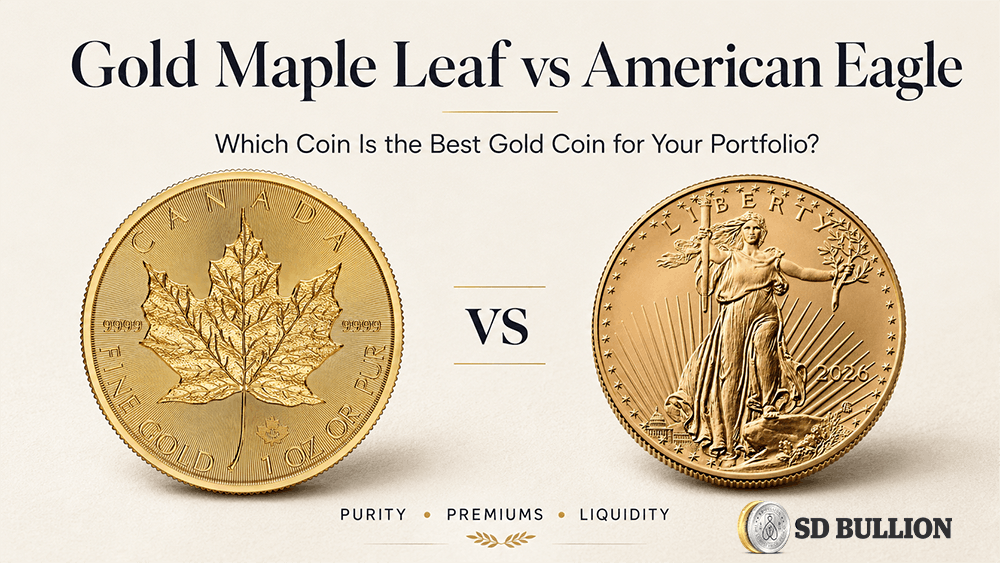
The Canadian Gold Maple Leaf and the American Gold Eagle are the two most widely held government-issued gold bullion coins in the world. The key difference: the Maple Leaf is struck in .9999 fine (24-karat) gold, making it one of the purest gold coins available, while the American Gold Eagle is struck in .9167 fine (22-karat) gold alloyed with silver and copper for added durability. Both contain exactly one troy ounce of pure gold per 1 oz coin.
This guide compares purity, design, premiums, liquidity, IRA eligibility, and resale value to help you decide which coin belongs in your portfolio
Key Takeaways
- The Canadian Gold Maple Leaf and American Gold Eagle are two leading government-backed gold bullion coin programs.
- Each 1 oz coin contains the same amount — one troy ounce of gold.
- The Canadian Maple Leaf offers maximum purity at .9999 fine gold.
- The American Gold Eagle contains .9167 fine gold blended with other metals for durability.
- Both coins are widely accepted in international markets.
- Premiums vary with market demand, spot price, and economic uncertainty.
- Both qualify for inclusion in certain IRAs.
Jump to: History and Origin | Purity and Composition | Design | Special Editions | Weights and Face Values | Liquidity | IRA Eligibility | Counterfeiting Concerns | Comparison Table
History and Origin
The Canadian Gold Maple Leaf
The Canadian Maple Leaf was introduced by the Royal Canadian Mint in 1979. At launch, it set a new global standard for purity by offering .9999 pure gold — making it one of the purest gold coins ever struck.
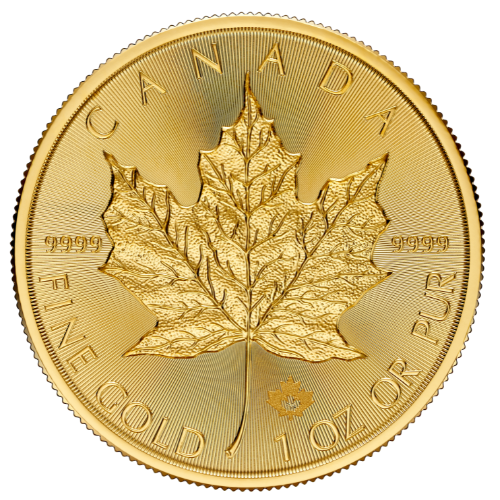
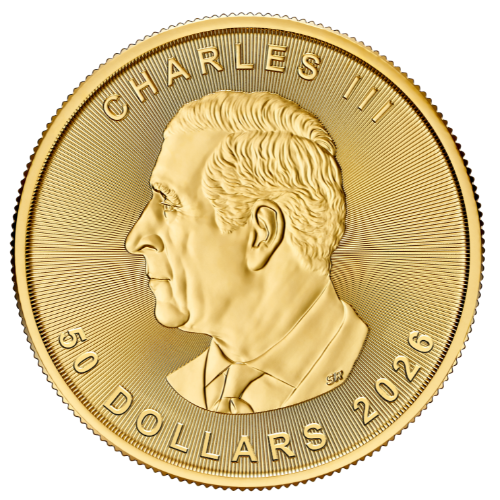
2026 1 oz Canadian Gold Maple Leaf Coin
At a time when other coins, such as the South African Krugerrand, dominated international markets, the Canadian coin quickly gained recognition for its higher purity and exceptional craftsmanship. Over time, the maple leaf coin became a symbol of Canadian gold coins and sovereign mint excellence.
The reverse side features the iconic maple leaf design, representing national identity and natural resources. The obverse traditionally featured Queen Elizabeth II, reinforcing its legal tender status under the Canadian government.
The American Gold Eagle
The American Gold Eagle was created under the Gold Bullion Coin Act of 1985 to compete with other coins such as the South African Krugerrand, which dominated the global gold bullion market at the time.
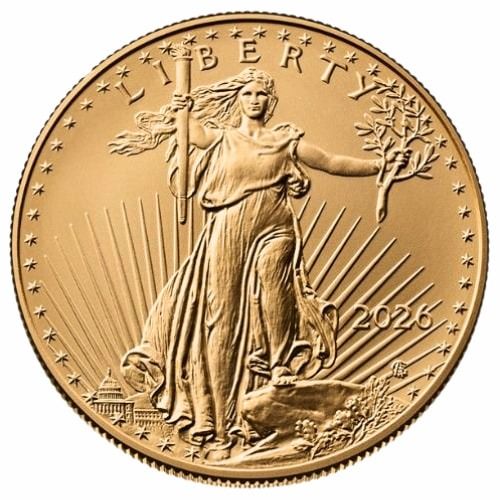
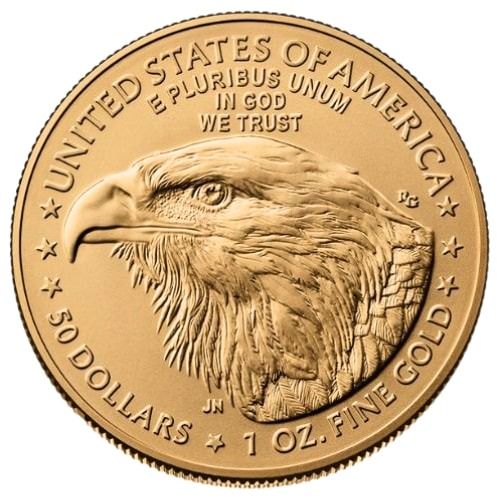
2026 1 oz American Gold Eagle Coin
Produced by the United States Mint, the American Eagle gold coins are considered the US' official gold bullion coin.
The obverse design features Lady Liberty, originally sculpted by Augustus Saint-Gaudens (often simply referred to as Saint Gaudens), holding a torch and an olive branch. While sometimes confused with the Walking Liberty design, this design is distinct and represents forward movement and freedom.
The reverse features bald eagles — more recently redesigned to display a close-up eagle’s head — reinforcing patriotic appeal.
How These Coins Shaped the Gold Bullion Market
Both coins have developed rich numismatic histories and strong global recognition. The Maple Leaf is widely known for its exceptional purity, while the American Gold Eagle stands out for its iconic design and strong appeal among U.S. investors.
More importantly, their introduction helped shape other bullion coins in the market. By offering government-backed, standardized gold coins, both mints provided investors with a reliable, trusted way to buy tangible assets. This system continues to support the precious metals market today.
Gold Purity and Composition
Gold purity is one of the biggest differences in the debate over the Maple Leaf vs. the American Eagle.
The Canadian Maple Leaf has distinct advantages on this matter as it is struck in .9999 gold, meaning maximum gold content and exceptional purity. This high fineness appeals to investors who prioritize owning the finest gold possible.
The American Gold Eagle takes a different approach. It is made from 22 karat gold (.9167). The remaining 8.33% is a blend of silver and copper. This alloy adds strength and durability while still containing a full troy ounce of pure gold.
That’s an important detail: both sovereign coins contain exactly one troy ounce of gold. The difference is in how that metal is alloyed. The Gold Eagle weighs slightly more overall due to the added metals, but its actual gold content remains 1 troy ounce.
Because of its fineness, the Maple Leaf is softer and may be more prone to small scratches or marks if not handled carefully. The American Eagle’s alloy makes it more resistant to wear and tear, which some investors appreciate if they plan to handle or store their coins outside of sealed packaging.
In simple terms:
- Choose the Maple Leaf if you prioritize maximum gold purity.
- Choose the American Eagle if you prefer added durability.
Both coins contain the same amount of gold, just in different structures.
Design and Symbolism
These coins are visually stunning and attract collectors worldwide. The Maple Leaf reflects Canadian identity and precision minting, while the Gold Eagle appeals strongly to American patriotism and history.
The Canadian Maple Leaf features the iconic maple leaf on the reverse side. The maple leaf is one of Canada’s most recognized national symbols, representing the country’s natural beauty, heritage, and strength. The obverse typically displays the reigning British monarch, reinforcing its status as official Canadian legal tender.
The American Gold Eagle carries powerful American symbolism. The obverse features Lady Liberty striding forward with a torch and olive branch, a design by Augustus Saint-Gaudens from the early 1900s. The reverse features a bold image of a bald eagle, a national emblem of freedom and resilience in the United States.
Market Demand and Price Premiums

Market demand plays a major role in premium levels.
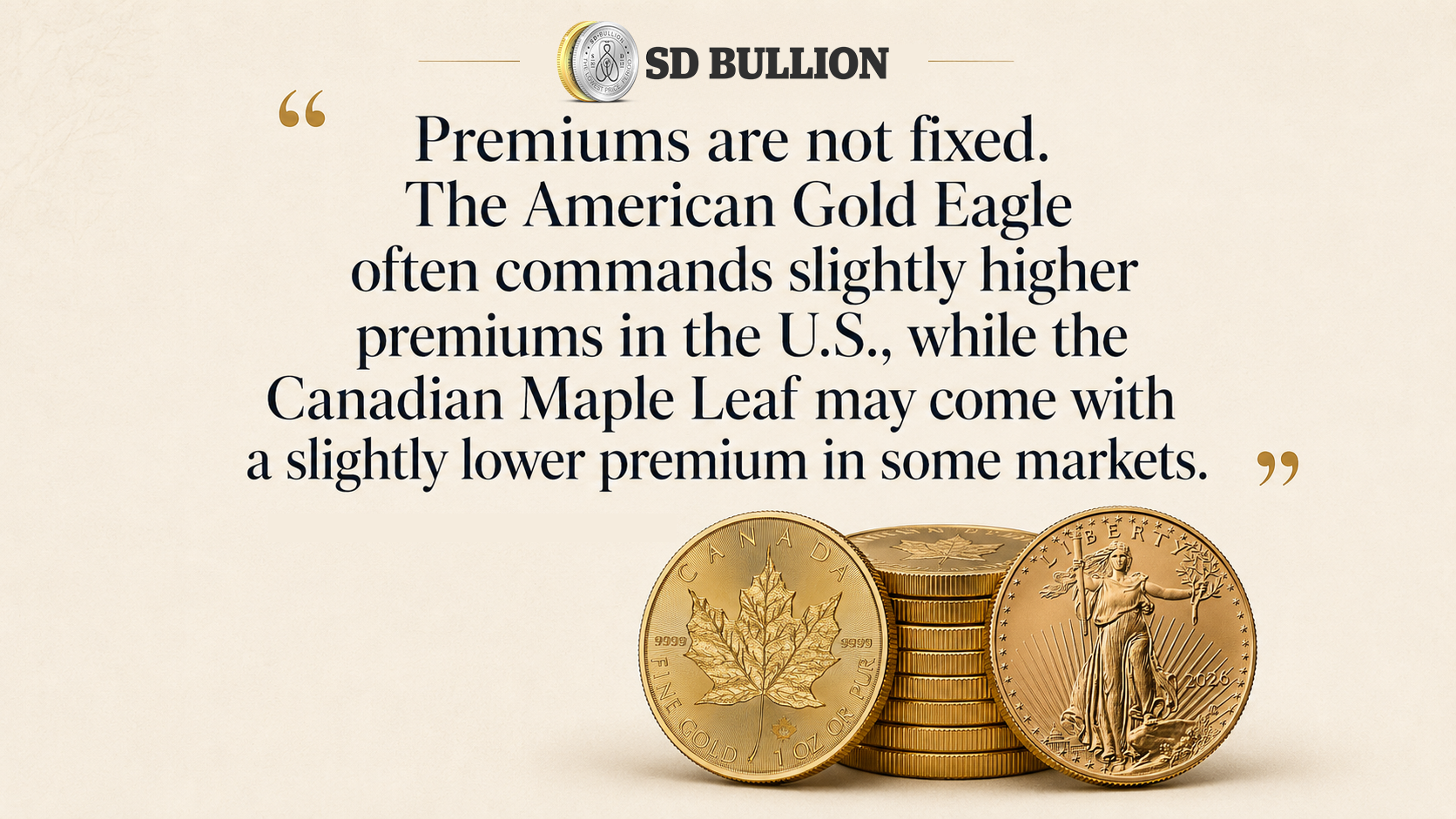
The American Gold Eagle often commands slightly higher premiums in the U.S. due to patriotic appeal, domestic recognition, and its status as the official gold coin of the U.S. It remains one of the most widely accepted coin programs in America.
The Canadian Maple Leaf enjoys strong recognition worldwide, often appealing to global investors seeking higher-purity gold coins. It is widely traded across Europe, Asia, and North America. In some markets, the Maple Leaf may come with a slightly lower premium than the Gold Eagle.
It’s important to remember that premiums are not fixed. They can fluctuate based on overall demand, gold market conditions, supply constraints, and economic uncertainty.
Collectability and Special Editions
Special editions offer lower mintages, unique finishes or design variations, historical significance, and potential long-term numismatic value.
The Canadian Maple Leaf has been released in a variety of special editions over the years. These include proof versions, limited mintages, and coins featuring unique privy marks. Some issues celebrate anniversaries, national events, or milestones from the Royal Canadian Mint. Because of their lower mintages, certain editions can become highly sought after in the secondary market.
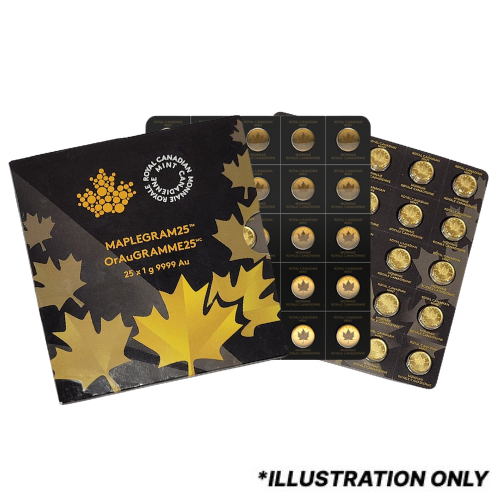
25 x 1 g Canadian Gold Maplegram25™ Coin Sheet
The American Gold Eagle also offers collectible versions, including proof coins struck with polished dies for a mirror-like finish. The United States Mint has released special design updates and limited-edition versions over time, which can generate additional collector demand.

NGC PF-70 1 oz American Gold Eagle Proof Coin - Random Year
For investors, they present a different kind of opportunity. While standard bullion coins track closely to the price of gold, special editions may carry additional premiums based on rarity and demand. In some cases, that added scarcity can lead to stronger resale values over time.
That said, special edition coins usually come with higher upfront premiums.
Weights and Face Values
Both the Canadian Gold Maple Leaf and the American Gold Eagle are available in multiple sizes, giving investors flexibility based on their budget and long-term goals.
The most common option is the 1-oz gold coin. It’s the preferred choice for many investors because it typically carries the lowest premium per ounce. However, both programs deliver fractional coins, including 1/2 oz, 1/4 oz, and 1/10 oz.
|
Weight |
American Gold Eagle Face Value (USD) |
Canadian Gold Maple Leaf Face Value (CAD) |
|
1 oz |
$50 USD |
$50 CAD |
|
1/2 oz |
$25 USD |
$20 CAD |
|
1/4 oz |
$10 USD |
$10 CAD |
|
1/10 oz |
$5 USD |
$5 CAD |
In reality, their market value is based on the current spot gold price plus dealer premiums not the printed monetary denomination. For example, even though the American Gold Eagle is priced at $50 USD, its true value reflects the price of one full ounce of gold, which is significantly higher.
The denomination simply confirms that these are official legal tender coins backed by their respective governments.
Liquidity and Recognition
One of the biggest advantages of both the American and the Canadian coins is liquidity.
These are two of the most recognized gold bullion coins in the world, making them easy to buy and sell in almost any market. Investors can typically sell them through:
- Local coin shops
- Online bullion dealers
- Private investors
- Precious metals exchanges
SD Bullion carries both coins in stock at competitive premiums over spot, with pricing updated in real time. This strong recognition reduces friction in the resale process. Buyers know exactly what they’re purchasing, and dealers can quickly price these coins based on the current spot price and market conditions.
Liquidity also provides flexibility. Whether you need to rebalance your portfolio, take profits, or respond to economic instability, they can usually be converted back into cash with relative ease.
Both coins are priced at a premium above today’s gold price. Their widespread global recognition helps build buyer confidence, offering a trusted, standardized, and easily verifiable form of physical gold—important qualities for investors seeking recognizable and liquid assets.
Which Gold Coin is Better For Resale?
Both the American Gold Eagle and Canadian Gold Maple Leaf offer strong resale liquidity, but the Gold Eagle holds a practical edge for U.S. based sellers. As the official gold bullion coin of the United States, it is immediately recognizable to domestic coin shops, dealers, and private buyers — reducing friction at the point of sale. The Maple Leaf compensates with broader international demand, making it the stronger resale choice in European and Asian markets where .9999 purity commands a premium. In either case, both coins trade close to spot price and can be sold quickly through reputable bullion dealers like SD Bullion, local coin shops, or precious metals exchanges — making resale a reliable exit option regardless of which coin you hold.
IRA and Retirement Account Eligibility
Holding gold in a retirement account can help diversify a portfolio, provide a hedge against inflation, and preserve purchasing power over time. Depending on the type of IRA, investors may also benefit from tax-deferred or tax-advantaged growth.
Both the American Gold Eagle and the Canadian Gold Maple Leaf can be included in a self-directed precious metals IRA.
The American Gold Eagle is especially popular in these accounts because it is specifically approved by the IRS, even though it is struck in 22-karat gold. Its recognition as the official U.S. gold bullion coin gives many American investors added confidence when choosing assets for their retirement portfolios.
The Maple Leaf coin also qualifies for IRA inclusion because it exceeds the IRS minimum purity requirement of .995 gold. With .9999 fine gold content, it easily meets the eligibility standards for precious metals IRAs.
It’s important to remember that IRA-approved gold must be stored in an authorized depository and cannot be kept at home. Understanding storage rules, contribution limits, and tax implications is essential before adding tangible assets to a retirement strategy.
Counterfeiting Concerns
Counterfeiting is a concern in any physical asset market. Fortunately, both the Canadian Gold Maple Leaf and the American Gold Eagle include advanced security features designed to protect investors.
The Canadian Gold Maple Leaf is especially known for its anti-counterfeiting technology. Modern issues feature precise radial lines and a micro-engraved laser mark that is difficult to replicate. These security enhancements make verification easier and help protect the coin's integrity.
The American Gold Eagle relies on highly detailed design elements, sharp strike quality, and strict production standards from the U.S. Mint. Recent design updates have also added additional security refinements to strengthen protection against counterfeit attempts.
Even with these anti-counterfeiting measures, investors should always take practical precautions. The safest way to reduce risk is to buy from reputable, established dealers with a strong track record in the bullion industry. Trusted dealers verify authenticity and source coins directly from recognized supply chains.
Proper storage also matters. Keeping your gold coins in a secure vault, a safe deposit box, or an insured home safe adds another layer of protection against theft or tampering.
While no investment is entirely risk-free, the combination of advanced mint security features, reputable dealers, and secure storage significantly reduces the chances of encountering counterfeit gold.
Canadian Maple Leaf vs. American Gold Eagle: Comparison
After reviewing purity, design, premiums, liquidity, IRA eligibility, and security features, it helps to see everything side by side. A direct comparison makes the key differences between these two leading gold bullion coins easier to evaluate at a glance.
|
Feature |
Canadian Gold Maple Leaf |
American Gold Eagle |
|
Gold Purity |
.9999 fine (24 karat) |
.9167 fine (22 karat) |
|
Gold Content (1 oz coin) |
1 troy oz of pure gold |
1 troy oz of pure gold |
|
Composition |
Pure gold |
Gold alloyed with silver & copper |
|
Durability |
Softer, more prone to scratches |
More durable due to the alloy |
|
Face Value (1 oz) |
50 CAD |
50 USD |
|
Mint |
Royal Canadian Mint |
United States Mint |
|
Primary Market Strength |
Strong international demand |
Strong U.S. demand |
|
IRA Eligible |
Yes |
Yes |
|
Premium Trends |
Often slightly lower in some markets |
Often slightly higher in the U.S. |
|
Security Features |
Radial lines & micro-engraving |
Advanced design detail & anti-counterfeit refinements |
With these distinctions clearly outlined, let’s take a final look at which coin may be the smarter investment for your specific goals.
Final Verdict: Which Coin Is the Smarter Investment?
Both the Canadian Gold Maple Leaf and the American Gold Eagle are high-quality, government-backed gold coins with decades of trust behind them. Each offers a reliable way to gain exposure to physical gold, and both are widely recognized, liquid, and IRA eligible.
So which one is the best gold coin for you?
The answer depends on what matters most to you and your personal preferences.
If you prioritize maximum purity and international recognition, the Canadian Gold Maple Leaf may be the better fit. Its .9999 fine gold content appeals to investors who want the highest possible level of purity in their bullion.
If you value durability, strong U.S. demand, and patriotic appeal, the American Gold Eagle may stand out. Its 22-karat alloy offers added strength, and its status as the official U.S. gold bullion coin supports consistent domestic demand.
Market conditions, premiums, and long-term goals should also factor into your decision. Some investors even choose to hold both coins to diversify within their gold allocation.
At the end of the day, investing in gold coins gives you something many financial assets cannot: a tangible, globally recognized store of value. Whether you choose the Maple Leaf, the Gold Eagle, or both, you’re adding a time-tested asset to your financial future — one that has preserved wealth for generations.