Coins, as we understand them today, first appeared around the 7th century B.C., according to most scholars. These earliest examples were struck in electrum, a natural alloy of gold and silver, sometimes carefully refined to specific ratios.
Over time, designs became more elaborate, and coinage evolved beyond its role in commerce to serve as a medium for expressing a city’s or nation’s identity and values.
Of course, systems of exchange existed long before the invention of coins. Metal was weighed, traded, and valued in lumps, with standardized pieces eliminating the need to measure every transaction. Eventually, marks were added to guarantee their value, a gradual process that unfolded over the 7th and 6th centuries B.C. Yet, the precise moment when these stamped lumps of metal became “coins” remains a subject of debate among numismatists.
In this list, we will present the top 10 of the oldest coins in the world, considering coins as pieces of metal of pre-determined value used to facilitate commerce and represent wealth.
Ancient Greece, Where Coins Were Born
Some of the coins discussed in this article come from Ionia, so let me clarify that it was a region in western Anatolia (modern-day Turkey) settled by the Ionians, Greeks who spoke the Ionian dialect, around 1150 BC.
When a coin is described as “Ionian,” it means it originated from one of the many cities within this territory.
While each city produced its own independent coinage, its coins often shared similarities in composition and design, since the development of coinage in the region influenced neighboring civilizations to adopt comparable systems.
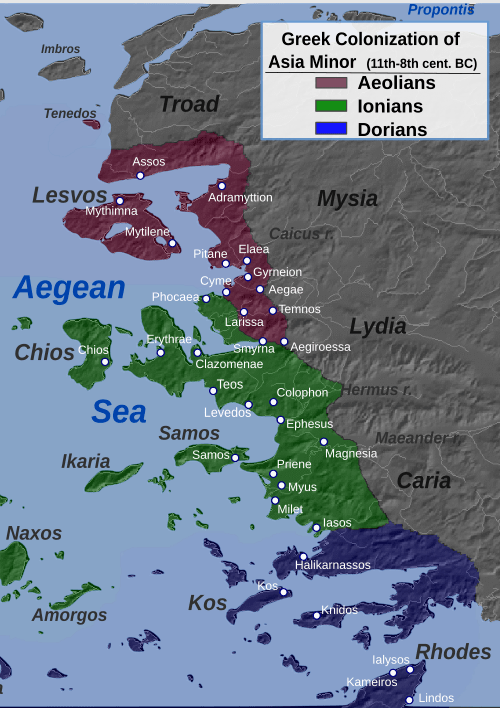
By Alexikoua - Own work. Data taken from: [1], [2]. Topography taken from DEMIS Mapserver, which is in the public domain, otherwise self-made. CC BY-SA 3.0, https://commons.wikimedia.org/w/index.php?curid=30582147
10. Ying Yuan
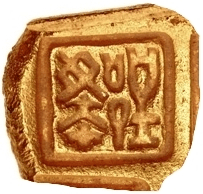
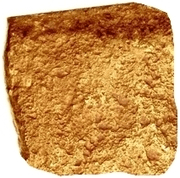
A few sources suggest that Ying Yuan coins may have originated around the same time as the earliest Greek coinage, roughly 600–500 BC, but they developed independently, making them distinct from the other coins I will present here.
The first confidently minted gold coins in China were issued by the ancient state of Chu in the 5th or 6th century BC and are known as Ying Yuan. While the exact emergence of this type of coin remains uncertain, the coin shown above is dated to approximately 400–220 BC, placing it among the newest on this list.
One of their most striking features is the unusual shape: unlike familiar round coins, Ying Yuan were cast as rectangular or block-like pieces. Many bear Chinese characters, which is why they are also called yin zi jin.
Some display the inscription Ying Yuan (郢爰), while others carry Chen Yuan (陳爰). The denomination appears to have been weight-based, with the stamp serving as validation rather than a guide for cutting, so weights, sizes, and shapes vary greatly.
Some scholars, however, consider these pieces funerary money rather than circulating currency, which is why Ying Yuan does not appear on every list of the world’s oldest coins.
9. Samian Lion Coins (Ionia)
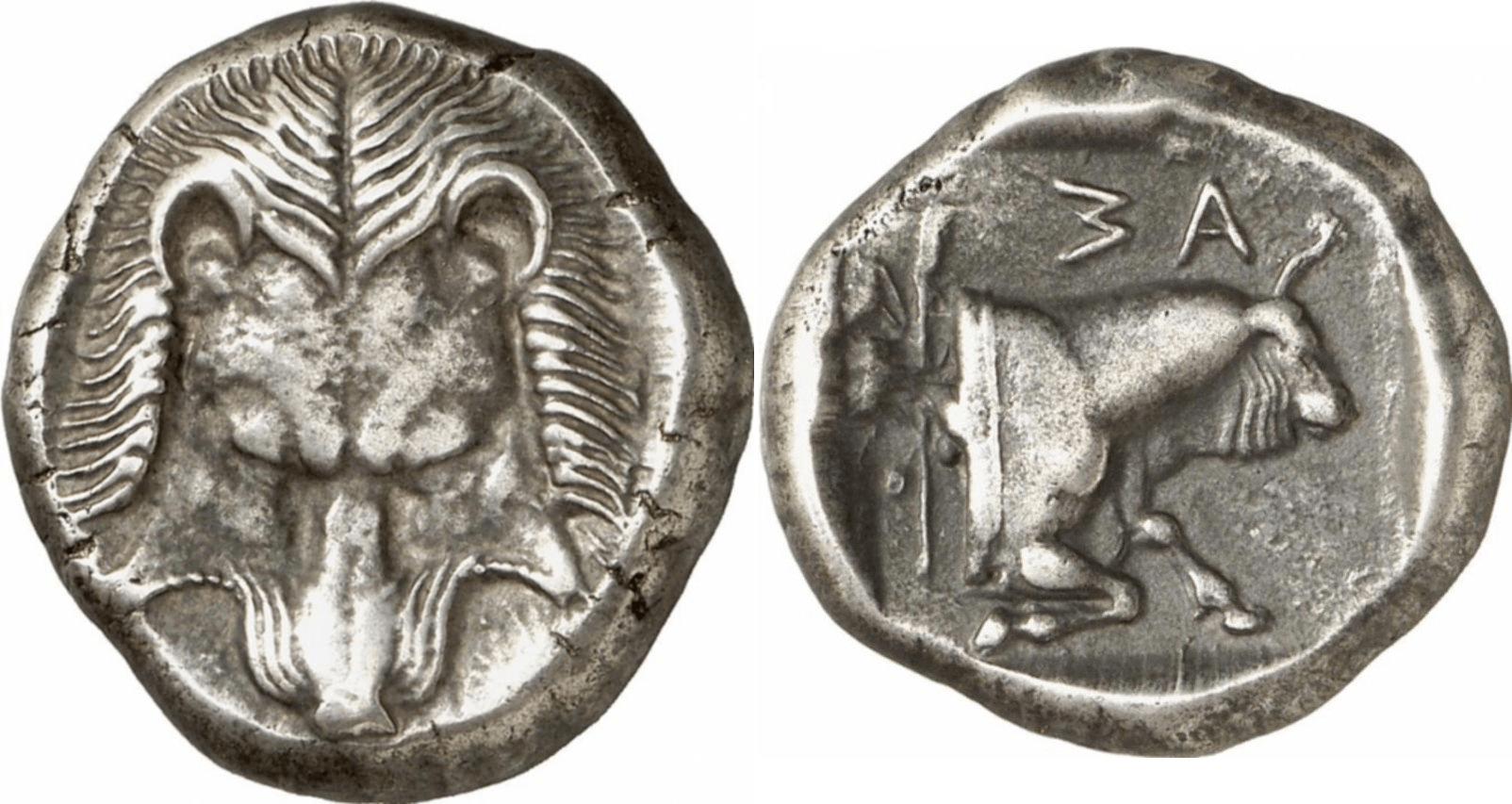
Samian Lion Silver Tetradrachma
Samos, a Greek island in the Aegean Sea, lies closest to the coast of modern Turkey (Asia Minor). In antiquity, it was a wealthy and powerful city-state, celebrated for its vineyards and renowned wine.
The coin shown above is a silver tetradrachm, weighing 13.10 grams of silver. The denomination tetradrachma means it was worth four times a drachma, the standard silver unit at most Greek mints. It was minted roughly between 499 and 439 BC, a period when Samos flourished both economically and culturally.
On the obverse, the coin displays a lion’s scalp facing forward, while the reverse bears the Greek inscription ΣA (“Sa”, abbreviation for Samos) alongside the forepart of a bull facing right.
Scholars continue to debate the meaning behind these images. The prevailing theory suggests that both the lion and the bull are symbolic, likely connected to local deities or religious cults, reflecting the island’s spiritual influences on its economic life.
8. Owl of Athens
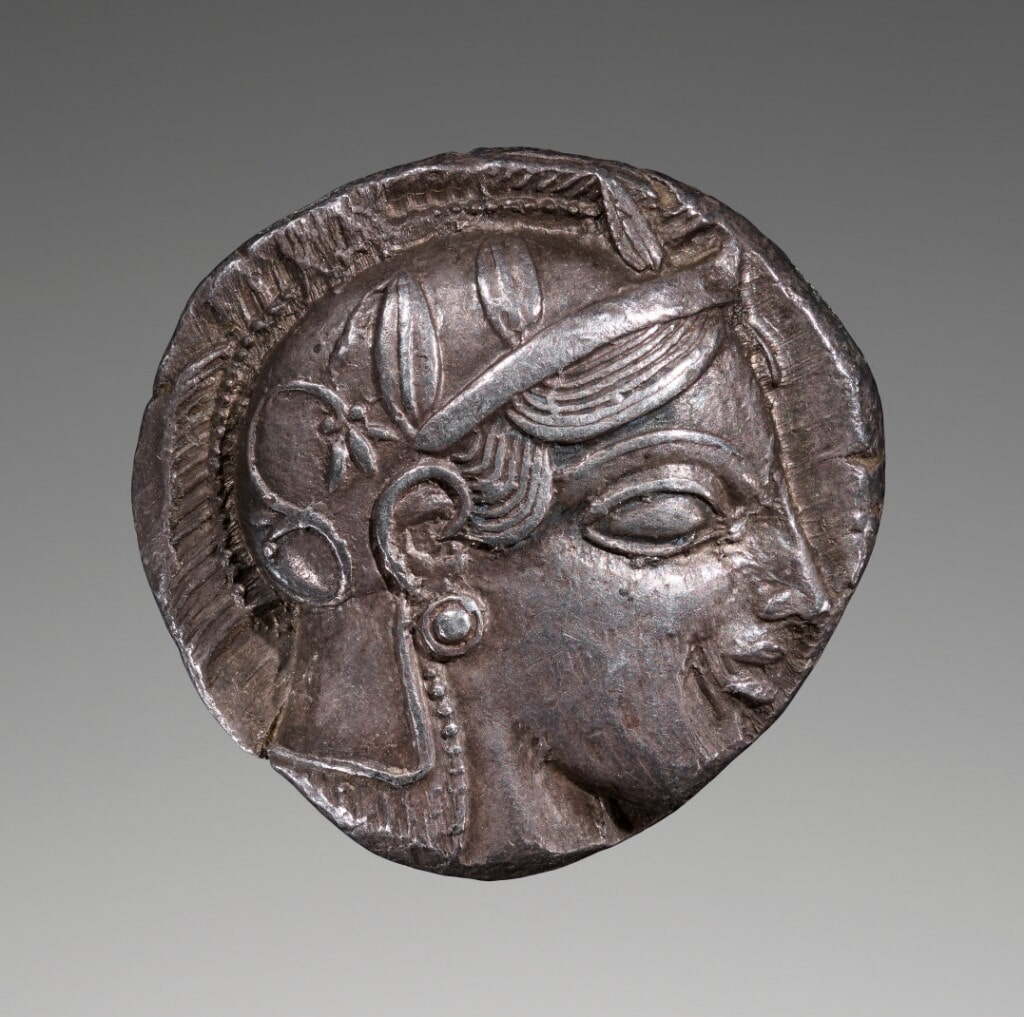
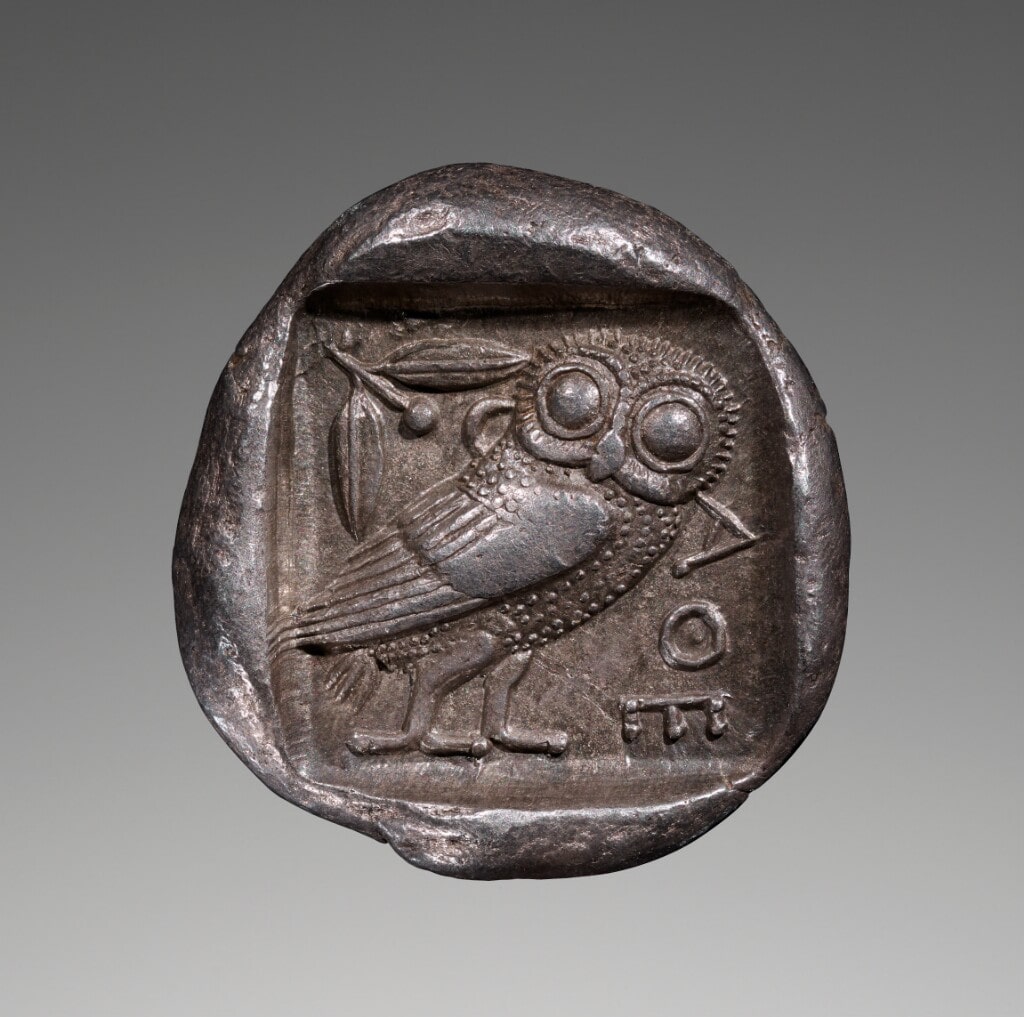
Tetradrachm of Athens, 475–465 B.C.
Going further on the list, we have the Athenian “Owls.” These were minted in Athens for over four hundred years, beginning in the 510s B.C (the image above shows a rare survivor of a more recent version). Although the style evolved, the coins retained the same basic design of Athena and an owl.
On the obverse, Athena gazes to the right, her crested Attic helmet adorned with olive leaves and a spiral palmette. Two loops of hair peek from beneath the helmet, framing her face, while her archaic smile and almond-shaped eye give the coin a timeless, almost iconic feel. The design stretches to the coin’s edge, even clipping her chin slightly.
The reverse features a striking owl, standing to the right with its head turned forward. Detailed feathers, a two-leaf olive sprig, and a crescent above its wing add to the imagery.
The inscription on the right is an abbreviation of ATHENAION (something like “of the Athenians”), confirming its origin. The owl appears in high relief, perfectly framed by the die, a symbol of wisdom, an element of the city’s identity.
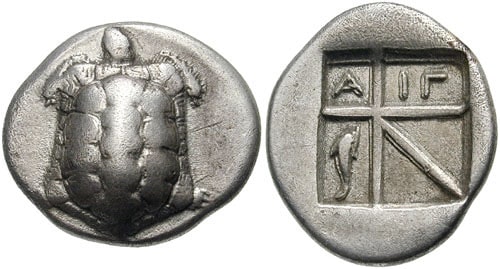
7. Turtle Stater of Aegina
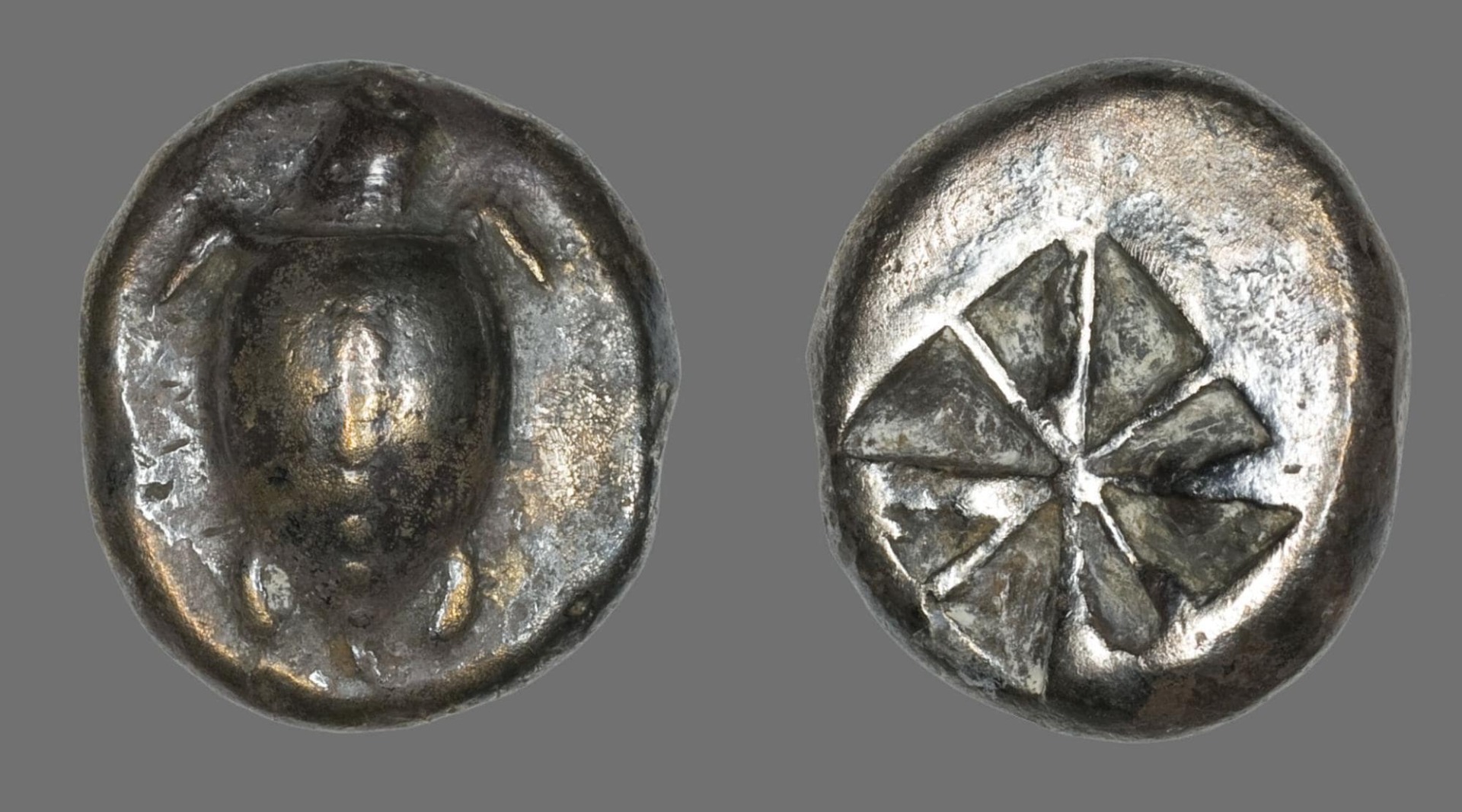
William F. Dunham (1857-1936), Chicago; given to the Art Institute of Chicago, 1920.
Around 510 and 485 BC, when Aegina reigned as the leading sea power among Greek city-states, its coins featured the image of a sea turtle. Shown on the obverse of this stater, the turtle symbolized naval strength and resilience.
In early Greek coinage, the stater was the main unit, electrum in Ionia and Lydia, silver in mainland Greece. From this standard came smaller fractions like the obol, hemiobol, tetartemorion, and hemitetartemorion, used for everyday trade, while staters and drachms carried the greater political and economic weight.
The reverse of this stater carried an incuse square divided into eight sections, a hallmark of early coinage stamped with official authority.
After the Peloponnesian War ended in 404 BC, the sea turtle was replaced by a land tortoise, marking a shift in the island’s fortunes and perception. Check below:
By Classical Numismatic Group, Inc. http://www.cngcoins.com, CC BY-SA 3.0, https://commons.wikimedia.org/w/index.php?curid=510407
6. The Gold Daric
By Classical Numismatic Group, Inc. http://www.cngcoins.com, CC BY-SA 3.0, https://commons.wikimedia.org/w/index.php?curid=74462590
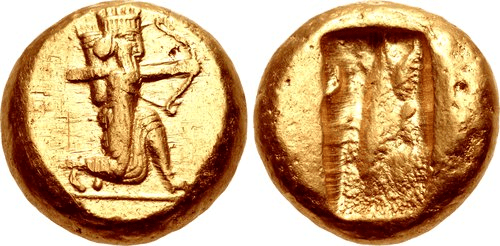
As evidence of its fame and longevity, this coin is even mentioned in the Old Testament and was widely used for trade across the region during the Achaemenid Empire of Persia (550–330 BC).
The image on the obverse shows a Persian king or hero in a kneeling-running position facing right, holding a spear in his right hand and a bow in his left, with a quiver slung over his shoulder. The reverse features a rectangular incuse punch.
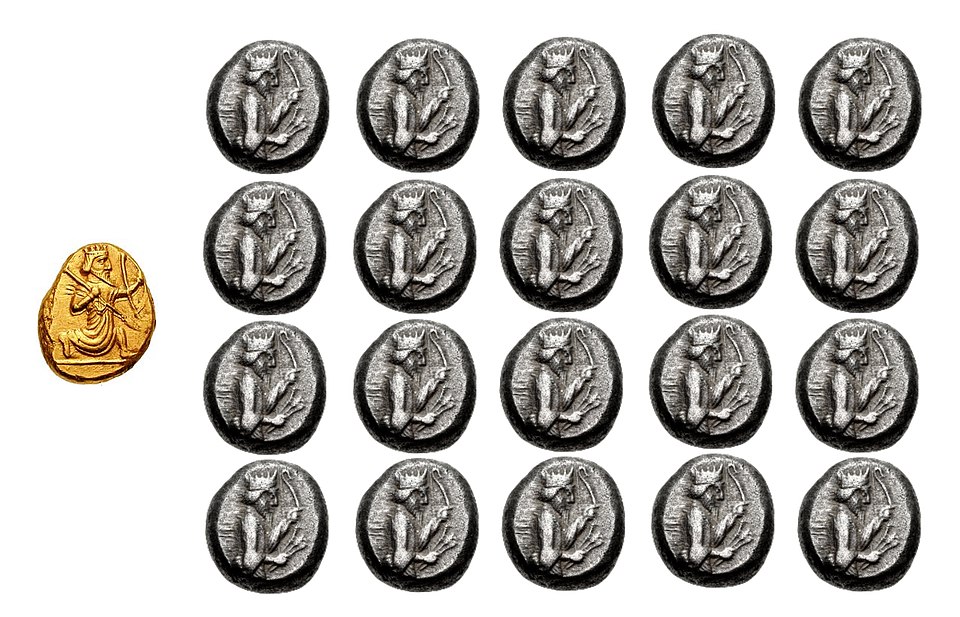
Known as the daric, this coin was a high-purity gold piece weighing 8.4 grams, based on the ancient Babylonian shekel standard. A daric represented a month’s pay for a mercenary foot soldier and could be exchanged for 20 silver coins at the time, the sigloi.
By Classical Numismatic Group, Inc. http://www.cngcoins.com, CC BY-SA 3.0, https://commons.wikimedia.org/w/index.php?curid=74463118
It was an international trade coin, with hoards discovered as far afield as Sicily and Afghanistan.
The Greek term dareikos derives from the name of Darius the Great (ruled 522–486 BC). We use the Greek name because it reflects how the Greeks referred to Persian coinage, particularly gold coins, although the exact Old Persian name is uncertain.
5. Ephesus “Bee” Coins (Ionia)
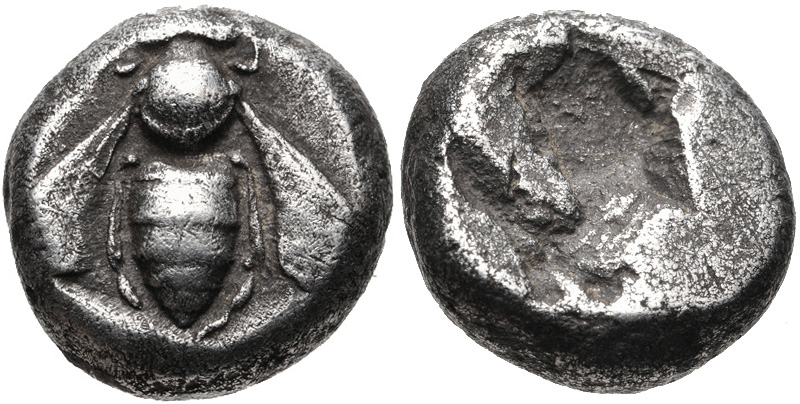
One of the most fascinating symbols on this list is the bee, featured on coins from Ephesus, one of the ancient Ionian cities, circa 550 and 500 BC. The coin above is one of many “bee coins” produced during that period.
Today, coins often display majestic animals, such as the Bald Eagle on the United States’ gold and silver bullion coins, to represent the country's strength and courage. In a similar way, the choice of the bee reflected the values of Ephesus at the time, a combination of religious significance and practical importance as a source of food.
Before humans formed agrarian societies, honey was considered a precious substance. In Ephesus, beekeeping was a vital activity that supported both the economy and the development of society. Bees were seen as messengers of divine blessing and symbols of fertility.
Scholars also link the bee directly to the cult of Artemis, the city’s most important goddess. As protector of nature and wildlife, Artemis was associated with fertility, and the bee became one of her symbolic animals.
Eventually, the bees disappeared from Ephesus’ coinage as the city came under Roman rule, when the Emperor's image featured on coins.
4. Corinthian-Style Staters
A stater, the basic unit of many coinage systems, often served as the standard, with other denominations as its multiples or subdivisions. Some cities, however, developed their own minting methods, making it impossible to keep coin weights strictly uniform.
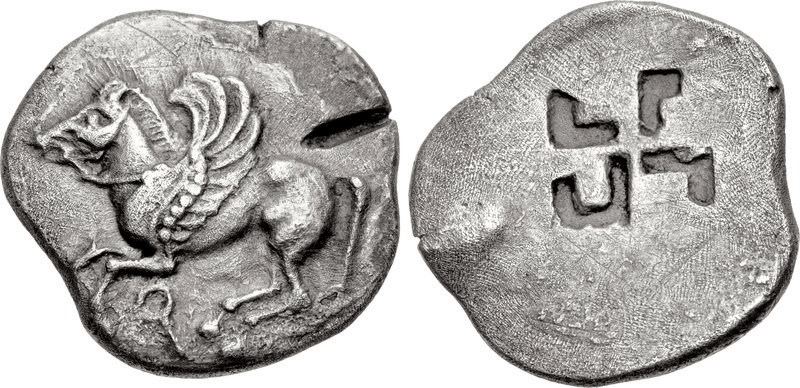
Corinthian Staters
Among the world’s oldest and most famous coins are the staters of Corinth, from the influential city at the junction of the Greek mainland and the Peloponnesus.
This early stater, dating from c. 550–500 B.C., features Pegasus, the winged horse of Greek mythology, in flight on the obverse. Below Pegasus is the archaic Greek letter Koppa, marking Corinth as the mint.
The reverse shows a simple incuse punch, also indicating its origin.
So popular were these coins that they were eventually struck not only in Corinth but also in many other Greek cities, Italy, and Sicily, most of which were Corinthian colonies.
3. The Coinage of Phanes
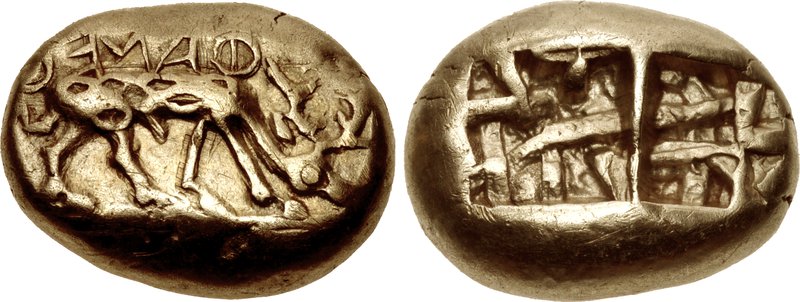
By Classical Numismatic Group, Inc. http://www.cngcoins.com, CC BY-SA 3.0, https://commons.wikimedia.org/w/index.php?curid=50058075
Among the oldest coins on this list are the coins of Phanes, struck around 625 and 600 BC. Remarkably, they are the first coins known to bear a legend (even before the Pegasus coin mentioned before).
The obverse shows an inscription in archaic Greek, ΦANEOS, meaning “of Phanes”; a grazing stag, an animal commonly associated with Artemis and used on later Ephesian issues, suggesting Ephesos as the minting city.
The series of Phanes Coins included several denominations: stater, 1/3, 1/6, 1/12, 1/24, 1/48, and 1/96 stater, some of which were inscribed with the phrase 'I am the badge/mark/symbol of Phanes.'
The true identity of Phanes remains uncertain; he may have been an individual or perhaps an institution, but most agree that the name functioned as the personal mark of the person who produced the coins.
2. Ionian Striated Coins
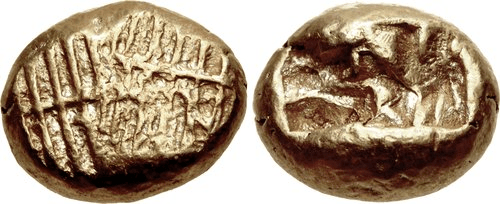
IONIA, Uncertain. Circa 650-600 BC. EL Hekte – Sixth Stater (10.5mm, 2.39 g). Lydo-Milesian standard.
Also struck in the same region as the Lydian Lion coins, these pieces stand out for their more abstract designs.
Their close proximity to the Lydian issues suggests that electrum was the standard for coinage production at the time. The choice of electrum was made because the alloy with silver makes the coins more resistant than if they were made of pure gold.
In fact, these two last coins are part of the ongoing debate among numismatists over which should be considered the world’s oldest coin.
1. The Lydian Lion Coin- The World’s First Coin
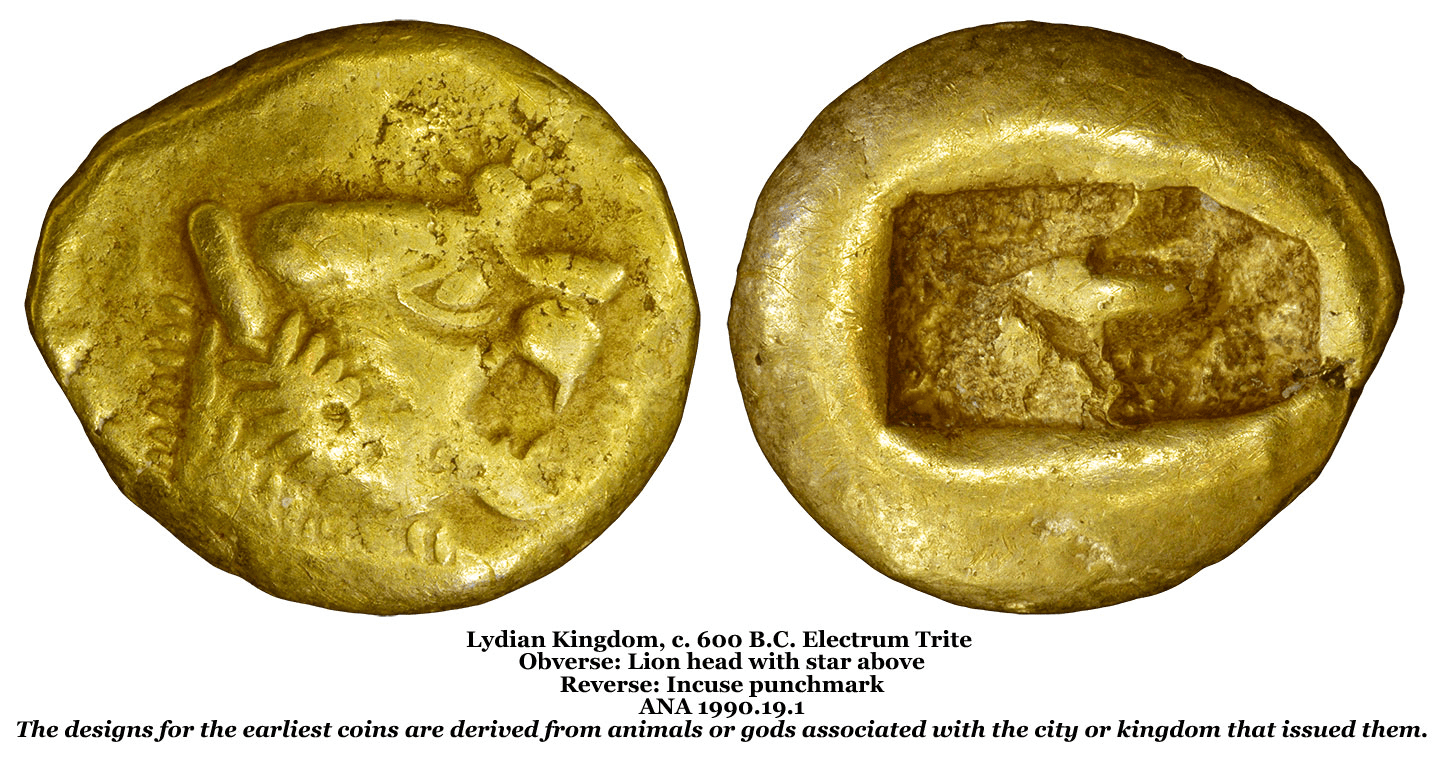
Often regarded as the world’s very first coin, the Lydian Lion was minted around 600 BC in the ancient kingdom of Lydia, located in Asia Minor (modern-day Turkey). At the time, Lydia was a powerful trading hub, and the introduction of standardized coinage revolutionized commerce across the region.
Unlike naturally occurring electrum, the Lydians carefully refined and controlled the proportions of each metal, demonstrating an impressive early grasp of metallurgy. Most examples feature the image of a lion’s head, likely a royal or cultural emblem, pressed onto the oval-shaped piece.
Although debates continue about what truly counts as the “first coin,” numismatist Neil S. Berman points out in his research that the Lydian Lion remains the most widely accepted candidate. More than just currency, it marked the beginning of the monetary systems that shaped economies for centuries to come.
Authority and Legitimacy
From the Lydian Lion to King Charles III, rulers used coins stamped with their emblems to project authority and trust.
Today, government-minted bullion commands a premium over private rounds for the same reason: official backing carries weight.
Respected institutions such as the U.S. Mint, the Royal Canadian Mint, and the Perth Mint are recognized worldwide for their quality and reliability.
From Lydian Lions to Gold Eagles: What Ancient Coins Teach Us About the Staying Power of Gold and Silver
The very first coin ever struck, the Lydian Lion of around 600 BC, wasn’t just a piece of metal; it was the birth of financial trust. Stamped with a recognizable emblem, it turned gold and silver into reliable, portable stores of value.
More than 2,600 years later, investors still rely on the same metals for stability and wealth preservation.
Many of the world’s oldest coins come to us from hoards, hidden away centuries ago by people who understood the importance of safeguarding their wealth. What began as stockpiling food in early societies evolved into hoarding precious metals once their enduring value became clear.
The same instinct lives on today in silver stacking and gold accumulation, proof that humans have always turned to rare, tangible assets as a safe haven for their resources.