Jump to: Coin Grading | Grading Scale | Benefits of Graded Coins | Grading Services | Grading Process | CAC and ANAC | Special Designations | PCGS vs NGC | Importance of Authentication | Turnaround Time for Grading | FAQs
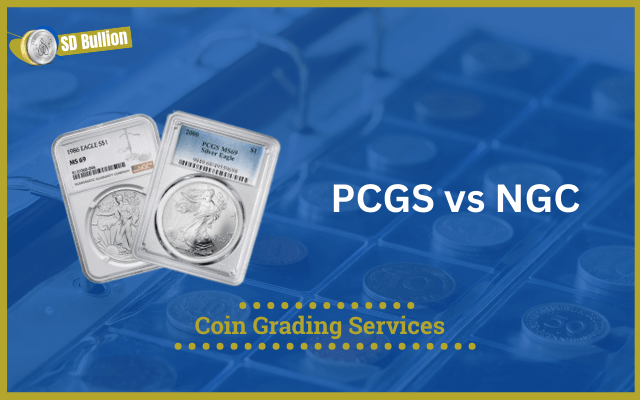
Choosing the best coin grading service can make or break a coin’s market appeal. Whether you are building a collection or preparing to sell, understanding how PCGS and NGC authenticate, grade, and encapsulate coins will help you make the right call.
This article breaks down exactly what each service does and how it can impact your coin’s value.
PCGS vs NGC Comparison Chart
|
Aspect |
PCGS |
NGC |
|---|---|---|
|
Turnaround Time for Grading |
Grading is slower overall, taking about 15–60 business days after PCGS enters the order, not counting opening or shipping. |
Considering all kinds of submissions, turnaround is usually 3–60 business days, so NGC is generally faster. |
|
Security of Graded Coins |
PCGS holders offer slightly superior security with advanced anti-counterfeit measures such as the gold shield. |
NGC holders are very secure, but their system is considered slightly less advanced than PCGS in terms of anti-counterfeit features and aesthetics. |
|
Popularity & Market Relevance |
PCGS is more dominant in the U.S. market, especially for rare American coins, giving it superiority among U.S. collectors. |
NGC is more influential internationally, often preferred for world coins, making it superior in global markets. |
|
Grading Scale Used |
Uses the Sheldon Scale (1–70). |
Uses the Sheldon Scale (1–70). |
|
Designations in Grading |
Overall, PCGS is strong in classic U.S. strike designations but offers fewer eye-appeal marks. |
NGC assigns its trademarked Star Designation ★ to coins with exceptional eye appeal for their assigned grade. |
|
Resale Value |
PCGS coins often have slightly higher resale value for rare U.S. |
NGC coins are usually below PCGS in U.S. premium levels. |
|
Standards |
PCGS is perceived as the strictest authority for grading older U.S. coins. |
NGC is also known for high standards, but particularly with world coins. |
Coin Grading
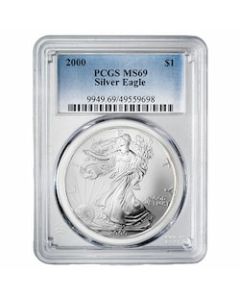
Understanding the grading system is crucial because it tells you whether the company you choose follows established market standards and numismatic consensus.
Professional graders evaluate each coin, usually in pairs, to ensure accuracy, and their final grade can greatly influence a coin’s value.
Understanding the Coin Grading Scale
The Sheldon Scale is a 1-70 grading scale used by PCGS and NGC to evaluate a coin’s condition, with 70 being a perfect coin.
The numbers are based on Dr. Sheldon's studies, which indicated that a coin in perfect condition would be worth 70 times as much as one in deplorable condition.
Higher grades, such as MS70 or PF70, indicate a coin with no imperfections under 5x magnification and are highly sought after by collectors.
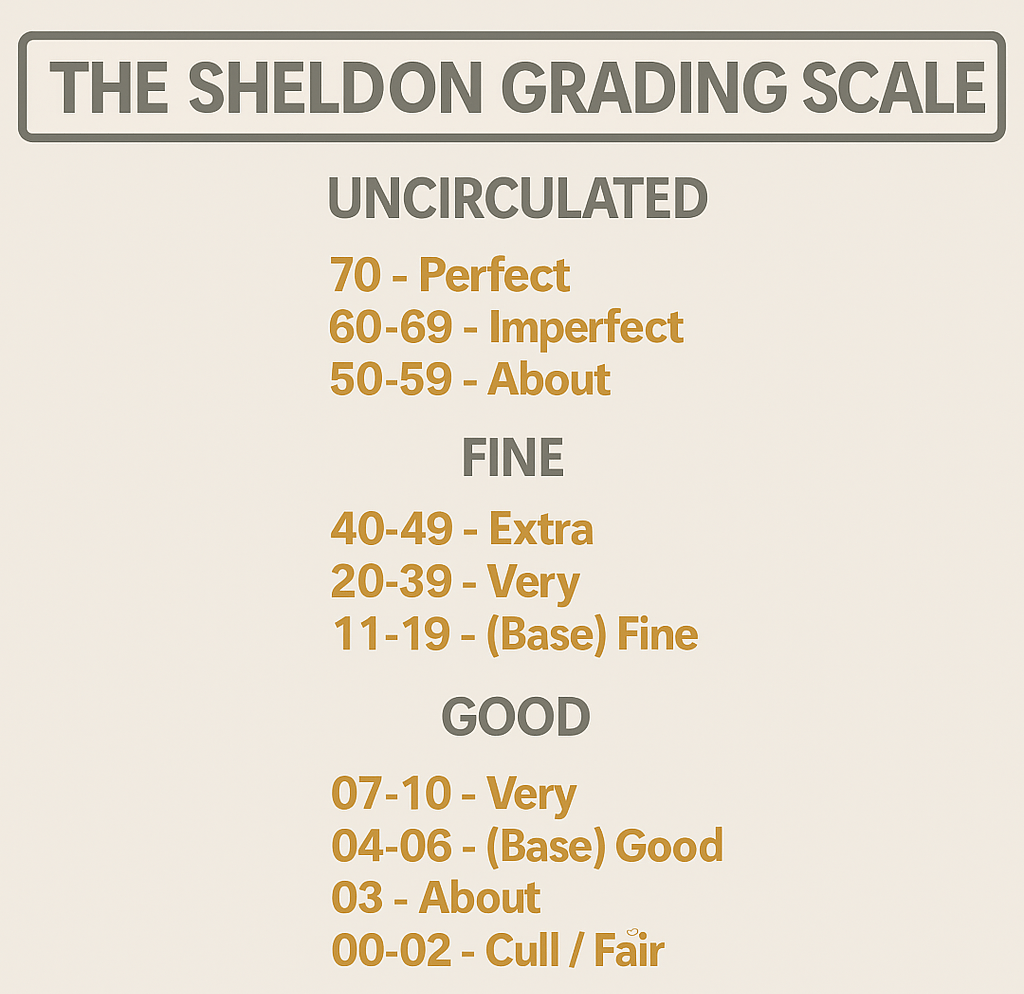
The grading scale is standardized, allowing for direct comparison between coins graded by different services, such as PCGS and NGC.
Benefits of Graded Coins
Having your coins graded by a reputable company boosts their value, provides buyers with a trusted, consistent evaluation, and makes them easier to sell.
PCGS and NGC also offer secure, tamper-evident slabs that protect your coins and reinforce market confidence.
Grading Services
PCGS and NGC are the leading coin grading companies, trusted for having graded millions of coins. While their standards and terminology differ slightly, both are widely respected across the numismatic market.
Other services like ANACS exist, but PCGS and NGC remain the most commonly used and the most trusted by collectors and investors.
The Grading Process
NGC
-
After you choose a service, your submitted coins must follow the company’s requirements. At NGC, once the package arrives, staff confirm the coin count and compare each coin’s date, denomination, and mintmark with the submission form. Security cameras monitor all receiving and grading areas.
-
Coins are then barcoded, stored in a vault, and examined anonymously. Specialists check for varieties, and at least two graders independently grade each coin using the 1–70 scale. Supplemental designations (RD, RB, BN) are added when appropriate. Damaged coins receive Details Grades, and non-genuine pieces are not encapsulated.
-
After grading, coins move to encapsulation, where labels with the coin’s date, mintmark, denomination, variety, grade, designations, and unique ID are printed and sealed inside the NGC holder.
-
Encapsulated coins return for a final check of grade accuracy and holder condition. Once approved, they go to Shipping, where counts and labels are verified. Coins are packed upright in divided boxes, sealed with wire-laced tape, and shipped registered, insured, and protected.
PCGS
-
When a package arrives, it is itemized, logged, and separated by service level. After opening, PCGS coins are counted, payment and service are verified, and identifying details are removed. A generic order number is assigned, data is entered, and a confirmation email is sent. In the Sticker Stage, coins are counted again and labeled with order and certification numbers, which are then tracked in the PCGS database.
-
PCGS coins are graded by 3 to 4 specialists who work independently. Different graders first confirm authenticity and check for alterations, then assess strike, luster, marks, toning, and overall eye appeal before assigning a grade on the PCGS 1–70 scale. Once all grades are verified, the order moves to labeling, where PCGS prints labels with the coin’s date, denomination, grade, variety, and unique certification number.
-
After sealing, PCGS sends the coins to Grade Verification, where another grader confirms accuracy and consistency; anything that falls short is removed and re-evaluated. The order then moves to Mechanical Verification, where each coin is matched to the submission form and checked for holder or label defects.
-
Finally, the Shipping Department recounts the coins, enters the shipping instructions, packs the order, and sends it back to the customer, who receives an automatic email once the package is on its way.
CAC and ANAC
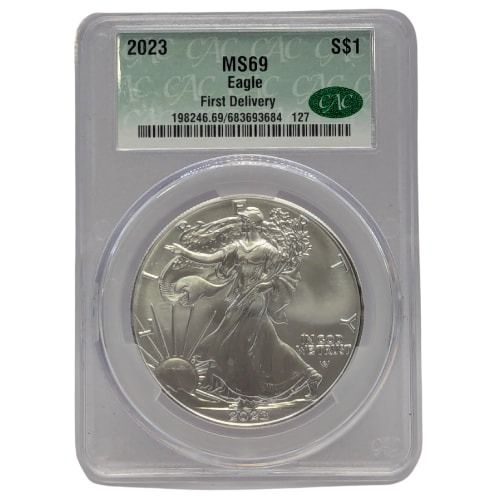
After understanding how PCGS and NGC grade coins, it’s important to note that some collectors might want to look for an extra layer of assurance.
The CAC offers this by reviewing already-graded coins and awarding a CAC sticker to pieces that meet their stricter quality standards. This sticker is widely trusted in the market and helps collectors identify coins with strong eye appeal and solid grades.
Early Releases and Special Designations
Designations are added after the numerical grade to highlight special attributes of a coin series that many collectors find valuable. Understanding these markings and the grading standards behind them, helps you make informed decisions based on more than personal preference.
Early Releases / First Releases
Both NGC and PCGS offer special labels for coins submitted within the first 30 days of a new issue. NGC uses Early Releases / First Releases (also called First30), while PCGS uses First Strike. Despite the different names, they all indicate the same thing: early submission within the initial 30-day release window.
Colors
NGC and PCGS uses color designations for copper coins based on how much original red remains: Red (RD) for more than 95%, Red-Brown (RB) for 5%–95%, and Brown (BN) for under 5%.
Red (RD) copper coins usually command the highest premiums. Because Red coins retain more of their original mint color, meaning less oxidation and better overall preservation. Copper naturally darkens over time, so a coin that remains mostly red is rarer, more visually appealing, and signals superior storage, making it more desirable to collectors and the market.
Strike Characters:
Contrast designations describe how a coin’s fields (background) and devices (raised details) interact with light.
NGC and PCGS use similar terms to describe mirrored fields and frosted devices, but their systems differ mainly in scope and application.
-
NGC uses Ultra Cameo and Cameo exclusively for Proof coins (referred to as PF), and PL/DPL (Deep Prooflike) exclusively for non-Proof coins.
-
PCGS uses Cameo and Deep Cameo for Proof coins, and Prooflike (PL) and Deep Mirror Prooflike (DMPL) for coins with mirrored fields (especially Morgan dollars).
NGC separates Proof and non-Proof designations strictly (PF-only vs. non-PF-only). At the same time, PCGS uses similar terminology but ties certain designations more closely to specific series (e.g., Morgan dollars for DMPL).
These designations can add value to a coin by providing provenance and authenticity. These designations can significantly impact the coin’s value, and are highly sought after by collectors and investors.
Eye appeal designations:
NGC uses a plus (+) for coins at the high end of their grade, and the Star (★) for coins with exceptional eye appeal.
PCGS also uses a + to show a coin sits at the top of its grade, but PCGS does not have an equivalent to NGC’s ★ designation.
So both companies use + for high-end graded coins, but only NGC awards a separate mark for standout visual appeal.
PCGS or NGC: Which is Right for You?
Both services provide reliable grading, but PCGS is often viewed as more prestigious and tends to bring higher resale values. Collectors usually favor PCGS for US coins, while NGC is preferred for world and modern issues.
This has been their main difference so far and NGC's most significant advantage.
However, this might change in the future, as PCGS recently introduced a 10-Point Scale for Chinese Ancient coins, adapted from the 70-point Sheldon Scale to reflect their unique features:
An MS-10 coin shows no visible casting flaws and retains full original gloss, while a PO01 has barely discernible details, closely mirroring the Sheldon Scale’s highest and lowest grades.
The Importance of Authentication
Authentication is a core part of any professional coin grading service, ensuring each coin is genuine and protecting serious collectors from losing money to counterfeits.
Both PCGS and NGC rely on expert numismatists and advanced technology to verify authenticity, which is one of the reasons PCGS plastic holders are so trusted in the US. coin market. Strong authentication upholds market demand and preserves overall coin value.
The Turnaround Time for Grading
Standard services for submitting coins vary: NGC typically takes about 10 days for U.S. coins and 30 days for world coins, while PCGS can take up to 35 business days for the same grade tiers.
Costs depend on the coin type, condition, rarity, or high value, and both companies adjust pricing and turnaround based on estimated value and bulk submissions.
PCGS and NGC turnaround time and fees matter, as they can determine when collectors or investors can buy or sell.
Check all costs involved in grading, including membership fees, per-coin grading fees, shipping, and insurance. You will need to cover these expenses when submitting coins.
The Security of Graded Coins
In the end, choosing between PCGS and NGC matters the same way as understanding coin grading itself. Both are reputable professional coin grading service providers trusted worldwide for authenticating gold, silver, and other valuable coins.
What truly protects the value of one coin is the ability to assess grading standards, market trends, and value considerations. When a person learns how to interpret grades accurately and determine whether a company is applying sound numismatic principles, they can make confident decisions, regardless of which of both services they use.
FAQs
What is the difference between PCGS and NGC?
The main difference between both NGC and PCGS is market strength: PCGS dominates the U.S. market, while NGC is preferred for world coins. Some collectors like PCGS’s perceived stricter standards, while others prefer NGC for the look of its NGC slabs. Because coin grading is highly subjective, choosing a service depends on your priorities, both companies are reputable and professional.
Which grading service is more trusted — PCGS or NGC?
While both NGC and PCGS offer exceptional grading for expensive coins, PCGS is often perceived as stronger for US coins, which leads some collectors to trust PCGS more. However, greater popularity or perception does not mean PCGS is inherently more trustworthy than NGC, as both maintain high, reliable standards.
Which grading service gives higher resale value?
Collectors often find that PCGS-graded coins achieve higher resale value because PCGS is widely regarded as the more prestigious and trusted grading service. Buyers are generally willing to pay a premium for coins certified by PCGS, which contributes to their consistently stronger market performance.
What are the main differences in grading fees between PCGS and NGC?
NGC’s grading fees are generally higher than PCGS, depending on the coin type. For coins of unlimited value, NGC charges $400 plus 2% of fair market value, while PCGS charges $300 plus a 1% guaranteed premium. For regular coins up to $2,500–$3,000 in value, PCGS charges $40 and NGC $55, providing collectors clear cost differences.
How long does the grading process take for PCGS and NGC?
PCGS typically takes about 35 days to grade most coins, while rare pieces may be completed in around 15 days. NGC’s turnaround is about 60 days for standard submissions and roughly 5 days for rarities, giving collectors a clear sense of expected timelines.
How can I tell if my coin has been graded by PCGS or NGC?
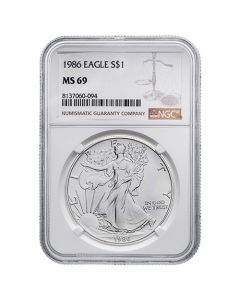
One can easily tell NGC vs PCGS by checking the label on the slab. An NGC slab displays the Numismatic Guaranty Corporation name and logo, while a PCGS holder clearly shows the PCGS name, logo, and the specific coin’s certification details.
Is one grading company stricter than the other?
Although grading remains somewhat subjective, most collectors view NGC and PCGS as stricter and more consistent in standardized grading, while ANAC slabs are seen as a tier lower. The same coins moved from an ANACS holder to PCGS slabs can often gain value simply due to PCGS’s stronger market reputation.
Do PCGS or NGC guarantee the grades they assign?
Yes. PCGS guarantees its grades; if a buyer believes a PCGS-graded coin is overgraded or not authentic, it can be submitted through the PCGS “Guarantee Resubmission” process for re-examination. NGC offers a similar protection: owners who believe an NGC coin is overgraded or not genuine may use NGC’s “Appearance Review” service. Membership isn’t required, though fees may apply.
What’s the difference between “First Strike” and “Early Releases” coins?
Coins graded soon after release may receive special designations. NGC uses Early Releases for coins submitted within 30 days, while PCGS uses First Strike for the same window. Though named differently, each label shows the coin was among the first graded by one company or the other, adding pedigree appeal for collectors who value early submissions.
Do PCGS and NGC grade bullion coins differently from collectible coins?
PCGS and NGC use the same numerical grade scale for bullion and collectible coins, but the market treats them differently. Bullion value depends more on metal price than on high-grade coins or a specific numerical grade, while collectible coins rely heavily on condition. Market trends tend to reward numismatic pieces far more than standard bullion issues.
Are PCGS and NGC recognized internationally?
Yes, both PCGS and NGC are widely recognized worldwide, with PCGS as the leading coin grading service in the U.S. market.