Gold Holds Above $5,100 as Largest Silver Withdrawals Ever Signal a Tightening Physical Market — Silver Is Vanishing and Washington Still Thinks Tariffs Fix a $2 Trillion Deficit
- Gold and silver finished last week with strength, even as headlines focused on court rulings and tariffs. Silver closed at $84.65 an ounce, while gold held near $5,107, showing resilience despite volatility
- The gold-to-silver ratio fell to 60, signaling that silver is starting to outperform gold again — often a sign that speculative and industrial demand is heating up
- Key technical resistance for gold sits around $5,120. Traders will be watching closely next week, especially as China returns from its Lunar New Year holiday
- The U.S. Supreme Court struck down proposed global tariffs that were expected to raise $1.5 trillion over a decade. But with annual federal deficits running near $2 trillion, tariffs were never going to fix the broader debt problem
- In just the past four weeks, roughly 90 million ounces of silver left the COMEX and Western ETFs combined — a historic outflow. India has been the primary destination for that metal
- The SLV silver ETF alone has seen about 45 million ounces flow out from its recent peak, including 12 million ounces drawn from New York vaults
- Industrial silver supplies continue to shrink, while global mine production struggles to keep up with demand. The silver market remains in structural deficit year after year
- Western institutional investors remain underexposed to gold. Since 2020, gold has more than tripled, yet cumulative inflows into gold ETFs are small compared to the trillions still parked in stocks, bonds, and cash
- Veteran commodity manager Leigh Goehring recently warned that while a pullback is possible in the short term, he believes a much larger second leg of this gold bull market still lies ahead
- This is not a normal year for gold or silver. Between record debt levels, ongoing monetary strain, and tightening physical supply, precious metals are increasingly being viewed as the anti-debasement trade in a world drowning in liabilities
90 Million Ounces Drained in Weeks as Record Silver Outflows Accelerate, U.S. Deficits Crush Tariff Illusions, and Western Investors Remain Shockingly Underexposed to the Precious Metals Bull Market
Silver Is Vanishing, Tariffs Are Falling, and the Gold Bull Market May Be Entering Its Next Phase
The U.S. Supreme Court’s February 20, 2026 decision to strike down the administration’s proposed global tariffs has added yet another layer of uncertainty to already fragile global markets. The tariffs—initially projected to raise $1.5 trillion over a decade—were ruled an improper use of emergency powers, triggering immediate policy reshuffling and fresh 10% global surcharges under alternative legal authorities. While the headline suggested relief, markets instead interpreted the ruling as confirmation that trade tensions, fiscal strain, and policy instability are far from resolved. With annual U.S. deficits running near $2 trillion, even fully implemented tariffs would have barely dented the structural imbalance. Rather than celebrating tariff reversals, investors appear increasingly focused on debt monetization risks, inflation pressures, and what many see as an inevitable currency debasement cycle.
Tariffs Won’t Solve a Structural Debt Crisis
The Supreme Court’s rejection of global tariffs underscores a larger reality: trade policy adjustments cannot resolve a structural fiscal imbalance. Even if the original tariff plan had remained intact, projected revenues would have been modest compared to persistent trillion-dollar annual deficits.
Markets appear to be internalizing that reality. Instead of focusing solely on tariffs, investors are increasingly asking how sovereign debt loads will ultimately be managed. Growth alone seems insufficient. Austerity is politically unpalatable. That leaves monetary tools—tools that historically favor tangible stores of value.
COMEX, CME, and China: A Physical Market Under Stress
While Washington debates trade policy, the real drama is unfolding in the physical silver market.
Over the past four weeks alone, roughly 90 million ounces of silver have left the COMEX and Western ETF systems, marking one of the largest drawdowns on record. The SLV ETF has seen approximately 45 million ounces flow out from its recent peak, including 12 million ounces removed from New York vaults.
This is occurring against the backdrop of a multi-year structural silver deficit. From 2021 through 2025, cumulative shortfalls approached 820 million ounces—nearly an entire year of global mine production. Now, in early 2026, registered COMEX silver inventories have fallen below critical thresholds, while open interest in futures contracts continues to exceed available deliverable supply by multiples.
China has added fuel to the fire. Effective January 1, 2026, Beijing implemented restrictive licensing requirements on refined silver exports, prioritizing domestic solar, EV, and AI-driven industrial demand. As the world’s largest refiner, China’s policy shift has effectively choked off a significant portion of refined silver supply to Western markets, intensifying the squeeze.
The strain has already manifested in extreme volatility. Silver briefly spiked above $120 per ounce earlier this year before correcting, prompting the CME Group to raise margin requirements to $25,000 per contract. Backwardation has appeared intermittently, signaling immediate physical demand. Concerns over potential delivery shortfalls have grown louder, particularly ahead of major contract notice periods.
Adding to suspicions, a late-February CME trading outage temporarily halted metals trading at a critical moment—just as silver surged past $91 per ounce and inventories hovered near decade lows. Whether coincidence or technical failure, the disruption deepened market anxiety about liquidity and pricing stability in the paper system.
China’s Exchanges vs. Western Trading
While COMEX and CME represent the dominant Western pricing mechanisms for precious metals, China’s Shanghai Gold Exchange (SGE) and Shanghai Futures Exchange (SHFE) increasingly reflect a different dynamic—one driven by physical delivery and strategic stockpiling.
Combined SGE and SHFE silver inventories have fallen toward decade lows, mirroring Western vault drawdowns. The difference is structural: China’s system is more tightly linked to physical demand from solar manufacturers, EV producers, and state-backed industrial planners. In contrast, Western exchanges remain heavily paper-leveraged, with futures open interest often dwarfing registered deliverable metal.
As physical silver continues moving East and industrial demand proves price-insensitive, the growing disconnect between paper pricing and physical availability becomes harder to ignore. If the current trajectory persists, pricing power could gradually migrate toward exchanges where physical settlement dominates.
Leigh Goehring: The Second Leg of the Gold Bull Market
Against this backdrop, veteran commodity fund manager Leigh Goehring has offered a striking perspective. Speaking just before the late-January selloff, Goehring argued that while a short-term pullback was likely due to excessive enthusiasm, the broader gold bull market is far from over.
He compares today’s environment to the 1970s bull market, suggesting we may be completing the first leg, with a potentially much larger second leg still ahead. For performance-oriented funds, tactical trimming may make sense. But for long-term retail investors, he believes gold and silver remain core holdings.
Goehring frames gold as the “anti-debasement trade,” warning that a monetary regime change—possibly involving overt debt monetization or dollar devaluation—may lie ahead. In such an environment, precious metals—assets that are no one else’s liability—could become essential rather than optional components of portfolio preservation.
His long-term thesis is simple: when debt burdens across Western governments exceed sustainable levels, history shows that currency debasement often becomes the chosen exit. If that regime shift materializes, hard assets may be among the few beneficiaries.
Weekly Market Update Notes:
The US Supreme Court struck down Trump's Global Tariffs today.
Ruling that they are illegal. Rejecting his use of emergency powers to impose trade duties.
The tariffs, covering imports from Canada, China, Mexico, and nearly all countries, were projected to raise $1.5 trillion over a decade.
Let me remind you in the grand scheme of things how tiny that $1.5 trillion figure is.
These are the first 4 months of US Federal Governments financials.
On the left is the fiat currency coming in, on the right is the fiat currency going out.
Customs duties from Oct 2025 through Jan 2026 were $118 billion, yet we were still on track for an annual deficit this year of near $2 trillion.
Tariffs aren't saving us, hey maybe the promise of robots and AI singularity can save us all.
OK back to reality, which it will likely require us inflating our way out quagmire as opposed to growing our way out with science fiction hopium.
We saw similar the future is milk and honey psyops before during the last Nasdaq Stock Bubble.
You can hopium for the best if you like, but I'm going to continue planning on the most typical way out of debt and unfunded liability promise pile fiascos. This debasement trade into bullion has only just begun, normies are still not in it.
In the second half of this week's bullion market update we're going to examine just how early we still are in terms of broad investor participation in the gold market.
Before we go to break I want you to hear what long time commodity fund manager Leigh Goehring has to say a couple days before the major selloff in both silver and gold late last month.
Industrial Silver bar supplies continue falling at rates never before seen. We'll cover that and more right after this brief message.
The silver and gold markets traded upward to close this week with strength.
The spot silver price ended the week at $84.65 oz bid.
The spot gold price closed the week basically flat at $5107 oz bid.
The spot gold silver ratio fell to close the week at 60.
Key near term technical price resistance for gold is at $5,120 oz so let us see how the market trades next week especially once China returns from its Lunar New Year Week long plus a few days holiday.
No this is not a normal year in gold, and neither in silver.
Let us see what happens with the combined decade low levels of silver bullion bars within the combines SGE & SHFE.
As for the COMEX silver warehouse system, silver continues to outflow as rates and in size never before seen.
In just the past 4 weeks we saw some 90 million oz of silver bullion on net leave the combined COMEX just over half, and the remainder coming out of unsecured Western silver ETF piles.
The lone major recipient of silver bullion on net the past month was India.
This month we saw some 45 million oz from peak to now flow out of SLV.
Blackrock iShares' SLV has even begun drawing down silver from its NY vaults having now pulled some 12 million oz from what used to be a larger chunk of the stagnant COMEX eligible pile.
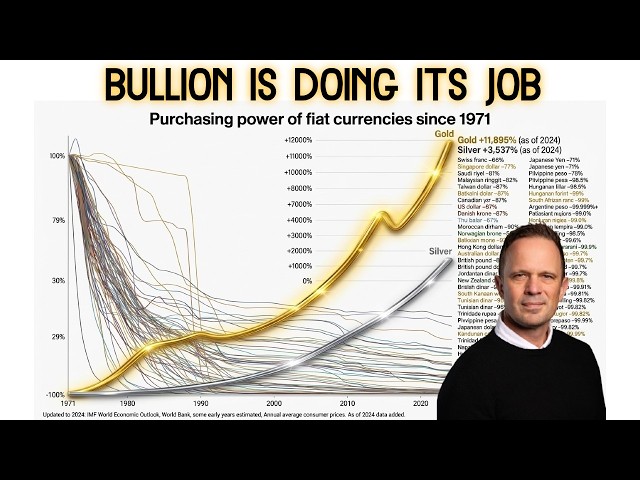
In all major fiat currencies you can name, silver has already shown its hand to start 2026. Those that think this bull market is over have next to no fundamental clue of what is setting up.
Turning to the gold market and focusing in on gold poor institutional investors and HNW investors in the West.
Pretty pathetic that since 2020, Gold has more than 3-folded in spot price and Western investors pretty much missed out.
There is your cumulative inflows by asset class for the decade with a paltry $100 billion flowed to gold, with around 100 times that firepower having underperformed in stocks, bonds, and fiat cash.
Gold's ETF market share is still nowhere near where it peaking in 2011, and that bull market was a joke compared to what we are already witnessing today.
Titans of the fiat financial investment world have bee front run by retail bullion stackers, emerging market central banks, and eastern precious metals buyers at large.
The silver market is remains a deficit producing machine year after year, with estimations of how much more we are using then we are mining and refining as levels which suggest the world silver market is nowhere close to finding balance.
Ultimately it will be exorbitantly higher silver spot prices that bring the market back into balance. But remember this is marathon not a sprint.
It took five years for the silver price outside of COMEX hours to balloon up from $80 to near $400 oz where it has since been hovering in a range.
It will likely take some time and a wild manic depressive ride from here to there, so get your mind's right. Spot silver has lots of work to do still.
If you missed, it SD Bullion CEO Chase Turner and myself spoke this past Wednesday morning considering the question of wether of not silver has bottomed?
Sources:
Administration Fiscal Year 2001 Budget Proposal
https://www.c-span.org/program/white-house-event/administration-fiscal-year-2001-budget-proposal/98388
Gold & Silver the 'Only Thing That Saves You' From Coming Debt DEFAULT: Leigh Goehring
https://youtu.be/fFRfxr19pHI?si=fJT4t3DXWzdbkGHG
SD Bullion discussion James Anderson with CEO Chase Turner — Did Silver Bottom?