Gold Holds Firm Above $5,000 as Silver Tightens and Stock-to-Gold Ratios Signal Major Shift
- Gold and silver weathered headline volatility this week, trading steadily until a Bloomberg story suggesting Russia might return to the U.S. dollar system sparked an algorithm-driven selloff. Russia’s central bank quickly denied the claim, but not before markets reacted sharply.
- Silver closed strong at $77.37 per ounce bid, while gold finished essentially flat at $5,042 per ounce bid, showing resilience despite the late-week turbulence.
- The gold-to-silver ratio ticked up to 65, suggesting silver has room to outperform if the broader metals bull trend continues to unfold.
- U.S. stock-to-gold ratios are rolling over, with the DOW/Gold ratio dropping to around 9 ounces of gold to buy the index. Similar breakdowns in the S&P 500/Gold and NASDAQ/Gold ratios hint that real (inflation-adjusted) equity valuations may be entering a longer-term reset phase.
- China’s physical silver bar inventories continue shrinking, with combined Shanghai exchange stocks now just above 25 million ounces. Meanwhile, COMEX registered silver is down roughly 54% since India stepped up imports in late 2025—clear signs of tightening supply.
- Global silver demand is heating up. Turkey imported nearly 9 million ounces in January alone, and Australia’s Perth Mint sold more silver than gold (in AUD terms) for the first time ever—often a classic signal that retail investors are rotating down the price curve into silver.
- Gold ETF inflows are accelerating in Asia, particularly in China and India, reinforcing the theme that global capital is seeking hard assets amid rising fiscal and geopolitical uncertainty.
- On the policy front, the U.S. Commerce Department announced a preliminary 132.83% anti-dumping tariff on Russian palladium, a move that could significantly reshape supply flows and potentially benefit domestic production like Montana’s Stillwater Mine.
- The macro backdrop remains firmly supportive of bullion: U.S. deficits are approaching $3 trillion annually, total debt is nearing $40 trillion, and fiscal discipline appears politically distant. As one Brookings Institution economist noted, we may be at the early stages of a longer-term currency debasement cycle.
- Finally, historical comparisons suggest that if gold were to more fully “cover” the expanding Federal Reserve balance sheet as it has during prior bull market peaks, much higher gold prices would be mathematically plausible. Whether or not those extremes materialize, the core takeaway is clear: global capital continues rotating toward precious metals as confidence in fiat stability erodes.
Despite a headline-driven selloff, global capital continues flowing into precious metals amid shrinking silver inventories, rising palladium tariffs, and mounting concerns over U.S. debt and currency debasement.
Precious metals markets showed resilience this week, with gold holding near $5,000 per oz and silver closing at $77.37 per oz despite a sharp, headline-driven flash crash selloff sparked by a now-denied report about Russia rejoining the U.S. dollar system. The brief volatility underscored how sensitive markets remain to geopolitical narratives, but physical demand trends suggest underlying strength. Second, tightening physical silver supply continues to stand out globally, with Chinese exchange inventories falling toward 25 million ounces and COMEX registered inventory down roughly 54% since India’s surge in imports last fall. Strong buying from Turkey, India, and robust sales at the Perth Mint reinforce the idea that retail and institutional investors alike are rotating more aggressively into silver. Finally, the broader macro backdrop remains firmly supportive of bullion, as U.S. deficits approach $3 trillion annually and total federal debt nears $40 trillion. With stock-to-gold ratios breaking down and fiscal discipline appearing unlikely in the near term, the long-term debasement narrative continues to drive strategic allocations toward gold and other precious metals.
The silver spot price ended the week at $77.37 oz bid.
The spot gold price closed the week basically flat at $5042 oz bid.
The spot gold silver ratio rose to close at 65.
Robin Brooks Warns: Currency Debasement Risks Could Fuel the Next Leg Higher in Gold
In a recent interview on Bloomberg’s Wall Street Week, Brookings Institution senior fellow Robin Brooks warned that we may be in the early stages of a longer-term “debasement” cycle — meaning governments, facing persistent deficits and rising debt burdens, effectively erode the purchasing power of their currencies over time rather than impose fiscal discipline. Brooks noted that neither political party appears positioned to meaningfully rein in U.S. debt, and with Treasury yields still relatively low and potential stimulus measures ahead, inflationary pressures could reaccelerate. In that environment, gold’s rise isn’t simply speculative enthusiasm — it reflects investors hedging against the declining real value of fiat currency. When market participants talk about debasement driving gold higher, they mean that as confidence in fiscal stability and currency purchasing power weakens, hard assets like gold tend to reprice upward to compensate, preserving real wealth even as paper money buys less. (Source: https://www.bloomberg.com/news/videos/2026-02-07/how-the-debt-problem-is-fueling-the-gold-market-video)
Physical Silver Inventories Shrink in China and COMEX Warehouses, Signaling Tightening Global Supply
Physical silver inventories continue to tighten on both sides of the Pacific, reinforcing the broader bullish undertone in the metals complex. In China, combined Shanghai Gold Exchange (SGE) and Shanghai Futures Exchange (SHFE) silver stocks have fallen to just over 25 million ounces, reflecting steady drawdowns amid firm local premiums. Meanwhile in the U.S., COMEX registered silver inventories are down roughly 54% since India ramped up imports in late 2025, with eligible stocks also trending lower. The migration of metal toward higher-bidding regions like India and Turkey highlights how global demand is absorbing available supply. For investors, shrinking exchange inventories often signal tightening physical conditions beneath the surface of headline prices — a dynamic that can amplify volatility if investment demand accelerates further.
Stillwater Mine Officials Hope Russian Palladium Tariff Will Revive Domestic Sales and Strengthen U.S. Supply Chain
The U.S. Commerce Department’s preliminary 132.83% anti-dumping tariff on Russian palladium could mark a pivotal turning point for U.S. domestic supply, particularly for the Stillwater Mine in Montana — the only primary producer of platinum and palladium in North America. The ruling follows findings that Russian producers were selling palladium into the U.S. market at roughly 133% below fair value, a practice that had pressured prices and undercut domestic competitiveness. With Russian imports having risen sharply in recent years, the steep tariff is expected to deter further inflows, potentially tightening supply and supporting higher prices. For Stillwater, that could mean improved margins, a pathway back to fuller operations, and even the possibility of rehiring of over 700 laid-off workers if market conditions stabilize after the final tariff determination later this year. In a broader sense, the move underscores how U.S. strategic metals policy is increasingly intersecting with national security and supply-chain resilience concerns.
50000 DOW Melting down vs Bullion Video Notes
If that opening clip wasn't embarrassing or confidence evaporating enough.
All you have to do is look at where capital is flowing to start the year to realize the US Stock bubble is experiencing a weakening entropy. A lack of bid and inflow, as well as being outperformed by other stock markets outside the USA for a major trend change.
All I have to do, it divide Ms. Bondi's three aforementioned US stock index brags by gold to see the truth, and watch her political talking points and credibility fall apart.
The Dow / Gold Ratio has rolled over. Breaking down, touching as low as 9 oz to buy that US stock aggregate.
Similar story for the S&P 500 / Gold ratio, the breakdown and trend of this key real value ratio has me thinking 1:1 parity is not long away from now possibly later this year.
The NASDAQ / Gold ratio melted down after the late 1990s early 2000s tech stock bubble.
Trends suggest we're going to see something similar again.
This current and upcoming rollover, we might again touch 1 to 1 parity there as well.
Coming up on the Chinese Lunar New Year week-long holiday next week. And with the gold price coiling right under a key technical level of $5,100 and $5,120 oz
Seeing some sort of price discovery psyop and nonsense should have been no surprise. Algorithmic selloff shennanigans hit yesterday morning with ridiculous reasonings at why many markets instantly sold off in concert.
Bloomberg had a hoax of an unsourced story about how Russia had proposals to return to the US dollar system.
Gold sold off, silver by a multiple in percentage terms too.
The central bank of Russia literally had to address the clownish Bloomberg story with the head of their central bank is not involved with any such matter currently.
And that is the world we live in, having to turn to turn to Eastern world leaders to figure who is lying to us yet again.
The truth is often very ugly and complex given inherent interests involved. We in a world where people get killed just trying to make an honest living. Simply mining precious metals is a dangerous affair, especially south of the border.
Apparently we'll put up gigantic tariffs on palladium if we have to.
Make sure our mines here at home can somehow compete with the Russians. They only mine about 40% of the world's supply of the precious hybrid car and catalytic converter laced stuff.
Regardless what happens with these palladium tariff proposals, all four major precious metals are in bull mode onward.
After this short break we'll run through more bullish bullion data around the world, and look at continued collapsing supplies of industrial silver bar inventories state side and over in China.
And take a deeper look at the probably the biggest force to propel precious metals in mania phases, the worsening fundamentals for the US bond market in focus.
The silver and gold markets traded fine this week until Bloomberg's Russia returning to the US dollar system hoax article.
The spot silver price ended the week at $77.37 oz bid.
The spot gold price closed the week basically flat at $5042 oz bid.
The spot gold silver ratio rose to close at 65.
Premium bids in China continue to stay high on all three major precious metals silver, palladium, and platinum.
China's combined SGE & SHFE silver inventories fell again now just over 25 million ounces of silver between the two major exchanges.
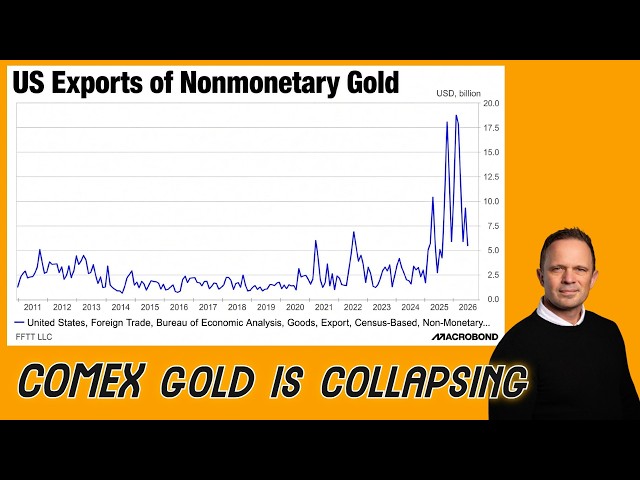
Similar story stateside as COMEX Registered has fallen nearly 54% since India came on strong into silver September 2025.
The COMEX Eligible pile is also falling of late, remember about 100 million ounces of which is reportedly unsecured oz held by the iShare SLV trust.
This is not a coincidence, much of that silver went over on premium bids to Indian investors and silver importers.
Turkey imported a record size of silver last month, nearly nine million ounces in January.
Australia's Perth Mint for the first time ever, sold more in silver bullion than they sold in gold in fiat AUD terms last month.
This is typical, gold leads, silver eventually follows, and investors begin thrifting more into silver over time.
We saw major inflows of gold into Asian ETFs both in China and India recently.
A similar amount of gold supposedly went into a combination of Western ETFs and to perhaps gain a larger semblance of credibility the balance sheet of supposed stable-coin tether (there's been no legit audits, and many of the founder names all over those 3 million Epstein files so take anything they claim with mines of salt).
The bottom line on gold flows, the world is running to it. The debasement trade is worldwide.
The US government tariff revenues aside is still running gigantic deficits, to the tune of nearly 3 trillion for this fiscal year if these rates continue.
The hard US debt level is now almost $39 trillion, it will break $40 trillion this year.
US Congressional Budget Office projections without recessions infused are terrible for as far as our eyes can see.
Why oh why would you want bullion over bonds, fiat currencies, and the nominal no longer 50,000 DOW?
Here's a key clip from Bloomberg's Wall Street Week published a few days ago.
This is the big debt and unfunded liability debasement consideration.
Given the state of this world, people are more and more bullion buying, and quite rationally so.
The Federal Reserves balance sheet is beginning to peculate upward.
Whatever it takes to keep the bond market in order, it will likely go up well more in time.
Dan Oliver of Myrmikan Capital recently wrote a piece I back-linked in the show-notes. He spells out how Trump's Federal Reserve chairman-designate Kevin Warsh will not be able to stop the bull market in gold.
Dan also pointed out the historical fact that when other past historical gold bull markets really get manic, the US Gold Reserves as a percentage of the fiat Federal Reserve's Balance Sheet tend to spike upward towards 100% coverage.
We're still a long way from that.
How far you wonder?
Unaudited for some seven decades, US gold reserves are reportedly worth about $1.3 trillion at today's gold spot price.
Assuming the Federal Reserves balance sheet somehow doesn't grow (which is basically impossible).
Well we still get a multiple of a factor of about five. So $25000 oz gold if history were to rhyme in time.
And of course the Federal Reserve's balance sheet is probably going to balloon, so we're probably more on track for the outside of London hours shadow gold price which is nearing $50,000 oz now.
I know it sounds nuts. But the Dow and Gold met at 1:1 parity in 1980 briefly too, that is within my lifetime and many of yours.
SOURCES:
60 Tons of Fake Silver Flood Market! Iron and Lead Inside, China’s Largest Gold Market Panic Strikes
https://youtu.be/RpbdWFLTUjo?si=fxCYf-BSpF8JLIjB
Stillwater Mine officials hope Russian-palladium tariff will boost domestic sales
https://youtu.be/ogTMZZtBSrg?si=12UcyhzeutWFIdOo
Myrmikan Research - February 9, 2026 - Just the Beginning
https://www.myrmikan.com/pub/Myrmikan_Research_2026_02_09.pdf