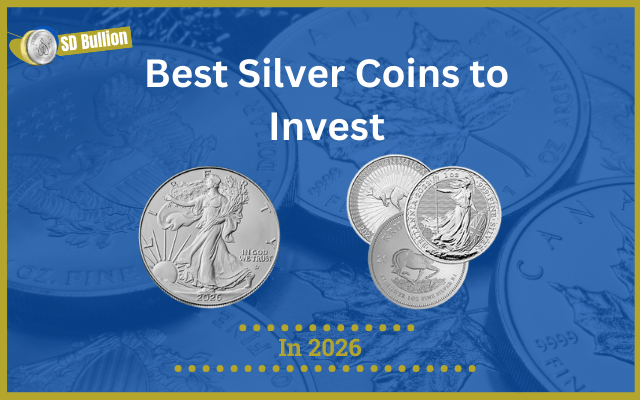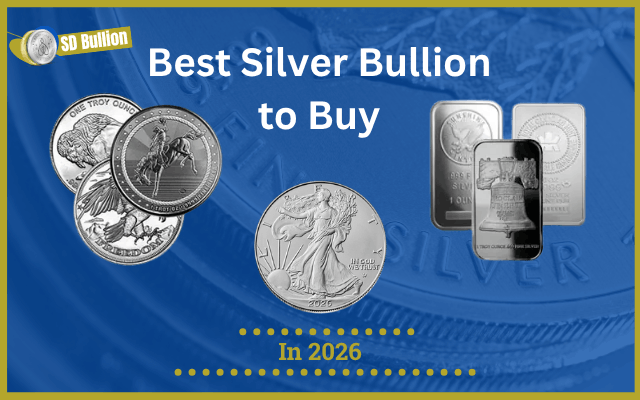
Quick Answer: Best Silver Bullion in 2026
- Best for liquidity: American Silver Eagle (1 oz, .999 fine, ~$3–$6 above spot)
- Best value per ounce: 100 oz silver bar (~$0.50–$1.50 above spot)
- Lowest premium: 1 oz silver round (~$1–$3 above spot)
- Best for Gold IRA: American Silver Eagle or Canadian Silver Maple Leaf (.9999 fine)
- Best overall: 10 oz silver bar (~3–6% above spot) — lowest premium with strong liquidity
The best silver bullion to buy in 2026 is the American Silver Eagle for investors who prioritize liquidity, the 100 oz silver bar for those maximizing ounces per dollar, and the 1 oz silver round for buyers seeking the lowest premium with recognizable designs.
Government-minted coins from the U.S. Mint, Royal Canadian Mint, and Perth Mint carry the strongest global resale demand, while private-mint silver bars and rounds typically run $1–$3 less per ounce over spot.
During Q1 2026, silver spot prices generally traded between approximately $28 and $34 per ounce, although pricing continues to fluctuate with broader market conditions.
Your ideal choice depends on four factors: premium tolerance, storage capacity, resale timeline, and IRA eligibility requirements.
Key Takeaways
- The best silver bullion in 2026 depends on your goals: American Silver Eagles offer top liquidity, 100 oz silver bars maximize ounces per dollar, and 1 oz silver rounds provide the lowest premiums.
- Government-minted silver coins carry higher premiums but are easier to resell globally due to stronger recognition and trust.
- Silver’s long-term investment appeal is driven by both industrial demand (solar, EVs, electronics) and its role as a hedge against inflation and economic uncertainty.
- Silver bars generally offer the best value per ounce, while coins prioritize liquidity and rounds balance affordability with recognizable designs.
- IRA-eligible silver must usually meet .999 purity standards and be stored with an approved custodian rather than at home.
Jump to: What is Silver Bullion? | Why Buy Silver Bullion in 2026? | Silver Coins vs Silver Bars vs Silver Rounds | Portfolio Allocation | Best for Beginners | Best for Long-Term | IRA-Eligible Silver Bullion | Top Silver Products | How to Evaluate Premiums? | How to Store Silver? | Online vs Local Shopping | Tax Implications | FAQs
What Is Silver Bullion?
Before choosing the right silver to buy, it’s important to understand what silver bullion actually is and how it works as an investment. Let’s start with a clear definition and the basics every investor should know.
Silver Bullion Defined
Silver bullion refers to physical silver that is valued primarily for its metal content rather than any collectible or historical significance. In simple terms, it’s silver in its purest investment form, typically produced as coins, bars, or rounds.
Unlike jewelry or decorative items, bullion is priced based on the current market value of silver, often called the “spot price,” plus a small premium. This makes it one of the most straightforward ways to gain exposure to precious metals.
Silver bullion offers a tangible asset that doesn’t rely on digital systems or financial institutions. It’s something you can hold, store, and control directly.
Silver Purity Standards (.999 Fine Silver)
Most modern silver bullion is produced to .999 fine silver purity, meaning it contains 99.9% pure silver. This standard is widely accepted across global markets and ensures consistency and trust when buying or selling.
Some products go even further, such as .9999 fine silver, but the difference is minimal. The key takeaway is that high-purity silver is easy to value, trade, and store.
Reputable mints, government and private, clearly stamp fineness and weight on each piece. Many IRA-approved silver products are also produced by refiners accredited by the LBMA (London Bullion Market Association), one of the most recognized global standards organizations for precious metals refining and purity verification.
This transparency helps buyers feel confident about what they’re purchasing.
Silver Bullion vs. Numismatic Silver
Silver bullion is valued mainly for its metal content. The silver price moves with the silver market, making it a practical choice focused on wealth preservation or growth.
Numismatic silver, on the other hand, carries additional value based on rarity, condition, age, and collector demand. Because of that, rare coins can be highly priced. While these coins can appreciate significantly, they also require more knowledge and come with higher premiums.
SD Bullion, one of the largest online silver dealers in the U.S., offers over 4,000 silver bullion products with live spot-price-based pricing and a best-price guarantee, making it a practical starting point for comparing premiums across coins, bars, and rounds.
Since 2012, SD Bullion has fulfilled orders for over a million customers and maintains an A+ Better Business Bureau rating and 4.8 out of 5 stars out of over 200,000 reviews across review platform Shopper Approved, reinforcing its reputation among precious metals investors. Verify all customer and ratings figures before publishing.
Why Buy Silver Bullion in 2026?
In 2026, a combination of industrial demand, economic factors, and market trends continues to shape how investors view silver as an asset.
Silver's Industrial Demand Drivers
Silver is also a critical industrial resource. In fact, a large share of global silver demand comes from industries that rely on its unique properties, such as conductivity and durability.
In 2026, this demand continues to grow. According to the Silver Institute’s 2025 World Silver Survey, global industrial silver demand reached approximately 680 million ounces, driven largely by solar energy expansion, electronics manufacturing, and electric vehicle production.
Especially in sectors such as solar energy (photovoltaic panels), electric vehicles, electronics and semiconductors, and medical applications. Modern photovoltaic solar panels alone use roughly 20 grams of silver per panel due to silver’s exceptional electrical conductivity.
As the world pushes toward cleaner energy and more advanced technology, silver plays a key role behind the scenes. This dual demand, industrial and investment, gives silver a unique position among precious metals.
This can create long-term upward price pressure, especially when supply struggles to keep up.
Silver as a Hedge: Historical Performance
Silver has long been seen as a hedge against inflation and economic uncertainty. While it can be more volatile than gold, it often performs well during periods of financial stress or currency weakness.
Historically, when inflation rises or markets become unstable, many investors turn to physical assets, such as silver, to help preserve purchasing power. It’s not about short-term gains. It’s about protection over time.
Silver also tends to move in cycles. There are periods of consolidation, followed by sharp upward moves.
Silver-to-Gold Ratio Explained
One of the most commonly used tools in precious metals investing is the silver-to-gold ratio. This ratio measures how many ounces of silver it takes to buy one ounce of gold.
For example, if the ratio is 80:1, it means 80 ounces of silver equals the value of 1 ounce of gold.
Many investors watch this ratio closely because it can signal relative value:
- A higher ratio may suggest silver is undervalued compared to gold
- A lower ratio may indicate silver is relatively more expensive
Investors use this strategy to shift between silver and gold over time, aiming to accumulate more ounces overall.
Silver Coins vs. Silver Bars vs. Silver Rounds
When buying silver bullion, you’ll quickly notice there are three main formats: coins, bars, and rounds. Each has its own advantages depending on your goals.
Silver Coins: Government-Minted, Higher Premium
Silver coins are crafted by official government mints and carry a legal tender monetary denomination. While that denomination is usually symbolic, it adds a layer of trust and recognition.
Popular strikes include the American Silver Eagle by the US Mint, the Canadian Silver Maple Leaf by the Royal Canadian Mint, and the Lunar Series (based on the Chinese Lunar Calendar) by the Australian Perth Mint. For example, the 1 oz American Silver Eagle contains 31.1 grams of silver and measures approximately 40.6 mm in diameter and 3.0 mm thick.
These silver bullion coins are widely recognized worldwide, making them easier to sell or trade. However, they typically come with higher premiums compared to other coins. As of May 2026, American Silver Eagle premiums commonly range from $3 to $6 above the silver spot price, depending on dealer inventory levels and overall market demand.
For many investors, that extra cost is worth it for the added liquidity and credibility.
Silver Bars: Lowest Cost Per Ounce
Silver bars usually offer the lowest cost per ounce, especially in larger sizes like 10-oz or 100-oz bars. A typical 10 oz silver bar measures approximately 3.15" × 1.77" × 0.65", while most 100 oz silver bars measure roughly 6.55" × 2.5" × 1.1", although dimensions vary slightly by refinery.
Because they’re simpler to manufacture and don’t carry the same legal tender status as coins, their premiums are generally lower. As of May 2026, many 100 oz silver bars trade at premiums between approximately $0.50 and $1.50 per ounce over spot.
This makes them a popular choice for accumulating more silver per dollar invested, often referred to as “stacking.”
Silver Rounds: Private Mint, Lowest Premium
Silver rounds look similar to coins on both the obverse and reverse sides, but are manufactured by private mints and do not carry a legal tender denomination. They often feature creative, visually appealing designs or replicas of famous, detailed designs, making them more attractive than standard silver bars.
At the same time, they are typically priced closer to bars than government-issued coins, offering a more affordable alternative. This balance makes silver rounds an appealing option for those who want recognizable designs without paying the higher premiums often associated with official mint products.
Summary:
Choosing between silver coins, bars, and rounds often comes down to your priorities—whether that’s recognition, affordability, or maximizing the amount of silver you own. Each format has its own strengths, and understanding the differences can help you make more confident buying decisions.
Silver Coins vs. Silver Bars vs. Silver Rounds |
|||
|
Feature |
Silver Coins |
Silver Bars |
Silver Rounds |
|
Mint Type |
Government mints |
Private mints (sometimes government) |
Private mints |
|
Legal Tender |
Yes (face value assigned) |
No |
No |
|
Premiums |
Highest |
Lowest (especially larger sizes) |
Low (usually between coins and bars) |
|
Cost Efficiency |
Lower |
Highest (best value per ounce) |
High |
|
Recognition |
Very high (globally trusted) |
Moderate |
Moderate |
|
Liquidity (Ease of Selling) |
Very easy to sell |
Easy, but depends on size |
Easy |
|
Design |
Official, standardized designs |
Simple, minimal design |
Creative, varied designs |
|
Best For |
Investors who value trust and liquidity |
Investors focused on maximizing silver weight |
Investors seeking balance between cost and design |
Which Is Best for Your Goals?
Choosing between silver coins, bars, and rounds depends primarily on an investor’s liquidity needs, tolerance for premiums, storage capacity, and long-term investment strategy.
- If you value recognition and liquidity, coins may be a great option
- If your goal is to maximize silver weight, bars usually offer the best value
- If you want a balance between cost and design, rounds are a strong option
Many investors choose to hold a mix of all three, giving them flexibility.
How Much Silver Should I Buy? A Budget-Based Framework
The answer depends on your budget, long-term goals, and whether you prioritize liquidity, lower premiums, or maximizing the total ounces you own.
Under $500: Start with 1 oz Silver Rounds
For investors starting with a smaller budget, 1 oz silver rounds are often the most practical choice. They typically carry lower premiums than government-issued coins, making it easier to accumulate silver without paying significantly above the spot price.
Their smaller size also offers flexibility, allowing buyers to build holdings gradually as they become more comfortable with the precious metals market.
$500–$5,000: Mix Silver Rounds with 10 oz Bars
As your investment budget grows, combining 1 oz silver rounds with 10 oz silver bars can create a more balanced strategy.
Silver rounds continue to offer flexibility and easier resale in smaller quantities, while 10-oz bars generally reduce the premium paid per ounce. This approach helps investors improve cost efficiency while maintaining accessible, recognizable silver products in their portfolio.
$5,000+: Focus on 100 oz Bars with Silver Eagles for Liquidity
For larger silver investments, many buyers prioritize maximizing ounces while lowering acquisition costs. In this range, 100 oz silver bars are among the most efficient options because they often carry some of the lowest premiums in the physical silver market.
At the same time, many experienced investors continue holding American Silver Eagles due to their exceptional liquidity and global recognition.
Combining large silver bars with highly recognizable government-issued coins can create a more flexible long-term silver strategy.
Best Silver Bullion for Beginners
Many new investors find that sticking to simple, well-known products makes the process much easier and less intimidating.
The key is to focus on silver that is easy to recognize, easy to sell, and reasonably priced.
American Silver Eagle: Most Recognized
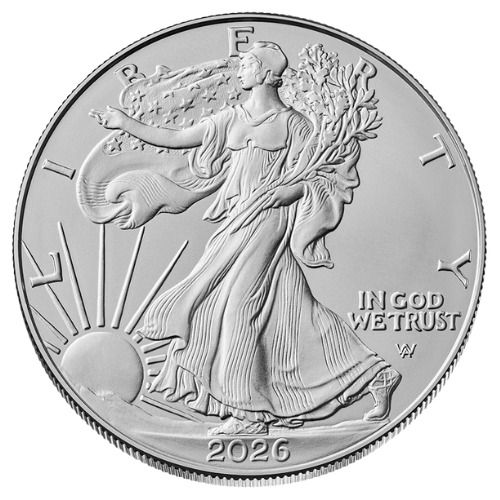
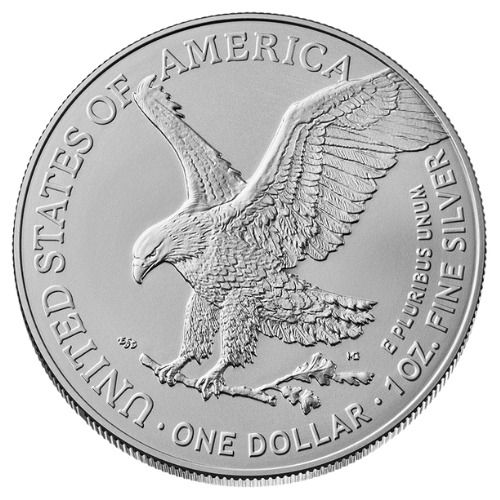
2026 1 oz American Silver Eagle Coin BU
The American Silver Eagle is the official silver bullion coin in the US and one of the most popular silver coins in the world. Minted by the US Mint, it’s widely trusted and instantly recognizable. For beginners, that recognition matters. It makes buying feel safer and selling much easier down the line.
While it usually carries a higher premium than other silver products, it may be a reliable starting point thanks to its liquidity and strong demand.
1 oz Silver Rounds: Most Affordable Entry

1 oz Silver Rounds (New) - Design Our Choice
If your goal is to get the most silver for your money, 1 oz silver rounds are one of the easiest ways to start.
Crafted by private mints, they typically have lower premiums than government-issued coins. This makes them ideal for beginners who want to build their holdings gradually without overpaying.
Even though they don’t carry legal tender status, most rounds are still clearly marked with weight and fineness, making them easy to trade.
10 oz Silver Bars: Best Value Starter

10 oz Silver Bars - Design Our Choice
For those ready to take a slightly bigger step, 10 oz silver bars offer an excellent balance between affordability and volume.
They usually come with lower premiums per ounce compared to smaller pieces, helping you accumulate silver more efficiently. At the same time, they’re still manageable in size, easy to store, and not too large to sell when needed.
Best Silver Bullion for Long-Term Investors
Once you move beyond the beginner stage, the focus often shifts toward maximizing value, optimizing storage, and thinking long term.
100 oz Silver Bars for Stacking
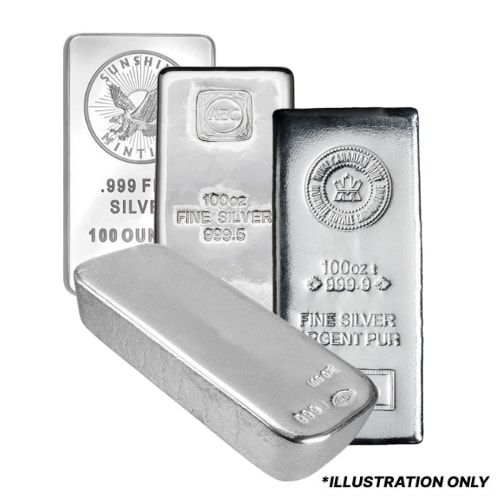
100 oz Silver Bar - Design Our Choice
100 oz silver bars are one of the most cost-efficient forms of physical silver bullion for long-term investors focused on maximizing ounces while minimizing premiums.
They offer some of the lowest premiums available, over the silver spot price, making them ideal for bulk investing. Over time, those small savings per ounce can add up significantly.
The trade-off is flexibility: larger bars can be harder to sell in smaller portions. That’s why many experienced investors combine them with smaller pieces.
Diversifying Across Formats
Diversifying across silver coins, bars, and rounds can help investors balance liquidity, storage efficiency, and premium costs within a long-term precious metals portfolio.
This approach provides flexibility:
- Smaller pieces for easier liquidation
- Larger bars for cost efficiency
- Recognizable coins for global liquidity
By spreading your holdings across different formats, you can adapt more easily to changing market conditions or personal financial needs.
IRA-Eligible Silver Bullion: Approved Products and Purity Requirements
For investors planning long-term retirement diversification, certain silver bullion products can be held inside a precious metals IRA.
These accounts allow investors to include physical silver alongside traditional retirement assets, potentially offering portfolio diversification and protection against inflation or economic uncertainty.
To qualify for IRA inclusion, silver bullion must typically meet a minimum purity requirement of .999 fine silver.
In addition, the products must be produced by approved government mints or accredited private refiners that meet IRS standards.These requirements are outlined under IRS Section 408(m)(3), which governs precious metals eligibility within self-directed IRAs.
Many qualifying refiners are also LBMA-approved, helping ensure globally recognized purity and manufacturing standards.
One important exception is the American Silver Eagle. Although it contains .999 fine silver rather than .9999, it remains fully IRA-eligible because it is officially issued by the U.S. Mint.
Investors should also understand that IRA-approved silver cannot be stored at home. The IRS requires these assets to be held by an authorized custodian or approved depository. Attempting personal storage may disqualify the account and create tax consequences.
Many retirement-focused investors choose highly recognizable bullion products because they offer IRA eligibility, strong liquidity, and broad market demand.
|
Product |
Purity |
Mint |
IRA-Eligible |
Notes |
|
American Silver Eagle |
.999 |
U.S. Mint |
Yes |
Most widely held IRA silver coin |
|
Canadian Silver Maple Leaf |
.9999 |
Royal Canadian Mint |
Yes |
Higher purity; strong liquidity |
|
Austrian Silver Philharmonic |
.999 |
Austrian Mint |
Yes |
Popular in European markets |
|
Generic Silver Rounds |
.999 |
Various private mints |
Varies |
Must be from IRS-approved mint |
|
100 oz Silver Bar |
.999 |
Various |
Yes (approved mints only) |
Lower premium; less flexible |
Before opening a precious metals IRA, investors should carefully review custodian fees, storage costs, and IRS regulations to ensure the account aligns with their long-term financial goals.
Top Silver Bullion Products at SD Bullion
With many options available, it can be helpful to look at what other investors are buying. Best-selling products tend to reflect a mix of trust, value, and long-term appeal.
Based on SD Bullion customer purchasing trends and best-seller rankings, the products below consistently remain among the most actively traded silver bullion options in 2026.
Best-Selling Silver Coins
Government-minted silver bullion coins remain among the highest-demand products in the precious metals market due to their global recognition, liquidity, and trusted purity standards.
Products like the American Silver Eagle, Canadian Silver Maple Leaf, and Austrian Silver Philharmonic are consistently in high demand.
These coins carry their national symbols and are trusted and widely accepted worldwide. For many investors, that added liquidity is worth the slightly higher premium.
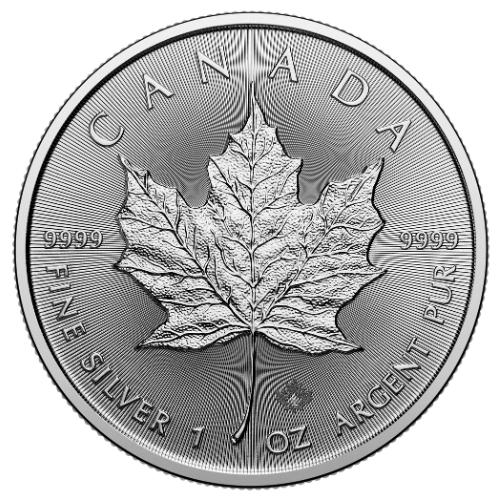
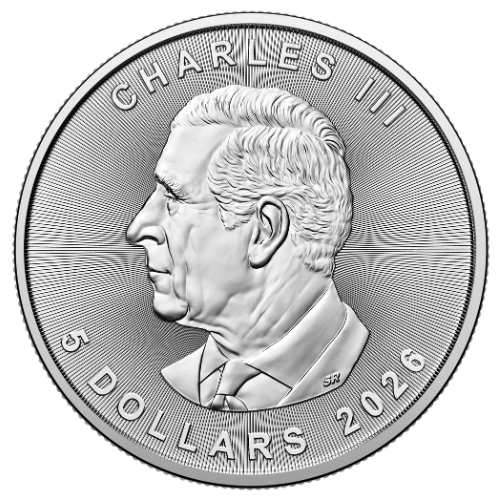
2026 1 oz Canadian Maple Leaf Silver Coin
Best-Selling Silver Bars
Silver bars remain one of the most cost-efficient ways to buy physical silver bullion because they typically carry lower premiums per ounce than government-issued coins.
The best silver bars for investment include 1 oz, 10 oz, and 100 oz silver bars, offering flexibility depending on your budget and strategy.
Larger bars tend to have lower premiums per ounce, which is why they’re often favored by long-term investors looking to accumulate more silver over time.

1 oz Silver Bars - Design Our Choice
Best-Selling Silver Rounds
Silver rounds are popular among bullion investors because they combine lower premiums with recognizable designs and flexible sizing options.
Popular designs often include Buffalo-style rounds, Liberty-inspired designs, or Heraldic Eagle replicas, which are easy to recognize and widely traded.
They typically offer some of the lowest premiums available, making them especially attractive for those steadily building their silver position.

1 oz Silver Buffalo Round - Random Mint
How to Evaluate Silver Premiums
Understanding silver premiums is essential to identifying real value and avoiding overpaying when buying silver.
What Drives Silver Premiums?
The premium is the amount you pay above the silver spot price, and it can vary depending on several key factors. These include the type of mint producing the silver—whether it’s a government or private mint—as well as overall demand and availability in the market.
During Q1 2026, silver spot prices generally fluctuated between approximately $28 and $34 per ounce, causing retail premiums to shift alongside broader market volatility and physical demand.
Production and distribution costs also play a role, along with broader market conditions that can influence pricing at any given time. For example, government-issued coins typically command higher premiums due to their global recognition and the added trust they confer on buyers and sellers alike.
Lowest-Premium Silver Products in 2026
If your goal is to maximize the amount of silver you own, focusing on low-premium products is essential. In most cases, this means choosing options like larger silver bars, such as 10 oz or 100 oz sizes, along with generic silver rounds and even secondary market products.
These types of bullion typically come with lower markups, allowing you to stretch your budget further and accumulate more silver, especially when buying in larger quantities.
Among the lowest-premium products on the market, 100 oz silver bars frequently trade at only $0.50–$1.50 per ounce above spot under normal market conditions.
When to Pay More for Government-Minted Silver?
There are situations where paying a higher premium makes sense, especially for government-minted coins from remarkable coinage programs, such as the American Silver Eagle.
These products often carry premiums closer to $3–$6 per ounce over spot as of May 2026, reflecting their strong global recognition and resale demand.
These coins tend to sell faster, are widely recognized across global markets, and often carry stronger resale demand for those who prioritize liquidity and trust. That added premium can be well worth the cost.
How to Store Silver Bullion Safely
Once you start building your assets, how to store your silver bullion becomes an important consideration.
Home Storage: Safes & Best Practices
Home silver storage remains one of the most common options for bullion investors who want direct access and full physical control over their holdings.
If you take this approach, investing in a high-quality safe is essential. Ideally, the safe should be fire-resistant, securely anchored to prevent theft, and displayed in a discreet location that isn’t easily visible or accessible to others.
It’s also a good idea to organize your silver in the safe to prevent damage, such as using protective cases or keeping items separated. Beyond physical security, discretion plays an important role in reducing the risk of becoming a target.
Bank Safe Deposit Boxes
Bank safe deposit boxes provide silver investors with an off-site storage solution that offers greater physical security than storing bullion at home.
This provides an extra layer of security and removes the need to keep valuables at home. However, access is limited to bank hours (which may be inconvenient for those waiting to access their locked holdings), and the bank itself does not always ensure that content is available.
Third-Party Vault Storage Options
Third-party precious metals vault storage is commonly used by investors with larger silver holdings who want professional security, insurance coverage, and off-site protection.
These facilities are specifically designed for precious metals and offer high-level security services, including 24/7 monitoring, controlled access, and advanced protection systems. In most cases, stored metals are also fully insured, adding an extra layer of protection that can be difficult to replicate at home.
While storage fees are involved, many investors see this as a worthwhile trade-off for the added security and peace of mind, especially as their holdings grow in value or volume.
Another advantage is convenience, as professional vaulting services often handle storage logistics and, in some cases, make it easier to sell or transfer your metals when needed.
For those seeking a trusted option, SD Bullion’s depository service offers secure, fully insured storage tailored for precious metals investors. It’s designed to offer safety and flexibility, making it a strong choice for anyone who prefers not to store large amounts of silver at home.
Compare:
|
Storage Method |
Avg. Annual Cost |
Insurance Included |
Access |
Best For |
|
Home Safe |
$0 (one-time safe cost) |
Homeowner's policy only |
24/7 |
Holdings under $10,000 |
|
Bank Safe Deposit Box |
$25–$150/yr |
Not FDIC insured |
Bank hours only |
Small, infrequently accessed holdings |
|
Third-Party Vault |
$100–$300+/yr |
Typically fully insured |
By appointment or online |
Holdings over $10,000 |
Buying Silver Bullion Online vs. Local Shops
Where you buy silver can affect the price and your experience.
Is Online Buying Safer Than Local Shops?
Online silver bullion dealers have become one of the most common purchasing channels for precious metals investors due to wider inventory selection, competitive pricing, and live spot-price-based pricing.
Reputable online dealers offer transparency, clear pricing, and a wide selection of products on their websites. As long as you’re purchasing from a trusted source, it’s a safe and convenient option. Reliable dealers typically provide a relaxed buying experience without using pushy or high-pressure sales tactics.
Local shops, on the other hand, offer in-person interaction but may have limited inventory.
Verification & Authenticity Risks
No matter where you buy silver, ensuring authenticity should always be a top priority.
The precious metals market is generally reliable, but counterfeit products do exist, especially in secondary markets or peer-to-peer transactions. That’s why sticking with well-known products and reputable dealers is one of the most effective ways to reduce risk.
Authentic silver bullion should always have clearly stamped details, including weight, purity, and often the mint or manufacturer’s name. Recognizable products, such as government-issued coins or widely traded designs, are typically easier to verify and harder to counterfeit convincingly due to their advanced security features.
Many modern bullion products also include anti-counterfeit security features, assay verification, serialized packaging, or precision mint tolerances designed to improve authenticity verification.
In addition to visual inspection, performing security verification using simple at-home tests, such as checking dimensions and weight or using a magnet (since silver is not magnetic), can help. More advanced methods, such as ultrasonic or electronic testing, are also available to provide added confidence, especially when making larger purchases.
After checking the weight, dimensions, and purity markings, and confirming the source is reputable, you reach a point where the process is complete—verification successful, and the silver meets expected standards.
It’s also important to be cautious of deals that seem unusually cheap. Prices far below the market rate can be a red flag, often signaling counterfeit or misrepresented products. Reputable dealers cannot sell silver below its current spot price. In addition, it is important to be wary of sellers who restrict payment options, such as only allowing wire transfers or cryptocurrency.
Buying from established dealers not only helps ensure authenticity but may also provide guarantees, return policies, and proper documentation, adding another layer of security to your investment.
Why Online Dealers Offer Better Prices?
Online precious metals dealers often offer lower silver bullion premiums than local coin shops because they operate with lower overhead costs and higher transaction volume. This allows them to offer more competitive pricing and tighter premiums.
They also operate at higher volumes, further reducing costs for buyers.
Silver Bullion Tax Rules and Reporting Requirements (2026)
Taxes are an important consideration when investing in physical silver bullion.
In the United States, profits from selling silver bullion are generally subject to capital gains tax. Because physical silver is classified as a collectible by the IRS, long-term gains on holdings kept for more than one year may be taxed at a maximum federal rate of 28%, depending on your income bracket and individual tax situation.
Certain silver transactions may also trigger dealer reporting requirements. In some cases, dealers are required to file IRS Form 1099-B when investors sell specific quantities of silver products that meet federal reporting thresholds.
These requirements often apply to larger transactions involving products such as 1,000 oz silver bars or significant quantities of certain government-issued coins.
Tax rules can vary depending on your state, the type of silver product purchased, and how long the bullion is held before resale. Because regulations may change over time, many investors choose to consult a qualified tax professional before making large precious metals transactions.
Ready to start building your silver position?
Browse SD Bullion’s full selection of silver coins, bars, and rounds, all competitively priced based on the silver price per ounce and current live spot pricing, with secure delivery directly to your door.
If you require further information, please contact SD Bullion’s customer service through our web chat feature or at 1(800)294-8732 during regular business hours.
What is the cheapest form of silver bullion?
The cheapest form of silver bullion is typically found in silver bars and generic silver rounds, which carry lower premiums over the spot price than government-issued coins. Larger bars, such as 10 oz or 100 oz options, often provide the best value per ounce. These products are ideal for maximizing silver weight while minimizing upfront costs and overall investment expenses.
Is silver bullion a good investment in 2026?
Silver bullion continues to attract investors in 2026 due to its unique combination of industrial demand and monetary value. It plays a key role in sectors such as solar energy and electronics, while also serving as a hedge against inflation and economic uncertainty. Its lower price compared to gold makes it more accessible, offering both growth potential and diversification within a broader investment portfolio.
This information is provided for educational purposes only and should not be considered financial or investment advice; consult a qualified financial advisor before making any investment decisions.
What silver bullion is IRA-eligible?
To be IRA-eligible, silver bullion must typically meet a minimum purity of .999 fine and be produced by an approved government or accredited private mint. Certain widely recognized products, such as the American Silver Eagle, qualify under these standards. Investors must also store these assets with an authorized custodian or depository, as personal possession is not permitted under a precious metals IRA.
How do I sell silver bullion?
Selling silver bullion is generally a straightforward process, especially when dealing with widely recognized products. Investors can sell to reputable online dealers like SD Bullion, local coin shops, or private buyers, depending on their preferences and timing. The resale value often depends on market conditions, product recognition, and condition. Well-known bullion tends to sell more quickly and closer to the current spot price, improving overall liquidity.