American Silver Eagle mint marks identify the U.S. Mint facility where certain collector versions were struck, including Philadelphia (P), San Francisco (S), and West Point (W). Most bullion Silver Eagles, however, have no mint mark.
This guide explains how Silver Eagle mint marks and “Struck at” attributions work, how they affect collectability and value, and what collectors and investors should check when comparing different issues.
Key Takeaways
-
Most bullion American Silver Eagles have no mint mark, even when produced at Philadelphia, San Francisco, or West Point. Mint marks are present on proof, reverse-proof, and uncirculated collector issues.
-
P, S, and W identify Philadelphia, San Francisco, and West Point, respectively, but mint attribution alone does not determine value. Mintage number, grade, finish, provenance, certification, and collector demand also affect premiums.
-
The 1995-W Proof is one of the most notable Silver Eagle varieties, with only 30,125 minted, while the 1996 bullion issue remains the lowest-mintage regular bullion Silver Eagle at 3,603,386 coins.
-
“Struck at” Philadelphia bullion coins require provenance rather than a visible P mintmark. Sealed Monster Box records, serial numbers, and third-party certification can establish mint attribution and may support higher collector premiums.
Jump to: Overview of Silver Eagle Mint Marks | Mint Mark Types on Silver Eagles | Historical Mintages and Mint Mark Impact | Philadelphia Mint and 'Struck At' American Silver Coins | Grading, Certification, and Labels for Mint Marks | Value, Face Value, And Market Considerations | Collecting Checklists For Silver Eagle Mint Mark Variaties | Frequently Asked Questions About Silver Eagle Mint Mark | Sources and Further Reading | FAQs
Overview Of American Silver Eagle Mint Marks
A mint mark is a letter identifying the mint facility where a coin was struck. For American Silver Eagles, mint marks help collectors distinguish certain proof coins and uncirculated coins produced by the United States Mint, including issues from the West Point Mint and other facilities.
Most Silver Eagle bullion coins, however, carry no mint mark. The bullion versions are intended to be identical regardless of where the coins are minted, while proof and uncirculated versions may identify their production facility.
This distinction became controversial after bullion coins without a “P” mint mark were attributed to Philadelphia, based on sealed-box records and serial numbers. Third-party graders began labeling some as “Struck at Philadelphia,” even though the US Mint did not consider coins produced at different mints to be separate varieties based solely on internal tracking information.
Mint Mark Types on Silver Eagles
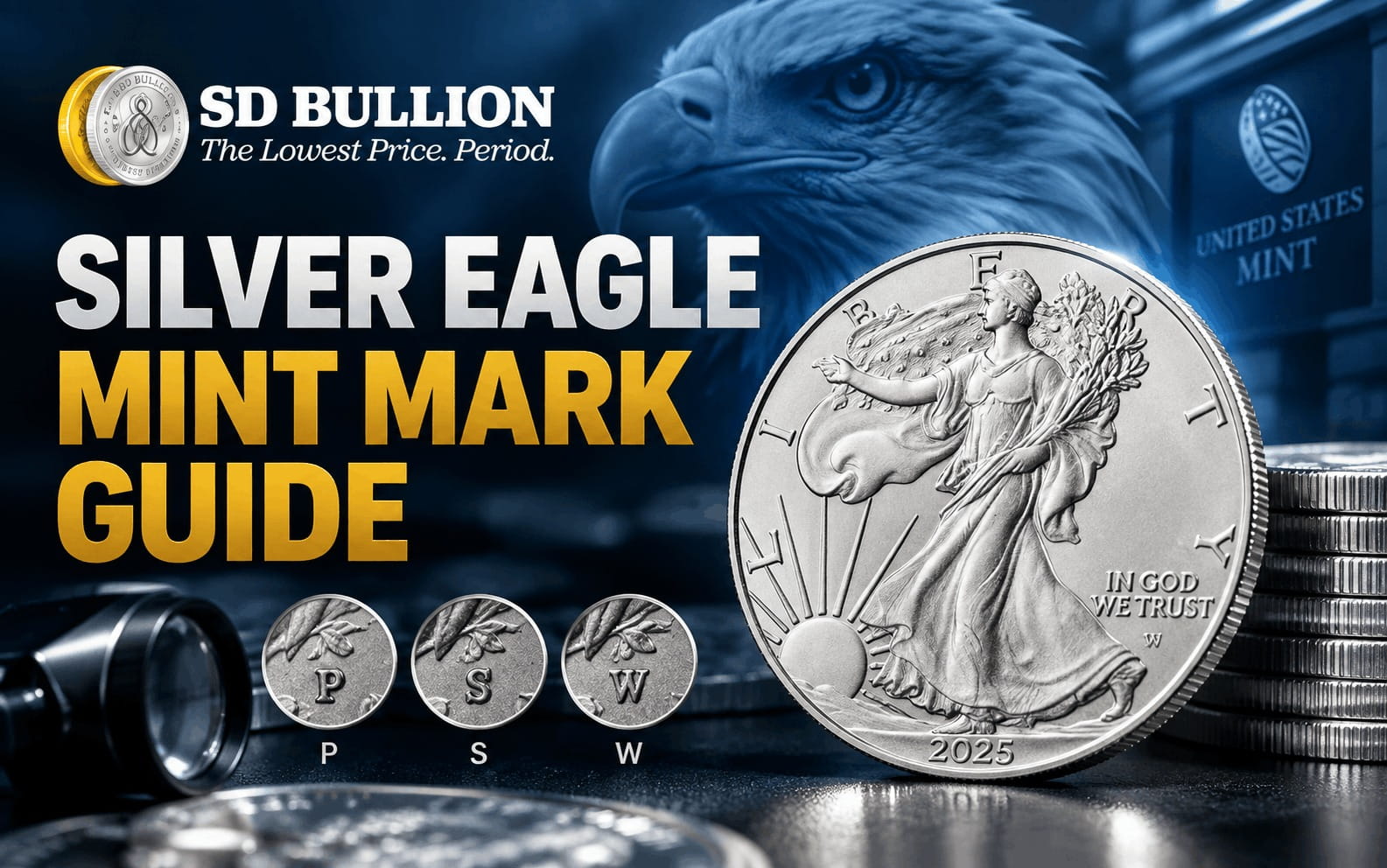
American Silver Eagle mint marks identify three United States Mint facilities: P for Philadelphia, S for San Francisco, and W for the West Point Mint. On mint-marked Silver Eagles, the letter appears on the coin’s reverse, while the obverse carries the Walking Liberty design.
The P mint mark appears on certain Philadelphia collector issues, including proof and reverse proof coin releases. The S mint mark identifies selected San Francisco proof. The W mint mark represents West Point, which produces many modern proof versions and burnished uncirculated versions of the Silver Eagle. PCGS notes that the 2006-W was the first uncirculated Silver Eagle to carry a W mint mark.
Mint marks are, therefore, more common on special finishes than on regular bullion versions, which generally have no mint mark. Regardless of finish, standard Silver Eagles contain one troy ounce of fine silver and carry a one-dollar denomination backed by the United States government.
Historical Mintages And Mint Mark Impact
The Main Key Date
The 1995-W Proof Silver Eagle is a key date because its 30,125-coin mintage is exceptionally low and collector demand has remained strong. Issued only in the 1995 10th Anniversary set, it also became the first Proof Silver Eagle with a W mint mark.
Its scarcity is reflected in the market: PCGS PR70DCAM examples have sold for tens of thousands of dollars, including $86,655 in 2013 at Great Collections.
Other Impressive Numbers
The program was authorized by the Liberty Coin Act of 1985, with the first Silver Eagle struck on October 29, 1986, and sales of American Silver Eagle coins began on November 24, 1986. The U.S. Mint sold a record 47 million bullion Silver Eagles in 2015, the highest mintage for a bullion coin, while the 1996 bullion issue had a mintage of 3,603,386, the lowest among regular bullion issues.
Demand pressures were especially visible in 2008. Bullion Silver Eagle sales rose from 200,000 in February to 1,855,000 in March, more than a ninefold increase, and the 2008 Proof Silver Eagle became unavailable from the U.S. Mint in August as silver planchets were prioritized for bullion production.
Philadelphia-attributed bullion coins created a different form of rarity. A Coin World FOIA request found that only 79,640 2015 Silver Eagles were struck in Philadelphia. Because these coins have no “P” mintmark, certification depends on original packaging and serial-number provenance.
That scarcity can translate into a significant collector premium. PCGS records an auction price of $7,699 for a 2015-(P) Silver Eagle graded MS70 in April 2023, showing how a documented mint attribution and high grade can push value far above the coin’s underlying silver content.
Philadelphia Mint And 'Struck At' American Eagle Coins
The “Struck at” designation emerged after FOIA requests from NGC and Coin World revealed that bullion Silver Eagles had been produced at multiple Mint facilities even though the coins carried no mintmark. Grading services began using sealed Monster Box provenance to attribute qualifying coins to Philadelphia, San Francisco, or West Point.
For 2015, each Monster Box contained 500 coins in 25 tubes of 20. Philadelphia boxes used handwritten tracking numbers 10001–10159, while West Point boxes could carry computer-generated labels marked “WPM.” However, some tracking numbers overlapped between facilities. The U.S. Mint later stated that these internal tracking numbers were created for quality control, not to establish collectible varieties. It said it would not verify individual boxes by tracking number or label.
Philadelphia-attributed coins can nevertheless command collector premiums when provenance and certification are preserved. For example, PCGS records a 2015-(P) MS69 sale at $468 in 2022 and an MS70 sale at $2,640 in 2025, although realized prices vary substantially with grade, label, population, and demand.
Grading, Certification, and Labels For Silver Eagle Mint Marks
NGC and PCGS use parenthetical mint marks (-(P)) to identify bullion Silver Eagles attributed to a specific mint facility, even though no mint mark appears on the coin. NGC labels qualifying coins with formats such as 2017(S) plus “Struck at San Francisco Mint”; the parentheses indicate that the “S” is an attribution, not a mark physically struck on the coin. PCGS similarly lists attributed issues as varieties such as 2017-(P) $1 Silver Eagle Struck at Philadelphia.
Because mint attribution depends on provenance, NGC requires eligible bullion coins to come from original sealed 500-coin Monster Boxes for this type of facility attribution. Collectors and coin dealers should therefore preserve sealed-box records and packaging whenever possible, especially when buying or selling Silver Eagle Monster Boxes for bulk investment.
Before buying or trying to sell a certified variety, compare its grade population with its total mintage. The NGC Census and PCGS Population Report show how many coins each service has certified by grade, helping distinguish a genuinely scarce grade from a coin that is simply scarce by overall mintage.
Value, Face Value, And Market Considerations
With silver at $66.30 per ounce, a 2026 1 oz American Silver Eagle priced at $76.28 carries a $9.98 premium. Investors can track the live silver spot price at SD Bullion, review broader guides on buying silver coins at low premiums, and compare it all with current American Silver Eagle prices, where product prices update as spot and market premiums change.
For collectible coins minted with identifying mint marks or special attributions, prices may also reflect mintage, grade, certification, provenance, and ongoing supply and demand. Scarce issues such as the 1995-W Proof and certified Philadelphia “Struck at” coins can therefore command premiums beyond their intrinsic silver value.
For valuation, collectors should compare recent realized sales rather than relying only on dealer asking prices. In addition to dedicated American Silver Eagle value guides from 1986 to 2021, the PCGS Silver Eagle Auction Prices database provides results by year, mint, finish, and grade. Comparisons should use coins with similar certification and condition because identical dates and mint marks can sell for significantly different prices.
Collecting Checklist For Silver Eagle Mint Mark Varieties
A practical way to start collecting American Silver Eagles is to build a one-coin-per-year set, then add scarcer varieties over time, such as the 1995-W Proof, the low-mintage 1996 bullion issue, or certified 2015-(P) coins with documented Philadelphia provenance.
-
Start with one coin from each year to establish a complete date set before pursuing expensive varieties.
-
Prioritize proof, reverse-proof, and certified “Struck at” coins if mint attribution and collectability are important to your strategy.
-
Record certification numbers, grading service, mint attribution, and provenance for every certified coin, especially Philadelphia-attributed issues that rely on original packaging or box records.
-
Note whether each coin is Type 1 or Type 2. Silver Eagles struck through mid-2021 use the original reverse design, while later 2021 issues introduced the Type 2 eagle reverse.
-
Compare mintage, grade populations, and recent auction results before paying a premium for a particular mint mark or label.
This approach keeps the collection organized while making it easier to distinguish ordinary date issues from scarcer mint-marked and provenance-based varieties.
Do bullion American Silver Eagles have mint marks?
No. Regular bullion American Silver Eagles do not carry mint marks, even when coins are minted at different facilities. NGC confirms that bullion issues struck at Philadelphia, San Francisco, and West Point can appear physically identical, with mint attribution possible only in certain cases through original packaging.
How many U.S. Mint facilities have produced American Silver Eagles?
American Silver Eagles have been produced at Philadelphia, San Francisco, and West Point. Regular Proof issues carried S mint marks from 1986–1992, P marks from 1993–2000, and primarily W marks beginning in 2001. San Francisco later returned for selected Proof, Reverse Proof, and other special-edition Silver Eagles.
Does a Silver Eagle mint mark change its face value?
No. Mint marks indicate which United States Mint facility struck the coin, but it does not change the Silver Eagle’s legal face value of one dollar. The U.S. Mint identifies Silver Eagles as one-ounce silver coins with a $1 denomination. Mint marks can influence collector sentiment, but never the denomination the US Mint established for the coin.
How can you verify that a Silver Eagle was struck at the Philadelphia Mint?
For bullion coins without a P mintmark, Philadelphia attribution generally requires qualifying original sealed Monster Box provenance. NGC uses box serial numbers and other Mint packaging markers to identify eligible Philadelphia strikes; loose coins cannot normally be attributed from appearance alone. NGC Philadelphia attribution requirements
Sources And Further Reading
-
For the program’s legislative history, see the 1985 Congressional Record, where Senator James McClure introduced the Liberty Coin Act amendment authorizing the American Silver Eagle. The Support of American Eagle Silver Bullion Program Act of 2002 later authorized the Treasury to purchase silver on the open market after the government stockpile was depleted.
-
For mint-attribution research, Coin World’s report on the U.S. Mint’s 2017 statement explains the “Struck at” controversy, while its follow-up on Monster Box tracking details Philadelphia and West Point box numbers and labeling. The U.S. Mint has also stated that bullion coins from different facilities are intended to be visually identical and carry no mint mark.
-
Collectors can check the NGC Census and PCGS Silver Eagle Population Report for certification populations by issue and grade. The PCGS Silver Eagle CoinFacts guide and Proof Silver Eagle checklist provide useful issue-by-issue references.
-
For current figures, the U.S. Mint Production and Sales Figures page provides official bullion mintage and numismatic sales data. The Coin Modernization, Oversight, and Continuity Act of 2010 was signed into law on December 14, 2010, expanding Treasury research authority over coinage materials and addressing continuity of certain numismatic products.
Where is the mint mark located on an American Silver Eagle?
Mint-marked American Silver Eagles display the P, S, or W on the reverse. On Type 1 coins, the mark appears near the heraldic eagle and shield design. The exact position changed with the introduction of the Type 2 reverse in 2021.
Why does my Silver Eagle not have a mint mark?
Most bullion Silver Eagles have no mint mark. The United States Mint issued bullion coins in mass without facility marks even when coins were minted at different locations. Proof, reverse-proof, and uncirculated collector editions are more likely to carry P, S, or W mint marks.
How can you identify which Mint produced a Silver Eagle without a mint mark?
A mint cannot usually be identified from the coin alone. Certain bullion issues can receive “Struck at” attribution when original sealed Monster Boxes, labels, and serial-number records establish provenance. Once coins are removed from qualifying packaging, reliable mint attribution may no longer be possible.
Are W-mint and S-mint Silver Eagles worth different amounts?
Yes. W- and S-mint Silver Eagles can trade at different prices because value depends on year, finish, mintage, grade, certification, and ongoing supply and demand. The mint mark alone does not determine value, so collectors should compare equivalent coins and recent auction results.
What are San Francisco Mint Silver Eagle production years and marks?
San Francisco produced regular bullion Silver Eagles from 1986 through 1998 without mint marks. Proof Silver Eagles from 1986 through 1992 carried the S mintmark, and San Francisco later produced additional special collector issues. Production year, finish, and mint mark should therefore be checked together.
How does a mint mark affect the market value of an American Silver Eagle?
A mint mark can raise collector premiums when it identifies a scarcer issue or production facility. However, grade, mintage, finish, provenance, and demand also matter. A Silver Eagle’s legal value remains one dollar regardless of mint mark, while its silver and collector value can be much higher.
Which Silver Eagle mint marks are considered rare or highly sought after?
The 1995-W Proof Silver Eagle is among the best-known scarce mint-marked issues, with only 30,125 minted. Certain S-mint reverse proofs and Philadelphia-attributed bullion issues are also sought after. Scarcity depends on the specific year, finish, grade, and certified population rather than the letter alone.
I'm new to coin collecting. How important are Silver Eagle mint marks when starting a collection?
Mint marks are useful but do not need to be a beginner’s priority. Start by learning the major dates, finishes, Type 1 and Type 2 designs, and how P, S, and W issues differ. Mint marks become more important when building date-and-mint sets or pursuing scarce varieties.
As a silver investor, should I pay attention to Silver Eagle mint marks when buying bullion by weight?
As an investor, no. Investors buying primarily for metal content typically focus on silver weight, spot price, premium, and liquidity, and may also compare silver coins versus silver rounds to balance premiums and collectability. Standard bullion Silver Eagles are distributed through the U.S. Mint’s authorized purchasers and generally have no mint mark despite their one-dollar denomination.
Which Silver Eagle mint marks or years have notable auction records or sudden price spikes in recent decades?
Key examples include the low-mintage 1995-W Proof and the 2019-S Enhanced Reverse Proof. PCGS records an auction high of $5,760 for the 2019-S Enhanced Reverse Proof. Philadelphia-attributed bullion coins have also commanded premiums when supported by certified provenance.