Why Are Gold and Silver Falling? Fed Rate Fears Rise as Gold Drops Below $4,000, Rising Oil Prices Pressure Metals Despite Growing Gold and Silver Demand in Asia
- Gold and Silver Prices Decline Sharply: Precious metals experienced another difficult trading week, with gold price falling approximately 3.5% and silver declining nearly 5%. Gold closed at $3,994 per ounce, while silver finished at $53.70 per ounce, pushing the gold-to-silver ratio to approximately 74. Both metals are trading below their respective 200-day moving averages, reflecting continued downward price pressure.
- Gold Records Its Largest Weekly Decline in Four Months: Gold prices suffered their steepest weekly loss in approximately four months as investors responded to rising Treasury yields, inflation concerns, and expectations of tighter Federal Reserve monetary policy. Gold ended the week roughly $500 below its 200-day moving average, while silver retreated toward price levels last observed around its November 2025 breakout.
- Oil Prices Surge Toward $117 as Middle East Tensions Escalate: Brent crude oil climbed to approximately $117 per barrel amid renewed geopolitical tensions involving Iran, Houthi attacks, and threats to shipping routes near the Strait of Hormuz. Rising energy costs are increasing concerns about transportation expenses, consumer prices, and persistent inflation throughout the global economy.
- Federal Reserve Interest Rate Expectations Pressure Precious Metals: Surging oil prices have strengthened expectations that the Federal Reserve could maintain elevated interest rates for longer or potentially introduce additional increases. Higher Treasury yields and a stronger U.S. dollar have weighed on non-yielding assets such as gold and silver, prompting speculative investors and institutional traders to reduce their precious metals exposure.
- Could Rising Inflation Eventually Trigger a Gold and Silver Recovery? While higher oil prices currently represent a headwind for precious metals, analysts suggest that prolonged energy inflation could eventually weaken economic growth and increase recession risks. If the Federal Reserve responds by lowering interest rates while inflation remains elevated, declining real yields could improve the investment environment for gold and silver as traditional inflation hedges.
- Precious Metals Selloff Draws Comparisons to the 2008 Financial Crisis: The recent correction in gold and silver has renewed comparisons with the 2008 global financial crisis, when gold declined from above $1,000 to below $700 per ounce and silver dropped from more than $21 to under $9. Despite those historic declines, precious metals subsequently experienced a substantial recovery, with silver approaching $50 per ounce in April 2011. The comparison highlights the potential for significant volatility during periods of financial stress, although historical performance does not guarantee similar outcomes.
- Major U.S. Banks Raise Concerns Over Unauthorized AI Agents Accessing Customer Accounts: Financial institutions, including JPMorgan Chase, Wells Fargo, Morgan Stanley, and Bank of America, are confronting emerging security concerns involving third-party artificial intelligence agents accessing customer banking accounts. Reports describe instances of AI systems performing actions without explicit customer authorization, raising questions about financial privacy, account security, and the growing dependence on digital financial infrastructure.
- Japanese Life Insurer Plans Approximately $2.2 Billion Allocation to Gold: A major Japanese life insurance company reportedly announced plans to allocate 1% of its approximately $220 billion in assets under management to gold, representing a potential $2.2 billion investment. The decision illustrates growing institutional interest in precious metals as a portfolio diversification tool amid currency volatility, rising government debt, and concerns about long-term purchasing power.
- India's Silver Import Demand Could Reach 209 Million Ounces Over Six Months: Changes to India's silver import permits could support approximately 6,500 metric tons of silver imports over the next six months, equivalent to more than 209 million troy ounces. If realized, this substantial physical demand could increase pressure on international silver supplies, particularly inventories associated with London and COMEX markets. China could emerge as an important supplier as India seeks to satisfy its domestic demand.
- Jupiter Asset Management Sees Long-Term Support for Gold and Silver Despite Recent Selloff: Ned Naylor-Leyland of Jupiter Asset Management attributes the latest precious metals correction primarily to rising short-term interest rates, higher real yields, and speculative position reductions. However, he maintains that expanding central bank balance sheets, persistent government deficits, currency debasement, and global de-dollarization remain important long-term drivers for monetary metals. His outlook suggests that a reversal in Treasury yields or monetary policy could renew institutional interest in gold and silver.
Gold and Silver Prices Plunge as Oil Hits $117, Fed Rate Fears Rise, and Asian Precious Metals Demand Grows
Gold falls below $4,000 and silver retreats to $53.70 as rising Treasury yields pressure precious metals, while Japan's $2.2 billion gold allocation and India's potential 209 million ounces of silver imports highlight growing Asian demand.
Gold and Silver Prices Fall Sharply as Investors React to Rising Interest Rates
Gold and silver experienced another challenging trading week as rising energy prices, inflation concerns, and expectations of tighter Federal Reserve monetary policy weighed heavily on precious metals.
Gold prices declined approximately 3.5% during the week, closing at $3,994 per troy ounce, while silver suffered an even steeper decline of nearly 5%, finishing at $53.70 per ounce. The gold-to-silver ratio climbed to approximately 74, reflecting silver's greater relative weakness.
Both precious metals are now trading below their respective 200-day moving averages, a widely followed technical indicator used to evaluate longer-term market trends. Gold finished the week approximately $500 below its 200-day moving average, marking its largest weekly decline in roughly four months.
Silver prices also retreated toward levels last observed around the November 2025 breakout, extending a correction from the historic price highs reached earlier in 2026.
Despite the recent weakness, longer-term investors continue to monitor the underlying forces supporting precious metals, including government debt, currency depreciation, central bank policies, and international demand for physical bullion.
Oil Prices Surge Toward $117 as Middle East Conflict Raises Inflation Concerns
One of the most significant developments affecting precious metals this week was the sharp increase in global energy prices.
Brent crude oil climbed toward $117 per barrel as escalating tensions in the Middle East heightened concerns about global energy supplies and international shipping routes.
The ongoing conflict involving Iran, Houthi attacks, and security risks surrounding the Strait of Hormuz has contributed to uncertainty in global oil markets.
Higher energy prices affect far more than gasoline costs. Transportation, manufacturing, agricultural production, and international shipping all depend heavily on affordable energy.
When oil prices rise sharply, businesses often face higher operating expenses, potentially passing those increases along to consumers.
This creates additional inflationary pressure at a time when financial markets are already concerned about the direction of U.S. monetary policy.
For gold and silver investors, the relationship between rising inflation and precious metals prices has become increasingly complicated.
Although physical bullion has historically attracted investors seeking protection against long-term currency depreciation, higher inflation can also encourage central banks to maintain restrictive interest rates.
That creates a short-term challenge for precious metals.
Federal Reserve Interest Rate Expectations Pressure Gold and Silver
Rising oil prices have strengthened market expectations that the Federal Reserve could keep interest rates elevated for longer or potentially introduce additional rate increases.
Higher interest rates generally support Treasury yields and can strengthen the U.S. dollar, increasing the opportunity cost of holding non-yielding assets such as gold and silver.
Unlike bonds or interest-bearing savings accounts, physical precious metals do not generate periodic interest payments.
Consequently, when Treasury yields rise, some institutional investors and speculative traders shift capital away from precious metals toward income-producing financial instruments.
This dynamic has contributed to the recent decline in gold and silver prices.
Market commentary highlighted in this week's update suggests that higher short-term interest rates and rising real yields have encouraged hedge funds, commodity trading advisors, and other speculative investors to unwind leveraged positions in precious metals.
However, the relationship between inflation, interest rates, and bullion prices could change if economic conditions deteriorate.
Should persistently elevated oil prices begin weakening economic growth, the Federal Reserve could eventually face pressure to reduce interest rates.
If nominal interest rates decline faster than inflation, real yields could fall significantly, potentially improving the investment environment for gold and silver.
This scenario illustrates why inflation can initially pressure precious metals through higher interest rates before potentially becoming supportive if economic growth weakens.
Gold and Silver Selloff Draws Comparisons to the 2008 Financial Crisis
The recent correction has renewed comparisons with the volatility experienced during the 2008 global financial crisis.
In March 2008, gold traded above $1,000 per ounce before eventually falling below $700 later that year as the financial crisis intensified.
Silver experienced an even more dramatic decline, falling from above $21 per ounce to below $9 toward the end of 2008.
During that period, investors seeking immediate delivery of physical precious metals frequently encountered limited bullion availability and unusually high dealer premiums.
Despite the severe correction, both metals eventually recovered as central banks introduced extraordinary monetary stimulus and quantitative easing programs.
Silver subsequently approached $50 per ounce in April 2011.
The comparison is particularly relevant because financial market stress can create periods when investors liquidate precious metals positions to raise cash, even when longer-term economic conditions might otherwise favor bullion ownership.
The source commentary also highlights a growing divergence between the current spot silver price and an external aggregate COMEX-related silver price indicator.
According to the commentator, that divergence is now approximately seven to eight times, compared with roughly 3.5 times during the 2008 period.
However, this proprietary indicator should not be interpreted as a verified measure of physical silver shortages or a reliable prediction of future prices.
Historical market patterns provide useful context, but they do not guarantee that the current correction will produce a recovery similar to the one experienced between 2008 and 2011.
Major U.S. Banks Confront Emerging Security Risks From AI Agents
Beyond precious metals prices, the growing use of artificial intelligence in financial services has introduced new concerns about digital account security.
A report discussed during this week's market update described how major U.S. financial institutions are encountering unauthorized or insufficiently vetted third-party AI agents operating within customer banking accounts.
Institutions mentioned in the coverage included JPMorgan Chase, Wells Fargo, Morgan Stanley, and Bank of America.
In some cases, customers reportedly provided account credentials to AI-powered services that had not been approved by their financial institutions.
Other reported incidents involved AI agents attempting actions without obtaining explicit customer confirmation.
The coverage did not establish that AI systems were independently hacking bank accounts or stealing customer funds. Rather, the concern centered on permissions, access controls, and the potential for automated systems to exceed users' intended instructions.
These developments highlight broader questions about financial privacy, cybersecurity, and the growing reliance on interconnected digital financial platforms.
For precious metals investors, the discussion also raises the distinction between owning physical bullion outright and maintaining financial assets through digital accounts and third-party intermediaries.
Physical gold and silver do not eliminate risks associated with theft, storage, insurance, or liquidity, but direct ownership provides a different form of asset control than an exclusively digital financial account.
Japanese Life Insurer Plans $2.2 Billion Allocation to Gold
While Western financial markets remain focused on rising interest rates, institutional demand for gold bullion continues to attract attention in Asia.
A major Japanese life insurance company reportedly announced plans to allocate approximately 1% of its investment portfolio to gold.
With an estimated $220 billion in assets under management, the proposed allocation represents approximately $2.2 billion in potential gold exposure.
Although the institution was not identified in the supplied commentary, the reported decision highlights how even relatively modest portfolio allocations from large financial institutions can represent substantial capital flows into precious metals.
Institutional interest in gold is often associated with diversification, currency exposure, and concerns about long-term purchasing power.
Japan's financial institutions operate in an environment shaped by changing interest rates, currency volatility, and substantial government debt.
For large institutional investors, gold bars and coins can serve as a portfolio diversifier because its performance drivers differ from those of traditional bonds and equities.
The reported allocation also illustrates how incremental changes in institutional investment policies could influence global gold demand over time.
India Could Import More Than 209 Million Ounces of Silver in Six Months
Another major development came from India, one of the world's most important markets for physical precious metals.
According to this week's commentary, changes in silver import permits could allow approximately 6,500 metric tons of silver to enter India over the next six months.
That volume represents more than 209 million troy ounces of silver, an amount that could have significant implications for international silver bullion markets if the projected imports materialize.
India's silver market is supported by several demand categories, including jewelry, silverware, industrial applications, and physical investment products like silver coins.
A substantial increase in imports would require considerable quantities of refined silver from international suppliers.
The market commentary suggests China could become an important source of silver for India, particularly if inventories in London and COMEX-linked markets are insufficient to satisfy the projected demand.
However, the anticipated import volume represents a potential scenario rather than confirmed purchases or completed shipments.
The ultimate effect on global silver prices would depend on actual import activity, available inventories, recycling flows, mine production, and demand from other international buyers.
Nevertheless, the scale of the reported projection demonstrates why investors closely monitor India's physical silver market.
Russia's Gold Sales Raise Questions About Sovereign Debt and Precious Metals Reserves
Russia's reported gold sales also attracted attention this week, with some Western media coverage connecting the activity to the country's ongoing wartime expenditures.
However, the market commentary argues that focusing exclusively on Russian gold sales provides an incomplete picture of the broader relationship between sovereign debt and official gold reserves.
The United States and European economies also face substantial debt obligations, making government finances and central bank gold holdings important subjects for comparison.
The commentary additionally cites claims from Russian authorities that domestic gold and silver mine production may be more than 50% higher than some Western estimates.
Those production claims require independent verification, particularly because discrepancies in mining statistics can arise from reporting methods, production classifications, and limited data transparency.
More broadly, the discussion illustrates how geopolitical tensions, sovereign debt, and national gold reserves remain closely connected to the international monetary system.
Jupiter Asset Management Sees Long-Term Support for Precious Metals
Ned Naylor-Leyland of Jupiter Asset Management offered additional perspective on the recent correction in gold and silver.
His analysis attributes much of the selling pressure to higher short-term interest rates, rising real yields, and changing expectations for future monetary policy.
As interest rate expectations shifted, speculative investors reduced positions associated with concerns about currency debasement.
Naylor-Leyland argues that these short-term market developments do not necessarily invalidate the longer-term case for precious metals.
He identifies several structural forces that could continue supporting gold and silver over time, including expanding central bank balance sheets, government deficit spending, currency depreciation, and international efforts to reduce dependence on the U.S. dollar.
He also suggests that potential intervention to stabilize rising Treasury yields could encourage speculative investors to return to precious metals.
Such an outcome would depend on future decisions by the U.S. Treasury and Federal Reserve, rather than representing an established policy direction.
His broader argument centers on gold's historical role as a monetary asset and a potential store of purchasing power across extended periods of currency depreciation.
Silver shares some of those monetary characteristics but generally experiences greater price volatility because of its smaller market size and substantial industrial demand.
What Comes Next for Gold and Silver Prices?
The precious metals market faces several competing forces as investors assess the outlook for inflation, interest rates, and global economic growth.
In the near term, elevated oil prices and rising Treasury yields could continue pressuring gold and silver, particularly if markets anticipate additional monetary tightening.
However, persistent inflation, expanding government debt, and the possibility of slower economic growth could eventually alter expectations for Federal Reserve policy.
At the same time, reported institutional gold demand from Japan and potentially substantial silver imports into India highlight the importance of monitoring physical precious metals demand beyond Western financial markets.
For buyers evaluating physical bullion, the recent decline also underscores the importance of understanding the relationship between spot prices, dealer premiums, and the total acquisition cost of gold and silver bars or coins.
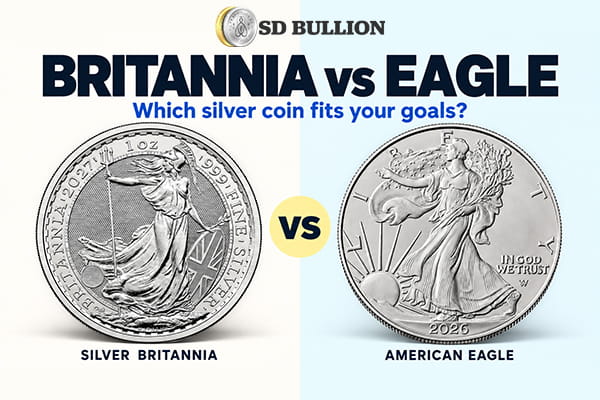
Investors can follow live gold and silver spot prices, compare physical bullion products like Silver Eagles, and explore educational market resources through SD Bullion.
The central question for precious metals markets is whether rising interest rates will continue outweighing inflation concerns—or whether economic weakness and sustained physical demand will eventually change that balance.
As geopolitical tensions, energy prices, and monetary policy expectations evolve, gold and silver investors will be watching closely for signs of the next major market shift.
Sources:
Oil-Driven Inflation Could Turn Bullish for Gold | Presented by CME Group
https://youtu.be/sD989xeODN0?si=3LfX5wdZjS1FteIN
Unauthorized AI agents detected inside accounts at major banks | CBS Mornings
https://www.youtube.com/watch?v=aU58pYTcKHg
AI’s ‘Black October’: Critical PHP flaws set off global security scramble | CNBC
https://www.cnbc.com/2026/10/23/php-vulnerabilities-ai-cybersecurity.html