Burnished American Silver Eagles are collectible coins made from specially prepared burnished coin blanks, giving them a distinctive satin-like finish.
Since the program’s inception in 2006, each burnished coin has attracted collectors seeking lower mintages and added numismatic appeal.
This guide compares burnished issues with proof Silver Eagles and bullion coins, covering rarity, value, buying, and care.
Key Takeaways
-
Burnished Silver Eagles** have substantially smaller mintages than standard bullion issues. PCGS records 466,573 coins for the inaugural 2006-W issue, while the 2018-W fell to 131,935 coins, illustrating the lower production levels that support collector interest.**
-
The 2008-W Reverse of 2007 is the standout burnished rarity. PCGS estimates only 46,318 coins, and an SP70 example sold for $1,995 in 2023, showing how a scarce variety can command a substantial premium.
-
Historically important dates can also attract premiums. The 2011-W Burnished Silver Eagle marked the series’ return after a two-year hiatus, with a 409,766 mintage number and a PCGS-recorded auction high of $348.
-
Regular burnished issues remain much more accessible than major rarities. A 2022-W Burnished Silver Eagle with its original box and Certificate of Authenticity is listed around $95 at SD Bullion, providing a useful benchmark for a non-key-date collector example.
Jump to: Burnished Silver Eagles Overview | Burnished Silver Eagles Mintage Figures | Burnished vs Regular Silver Eagles | Appearance and Finish Differences for Silver Eagles | Mintmarks and Production Differences for Burnished Silver Eagles | Valuation and Market Prices for Burnished Silver Eagles | Buying, Grading, and Investing in Burnished Silver Eagles | Care, Storage, and Display for Silver Eagles | Common Collectors Questions | Conclusion | FAQs
Burnished Silver Eagles Overview
Burnished Silver Eagles are one-ounce .999 fine silver coins that the U.S. Mint classifies as Uncirculated. Their satin-like finish is achieved by striking specially prepared burnished coin blanks, creating a softer appearance than proof Silver Eagles, which have a mirror-like finish.
Introduced in 2006, burnished coins are generally produced in lower quantities than standard bullion issues and carry a “W” mint mark indicating they are produced at West Point. They are typically sold as collector products with protective packaging and a Certificate of Authenticity.
Collectors can compare burnished, proof, and bullion American Silver Eagles at SD Bullion to see how finish, packaging, and current premiums differ across available issues.
Burnished Silver Eagles Mintage Figures
For a broader context on dates, grading, and pricing across the series, collectors often reference American Silver Eagle value guides from 1986–2021.
The series debuted in 2006 with 466,573 coins, while the 2007 issue reached just over 600,000, still below the levels typical of bullion production. No burnished coins were issued in 2009 or 2010, and mintages generally declined after the program resumed in 2011.
|
Year |
PCGS Mintage |
SD's Take |
|
2006-W |
466,573 |
First burnished issue |
|
2007-W |
621,333 |
Highest PCGS-listed annual mintage |
|
2008-W |
533,757 |
Includes a notable Reverse of 2007 variety |
|
2009 |
No issue |
Burnished production suspended |
|
2010 |
No issue |
Burnished production suspended |
|
2011-W |
409,766 |
Program resumed |
|
2012-W |
226,120 |
Lower production |
|
2013-W |
221,981 |
- |
|
2014-W |
253,169 |
- |
|
2015-W |
223,879 |
- |
|
2016-W |
216,501 |
30th Anniversary lettered edge |
|
2017-W |
176,739 |
- |
|
2018-W |
131,935 |
Lowest PCGS-listed regular issue in this table |
|
2019-W |
N/A |
PCGS does not currently provide mintage |
|
2020-W |
154,000 |
- |
|
2021-W |
N/A |
Type 2; PCGS mintage listed as N/A |
|
2022-W |
N/A |
PCGS mintage listed as N/A |
|
2023-W |
N/A |
PCGS mintage listed as N/A |
|
2024-W |
N/A |
PCGS mintage listed as N/A |
|
2025-W |
N/A |
PCGS mintage listed as N/A |
Mintages declined substantially after the early issues, falling from 621,333 in 2007 to 226,120 in 2012 and 131,935 in 2018. The long-term trend is toward lower production, which can increase collector interest in scarcer dates.
Silver Eagles Mintage Comparison
Burnished Silver Eagles are produced in much smaller quantities than both proof and standard bullion Silver Eagles. In 2018, for example, PCGS reports 131,935 burnished coins, compared with 361,192 proof coins and 15.7 million regular bullion Silver Eagles.
Across the 11 comparable issue years from 2006–2008 and 2011–2018, PCGS mintage figures produce the following averages:
|
Silver Eagle Type |
Average Mintage per Issue |
|
Burnished / Special Strike |
316,523 |
|
Proof |
765,920 |
|
Bullion / Regular Strike |
29,017,960 |
Among regular Burnished Silver Eagles for which PCGS reports a mintage, none exceeds 700,000 coins; the 2007-W is the highest at 621,333
Note: PCGS CoinFacts mintage figures for the 2006–2008 and 2011–2018 Silver Eagle issues. PCGS lists the regular strike, proof, and burnished issues for these years in its Silver Eagles Type 1 CoinFacts database
Burnished vs Regular Silver Eagles
Burnished and regular bullion Silver Eagles contain the same one troy ounce of .999 fine silver, but differ in finish, production, packaging, and collector premiums.
|
Feature |
Burnished Silver Eagle |
Regular Bullion Silver Eagle |
|
Finish |
Soft, satin-like appearance |
Brighter standard bullion finish |
|
Mintmark |
“W” for West Point |
No mint mark |
|
Production |
Specially burnished coin blanks |
Standard bullion production |
|
Packaging |
Capsule, presentation box, COA |
Typically tubes or bulk packaging |
|
Price |
Higher collector premium |
Usually lower premium |
Burnished Silver Eagles generally cost more because of their lower mintages and collector presentation. For example, as of September 2026, a random-year burnished coin with its original box and Certificate of Authenticity was recently listed around $99.
At the same time, bullion Silver Eagles are typically priced much closer to the spot price of silver, similar to many other government-issued silver investment coins.
Appearance and Finish Differences for Silver Eagles:
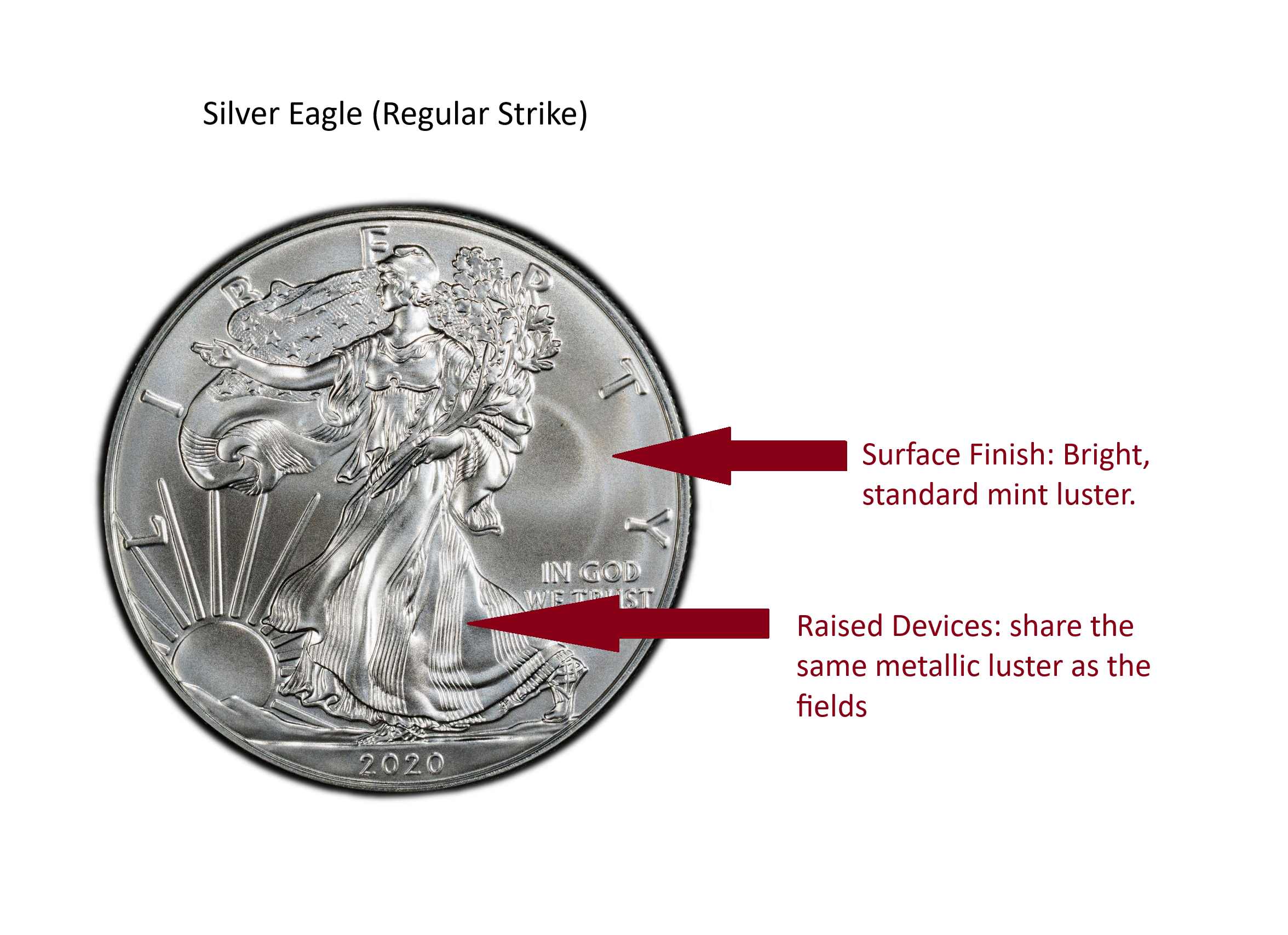
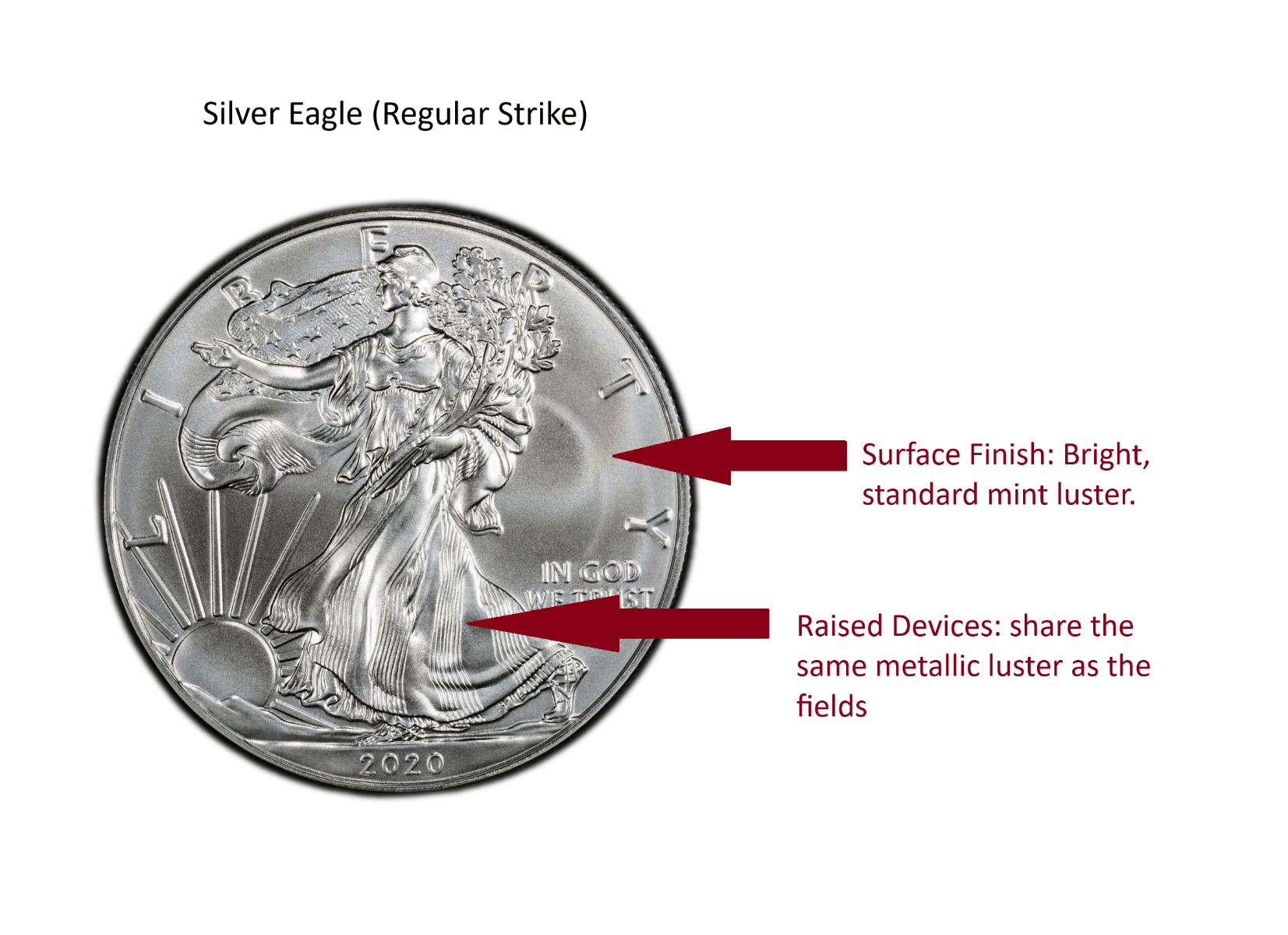
Regular Strike Silver Eagle
Regular bullion Silver Eagles have a bright, standard mint luster with relatively uniform reflectivity across both the fields and raised design elements.
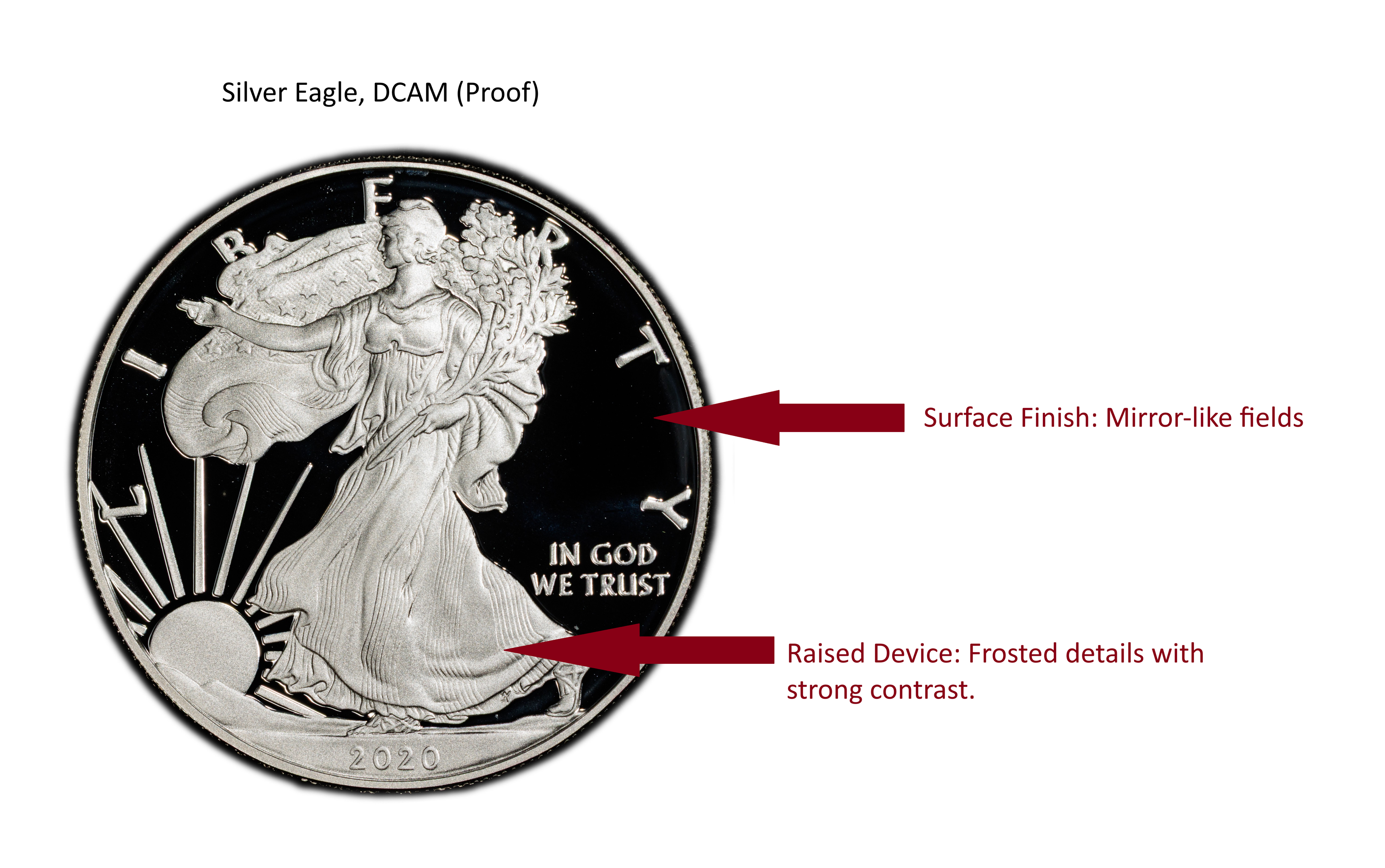
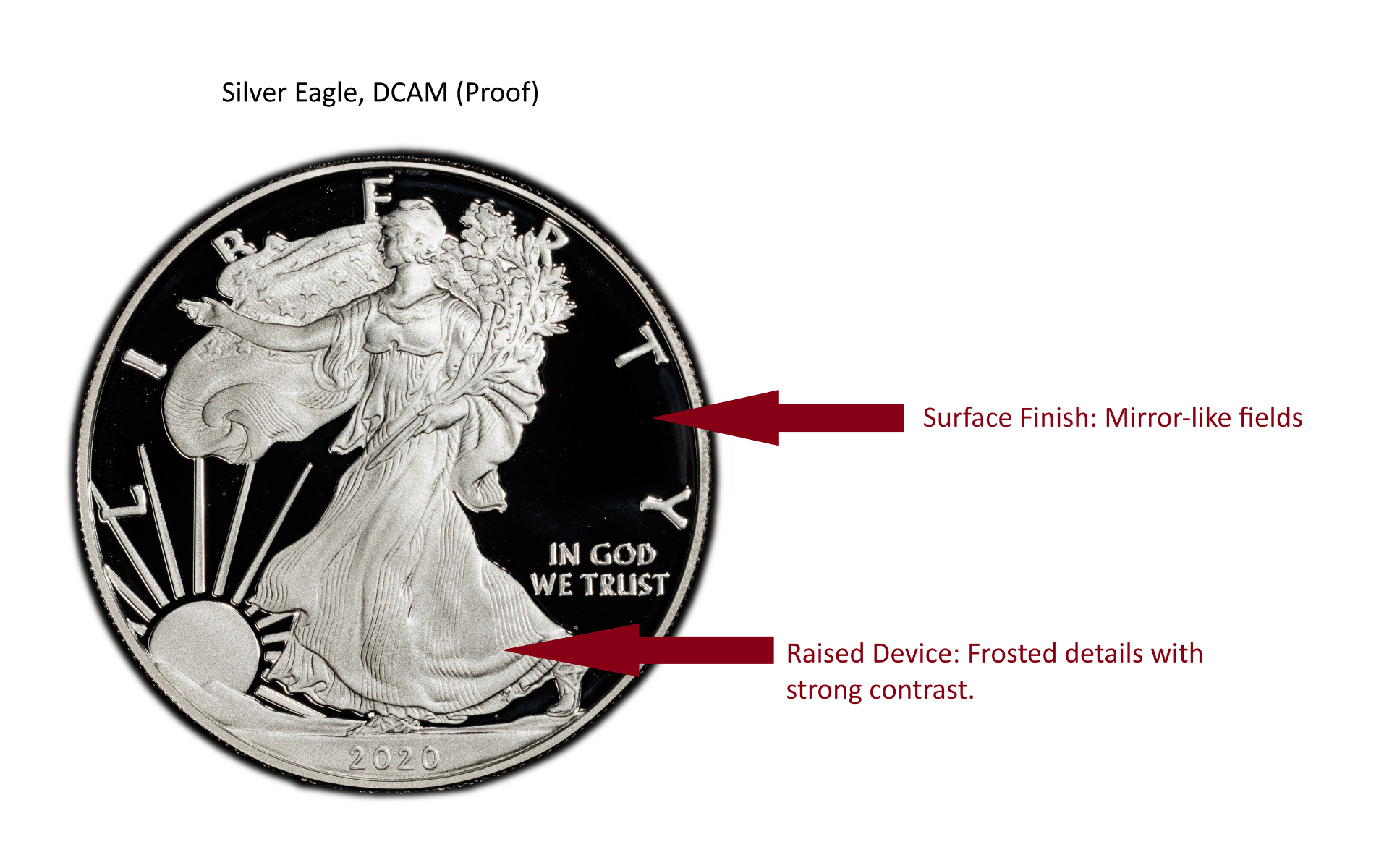
Proof Silver Eagle
Proof Silver Eagles have highly reflective, mirror-like fields and frosted raised devices, creating the strongest visual contrast of the three finishes.
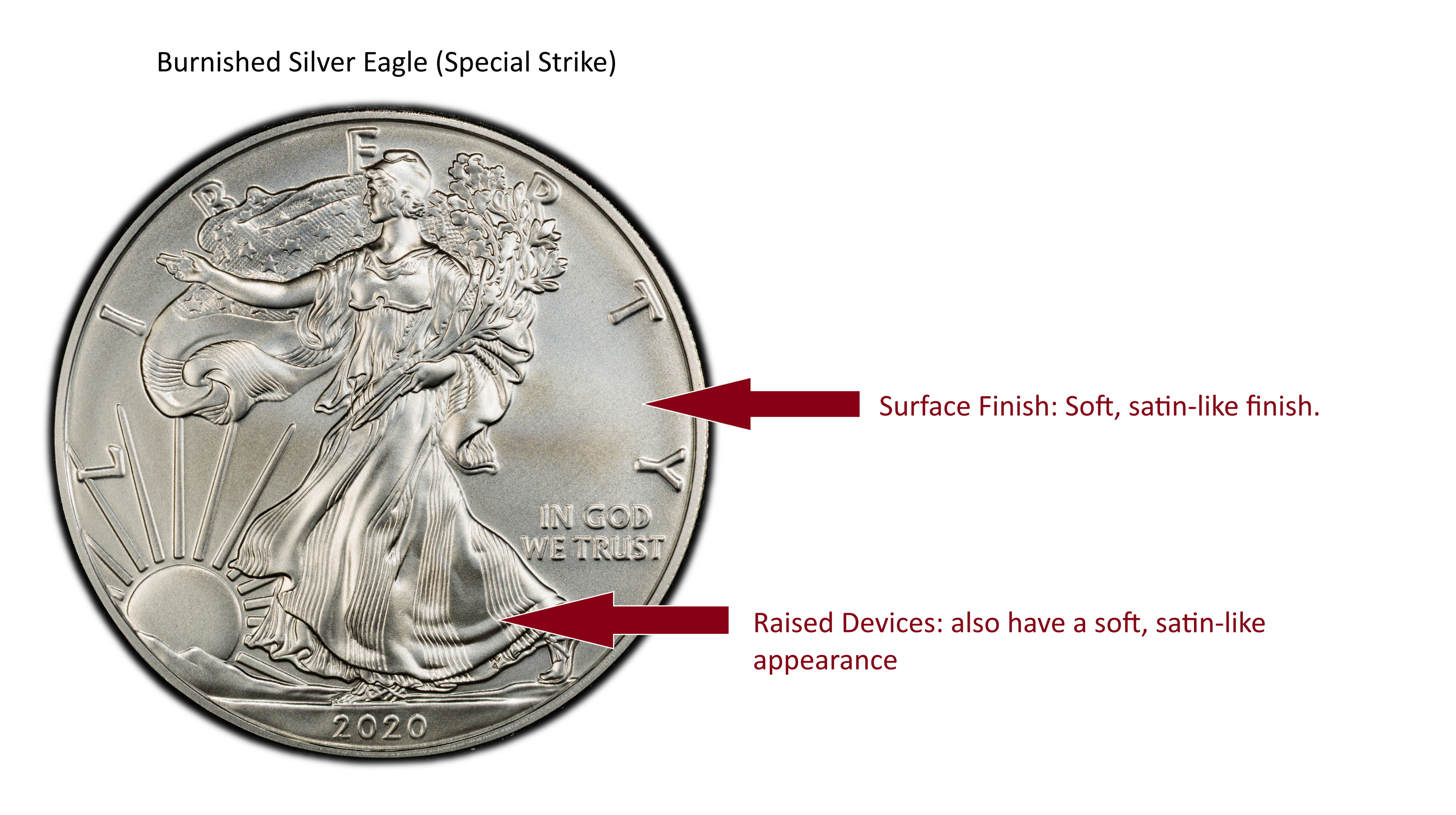
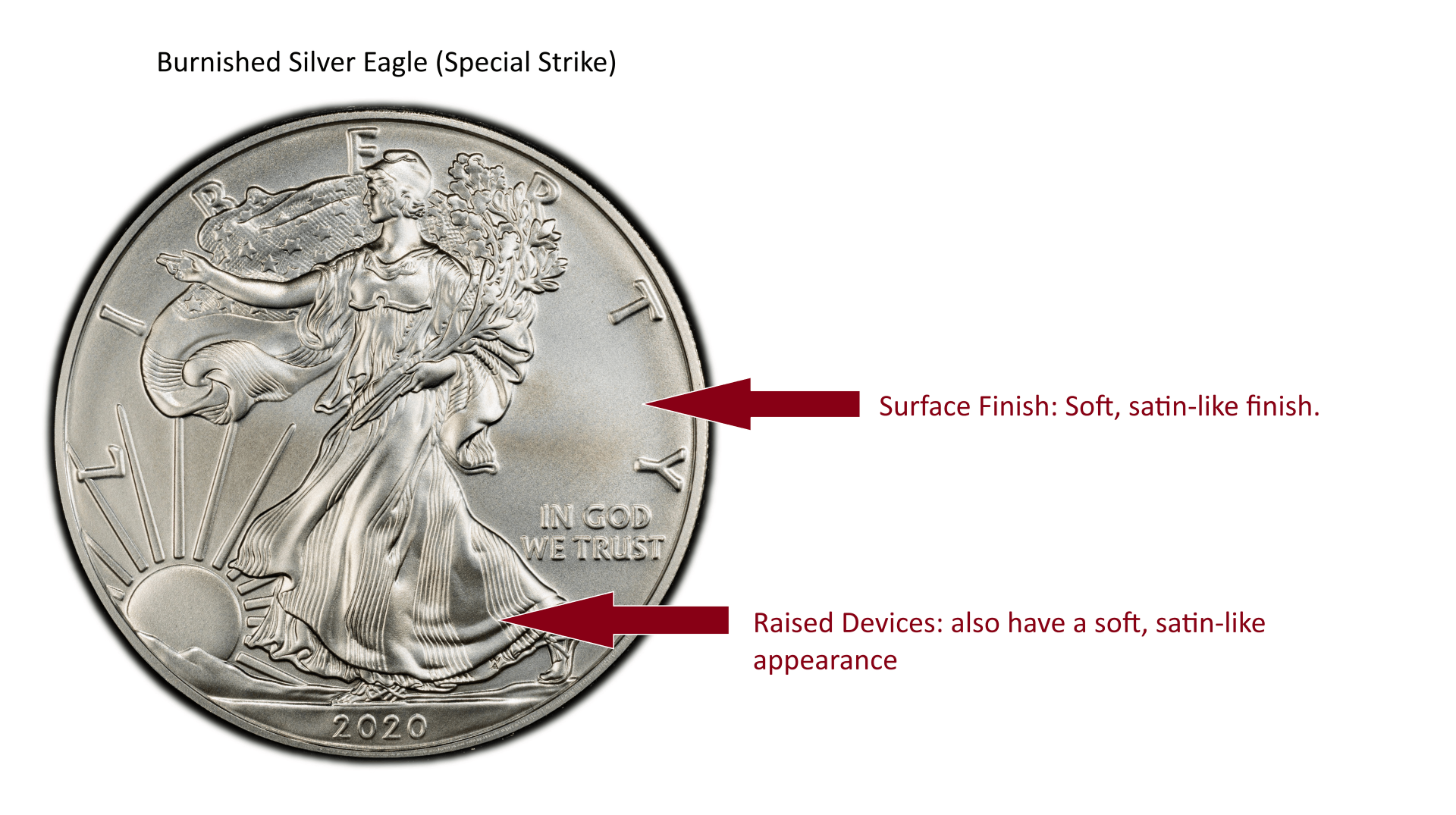
Burnished Silver Eagle
Burnished Silver Eagles have a softer, satin-like surface with more subdued reflectivity across both the fields and raised design elements.
Mintmarks and Production Differences for Burnished Silver Eagles
Burnished Silver Eagles are generally struck at the West Point Mint and carry a “W” mint mark, which distinguishes them from standard bullion Silver Eagles that typically lack a visible mint mark.
Their production also differs from proof coins. Burnished, or Uncirculated, Silver Eagles are struck on specially burnished blanks and receive a single strike, while proof coins are struck at least twice to create sharper detail and stronger contrast.
The U.S. Mint explains that uncirculated and bullion coins are struck once, whereas proof coins receive multiple strikes.
Valuation and Market Prices for Burnished Silver Eagles
When the first standalone Burnished Silver Eagle was released in 2006, the U.S. Mint priced it at $19.95. Today, Burnished Silver Eagle values vary by year, condition, certification, and original packaging.
In the current secondary market, a random-year burnished Silver Eagle with its original box and Certificate of Authenticity is listed around $99 at SD Bullion.
2008-W $1 Burnished Silver Eagle Reverse of 2007 (Special Strike)
Scarcer varieties can command much higher premiums. The 2008-W Reverse of 2007 has an estimated mintage of just 46,318 coins, according to PCGS. In 2023, an SP70 was sold for $ 1,995 on eBay.
Recent 2026 auction results include $336 for an SP69 example in the PCGS March 2026 auction result and around $660 for SP70 examples.
2011-W $1 Burnished Silver Eagle (Special Strike)
The 2011-W is another key date because it marked the return of the burnished Silver Eagle after a two-year production hiatus; PCGS lists its mintage at 409,766 coins. In 2019, a SP25 was sold for $348 at Ebay in 2019.
2018-W $1 Burnished Silver Eagle (Special Strike)
The 2018-W is another key date because its 131,935-coin mintage places it among the lower-mintage regular burnished Silver Eagles. PCGS lists an auction record of $249 for an SP70 example sold in May 2022.
Buying, Grading, and Investing in Burnished Silver Eagles
To verify a Burnished Silver Eagle, check its “W” West Point mint mark, one-troy-ounce weight of 31.10 grams, 99.93% Silver, .007% Copper composition, 40.60 mm diameter, and reeded edge against U.S. Mint specifications. The Mint officially labels these coins “Uncirculated,” so listings using only “burnished” should still match the correct year, finish, and mint mark.
For valuable key dates, collectors can submit coins to PCGS or NGC for professional authentication, grading, and encapsulation. PCGS generally classifies burnished Silver Eagles as Specimen (SP), while NGC grades them as Mint State (MS); proof Silver Eagles use Proof designations, while standard bullion issues are graded as Mint State.
Investors primarily seeking silver exposure may prefer lower-premium bullion Eagles, often looking first at low-premium silver bullion products, while burnished issues generally make more sense for collectors prioritizing rarity, condition, complete packaging, and specific dates.
Care, Storage, and Display for Silver Eagles
Burnished Silver Eagles should be stored in their original capsules or hard, PVC-free holders to protect their surfaces from fingerprints, scratches, and contaminants. The U.S. Mint recommends acid-free, PVC-free storage materials and keeping collectible coins cool and dry.
Silver tarnishes faster as humidity increases, so the Canadian Conservation Institute recommends keeping silver below 50% relative humidity.
For long-term storage, chemically stable materials such as polyethylene, acid-free unbuffered paper, and sealed enclosures are preferred. CCI also recommends silica gel to help control humidity and tarnishing gases. For temperature, PCGS recommends minimizing fluctuations and keeping coins below about 75°F (24°C).
Are burnished Silver Eagles silver-plated?
No. Burnishing is a surface preparation process, not plating. The U.S. Mint strikes these coins on specially burnished blanks; no additional silver coating is applied.
Why do burnished Silver Eagles sometimes look like bullion coins?
The difference can be subtle. The U.S. Mint describes the burnished finish as similar to its bullion counterpart, with the presence of a “W” mint mark providing a useful identifier.
How do I build a complete burnished Silver Eagle set?
Collectors can assemble the series by date, beginning with 2006 and accounting for years without regular issues. More advanced sets may also include notable varieties such as the 2008-W Reverse of 2007. Many builders also compare offerings across one-ounce American Silver Eagle coins when planning or upgrading their sets. PCGS Set Registry provides established Silver Eagle set formats for reference.
Conclusion
Burnished Silver Eagles combine one ounce of .999 fine silver with lower mintages, distinctive finishes, and added collector appeal. Buyers should compare mintage, condition, certification, and current market prices before purchasing.
SD Bullion offers Burnished American Silver Eagles and other Silver Eagle issues, allowing collectors to compare and sort available dates, grades, and current pricing before adding to a collection.
What is a burnished American Silver Eagle coin?
A burnished American Silver Eagle is the U.S. Mint’s collector “Uncirculated” version of the Silver Eagle. It contains one troy ounce of .999 fine silver and is struck on specially burnished blanks, producing a soft, matte-like finish. Burnished Silver Eagles are typically struck at West Point and carry a “W” mint mark.
What is the Difference between burnished, proof, and bullion silver eagles?
Burnished Silver Eagles have a soft, satin-like finish, while proof Silver Eagles feature frosted details against mirror-like fields. Bullion Silver Eagles have a standard finish and are primarily produced for precious-metal investment. Burnished and proof issues are collector products.
How are burnished silver eagles made by the US Mint?
Burnished Silver Eagles are struck once on specially prepared burnished coin blanks. The U.S. Mint polishes the blanks before striking, producing the coin’s softer, satin-like surface. Unlike proof Silver Eagles, which receive multiple strikes for stronger contrast and detail, burnished coins retain a more subdued finish.
Why do burnished silver eagles have a W mint mark?
Burnished Silver Eagles carry a “W” mint mark because they are produced at the U.S. Mint facility in West Point, New York.
Why does the U.S. Mint produce burnished finishes for Silver Eagles — what is the purpose?
The U.S. Mint produces burnished Silver Eagles to offer collectors a distinct numismatic version of the standard bullion coin. The specially prepared finish, West Point mint mark, collector packaging, and Certificate of Authenticity distinguish Uncirculated issues while retaining the Silver Eagle’s one-ounce .999 fine silver content and established designs.
Where should a new collector on a budget buy authentic burnished Silver Eagles — reputable sellers and marketplaces?
New collectors on a budget can compare Burnished Silver Eagles at established dealers such as SD Bullion, where available listings may include raw, capsule-only, original-packaging, and certified coins. Random-year or capsule-only examples can be more affordable than high-grade key dates.