Jump to: Types of Gold Investments | Bars and Rounds | Investing in Bullion | Gold Rounds vs Coins | Storage and Security | Liquidity | Tax Implications | Reputable Dealers | Diversifying your Portfolio
When it comes to gold investing, I’ve learned there’s no single “best” option—only the one that best fits your goals, budget, and strategy, whether that’s gold coins or rounds or bars.
Both are commonly used by investors seeking inflation hedging and long-term diversification, but understanding how they differ allows you to make more informed decision.
Key Takeaways
-
Gold coins, gold bars, and rounds serve different purposes within an investment portfolio.
-
Market acceptance and liquidity vary by product type and issuing mint.
-
Storage, security, and tax considerations are essential parts of any investment strategy.
-
Working with reputable dealers helps ensure authenticity, quality, and peace of mind.
-
Gold can play a key role in portfolio diversification and long-term wealth protection.
Types of Gold Investments
Understanding the basic types of precious metal investments makes every decision easier.
Gold coins are minted by sovereign governments and carry an imprinted face value, making them official currencies in their country of origin.
Government minted coin designs portray national symbols of culture and historic significance. The American Gold Eagle shows the effigy of Lady Liberty, the embodiment of the ideals of freedom, free thought and enlightment.

2026 1 oz American Gold Eagle Coin BU
Gold bars, on the other hand, are typically produced by private mints, though a few government mints, such as the Royal Mint and the Royal Canadian Mint also produce their own gold bars for private investors.
They’re designed with cost-effectiveness in mind; therefore, buying gold bars may offer a simple way to make a larger investment at lower premiums over spot.

1 oz SD Bullion Cross and Flag Gold Bar
Rounds sit somewhere between coins and bars. They resemble coins in size and shape but are not official currency because they are usually struck by private mints. What they lack in face value, they often make up for in affordability and intricate designs.

1 oz The Rifleman Gold Round - Cowboy Series
Silver rounds are usually more commonly available than gold rounds, but both share the fact that they are minted by private institutions and do not carry legal tender status or face value.
Gold Bars and Gold Rounds
Because neither has a face value like government-issued coins, their pricing is driven almost entirely by their content.
Gold bars usually have lower premiums compared to gold coins, making them more cost-effective for bulk purchases. Rounds provide a similar advantage in smaller, more flexible sizes, combining affordability with eye-catching designs from reputable private mints.
|
Gold Bars vs. Gold Rounds: Key Differences |
||
|
Feature |
Gold Bars |
Gold Rounds |
|
Issuer |
Private mints and refineries |
Private mints |
|
Legal Tender Status |
No face value; not legal tender |
No face value; not legal tender |
|
Primary Purpose |
Maximizing metal content and cost efficiency |
Affordable gold ownership with flexible sizing |
|
Premiums Over Spot |
Typically lower, especially in larger sizes |
Low, often slightly higher than bars but lower than coins |
|
Common Sizes |
Larger weights (10 oz, 1 kilo, 400 oz) |
Smaller, investor-friendly sizes (1 oz most common) |
|
Design Focus |
Minimal, often utilitarian |
More variety and decorative designs |
|
Best For |
High-volume investors focused on efficiency |
Those seeking lower entry costs and flexibility |
Whether you’re building a large gold position or adding ounces over time, bars and rounds offer simple exposure to gold’s intrinsic value without paying extra for official currency status or numismatic appeal.
Investing in Bullion
Bullion investing is often used as a core component of precious metals strategies—simple, tangible, and built around real metal content. Direct investments in platinum, gold, and silver bullion frees you from relying on paper assets or complex financial products.
Bullion coins, such as gold and silver coins from sovereign mints, offer their metal content, guaranteed weight and purity, official currency status, and often feature iconic designs that appeal to collectors. In some cases, that recognition and rare coins can add a layer of numismatic interest to their bullion worth.
Bullion bars, including gold and silver bars, are usually the go-to option for maximum metal at the lowest possible cost. With lower premiums over spot and higher precious metal content per dollar used, Bullion bars are often chosen by investors focused on cost efficiency and long-term accumulation.
At the end of the day, precious metal investing isn’t one-size-fits-all. Coins, bars, and rounds each serve a different purpose, and choosing the right mix depends on your investment goals, budget, and personal preferences.
Gold Rounds vs. Coins
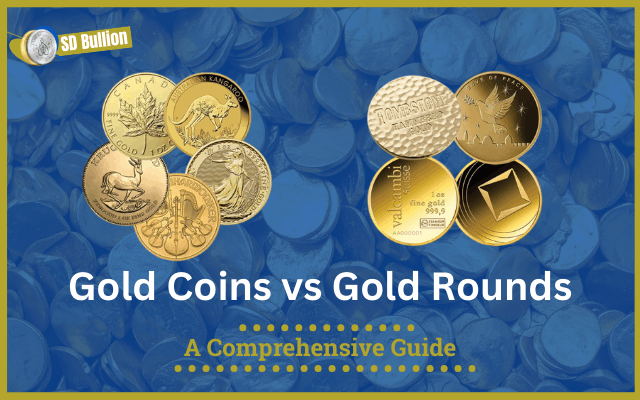
Comparing coins and rounds side by side, the difference comes down to what you are paying for: added history and collectibility, or metal composition.
Gold coins typically carry higher premiums because they’re minted by sovereign governments, and they have a minimum face value. In addition, Some gold coins may trade above their intrinsic metal value due to rarity or collector demand due to their rarity and historical significance. For collectors or investors who demand rarity, recognition, and long-term appeal, those extra costs can make sense.

1 oz Gold Coins - Design Our Choice
Some of the most popular gold coins include the American Gold Eagle and the Gold Canadian maple Leaf.
Unlike coins, rounds are produced by private mints and sold at lower premiums because they focus almost entirely on melt value rather than numismatic value.

1 oz Gold Round - Design Our Choice
Another key distinction lies in who produces them. Sovereign mints issue coins, while private mints produce rounds, leading to variations in design style, production methods, and artistic creativity.
|
Gold Coins vs. Gold Rounds: Key Differences |
||
|
Feature |
Gold Coins |
Gold Rounds |
|
Issuer |
Sovereign (government) mints |
Private mints |
|
Legal Tender Status |
Yes |
No |
|
Face Value |
Yes, assigned by the issuing government |
None |
|
Premiums Over Spot |
Higher, due to the minting authority and collectible appeal |
Lower, focused on metal value |
|
Numismatic Value |
Possible, especially for limited or historic issues |
Minimal to none |
|
Design Standards |
Strict government specifications |
More design freedom and variety |
|
Collector Appeal |
High |
Low to moderate |
|
Investment Focus |
Blend of metal value and collectibility |
Maximizing gold content per dollar |
|
Liquidity & Recognition |
Widely recognized and easy to resell globally |
Liquid, but recognition depends on the mint |
|
Best For |
Collectors and investors seeking premium-backed assets |
Cost-conscious investors focused on ounces |
Storage and Security
No matter which form of gold is chosen, storage and security are non-negotiable. Physical gold is a tangible asset, and that’s part of its appeal, but it also means it needs protection from theft, damage, or loss.
There are several storage options available, ranging from home safes to professional vaults and third-party storage facilities. Home storage offers immediate access and privacy, but it also entails additional responsibility and risk. Professional storage solutions, on the other hand, are specifically designed for precious metals and often provide high-level security, climate control, and insurance coverage.
Many reputable mints and dealers also offer secure storage programs that may include insured vaulting and protected transportation.
Ultimately, the security of such an investment is just as important as the purchase itself. A single incident of theft or damage can erase years of careful planning, which is why it is advisable to evaluate storage options as part of the overall investment strategy, not as an afterthought.
Market Acceptance and Liquidity
Market acceptance plays a direct role in value.
Gold coins are minted by government issuers, such as the Royal Mint, which provides a level of authenticity and trust that is often absent in gold bars.
The authenticity of gold coins is typically easier to verify due to their government certification, while gold bars may require additional checks. Because of that, coins often command slightly higher prices because buyers know precisely what they’re getting. That familiarity can reduce friction during resale and make transactions quicker and smoother.
That said, it is important to note that gold coins are official currency, which makes the attempt to forge them a federal felony in many U.S. jurisdictions, characterized as counterfeiting.
Gold bars are also highly liquid, particularly standard sizes, though larger bars may appeal to a narrower buyer pool.
Despite their lower cost, rounds, while still easy to sell, can sometimes depend more on the reputation of the private mint that produced them.
Tax Implications
Taxes can quietly impact overall returns if you’re not paying attention. Gold investments may be subject to capital gains tax, sales tax, or other local taxes, depending on how, where, and what you buy or sell.
The tax treatment of gold isn’t universal. It can vary by jurisdiction and sometimes by product type, with certain coins potentially treated differently than bars or rounds under local tax laws. That means two investors holding the same amount of gold could face very different tax outcomes based on location and structure.
Because these rules can change and often come with exceptions, it is crucial to get clear guidance to ensure compliance while avoiding unnecessary surprises when it’s time to sell.
Working with Reputable Dealers
Where you buy gold matters just as much as what you buy. Working with a reputable precious metals dealer makes the entire investment process clearer, safer, and far less stressful. Clear policies, secure shipping, strong customer support, and industry recognition all signal that you’re working with a reliable partner.
Established dealers offer expert guidance, transparent pricing, and educational resources that help investors make informed decisions instead of emotional ones. Just as importantly, these dealers help protect buyers from counterfeits and scams by guaranteeing the authenticity, weight, and purity of their products.
Another advantage is access. Trusted dealers typically carry a wide selection of gold coins, bars, and rounds, making it easier to compare options and choose products that align with specific goals—whether that’s low premiums, global recognition, or collectible worth.
Diversifying Your Portfolio
Acquiring precious metals is a time-honored strategy for diversifying and securing investment portfolios. Gold historically has shown different price behavior compared to traditional assets like stocks and bonds.
Considering a historical context, gold has a long track record as a hedge against inflation and market volatility. Economic uncertainty often drives investors toward gold rounds and coins as a safe-haven asset. During certain periods of economic uncertainty, gold has historically attracted increased demand. That kind of balance is hard to ignore when building a resilient portfolio.
Diversification isn’t about adding assets at random. It is advisable to consider investment goals, time horizon, and risk tolerance before deciding how much gold or other metals to include. While gold can offer protection and stability, It may be more effective when included as part of a broader strategy rather than used alone.
Final Thoughts
When it comes to choosing between bars, coins, and rounds, the “best” option depends entirely on what you want gold to do in your portfolio. Legal tender coins bring recognition, and may be an attractive option, while rounds and bars are cost-efficient, maximizing precious metal content per dollar.
Understanding differences in premiums, liquidity, storage, taxes, and market acceptance makes it easier to invest with confidence instead of uncertainty. Gold works best when it’s chosen intentionally—aligned with personal goals, risk tolerance, and long-term strategy.
Whether you’re building wealth, preserving purchasing power, or diversifying beyond traditional assets, physical gold offers flexibility that few investments can match. Taking the time to understand your preferred choice is what turns a simple gold purchase into a more informed portfolio decision.
This content is for informational purposes only and should not be considered financial, tax, or investment advice. Investors should conduct their own research and consult with a qualified financial professional before making investment decisions.