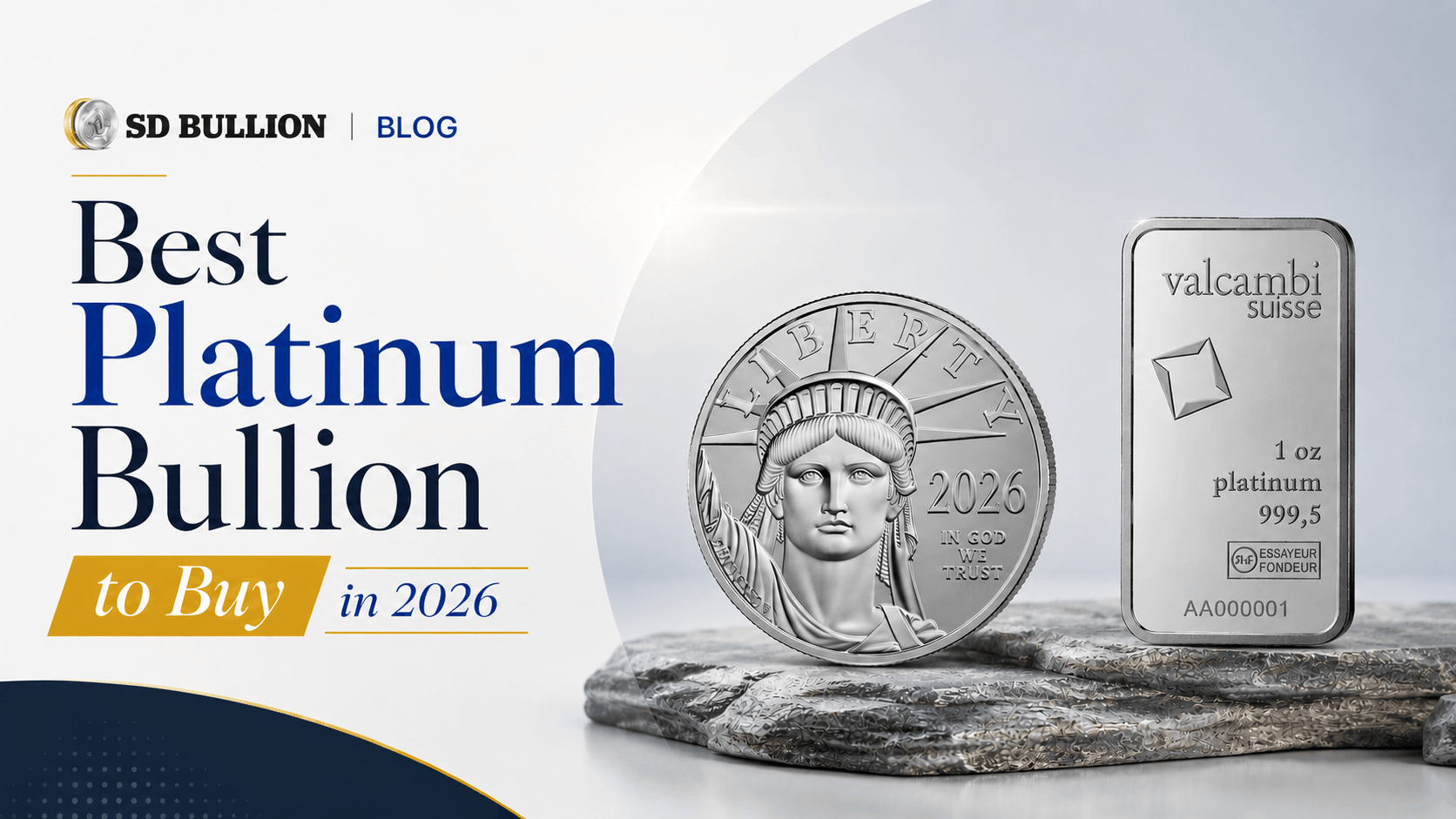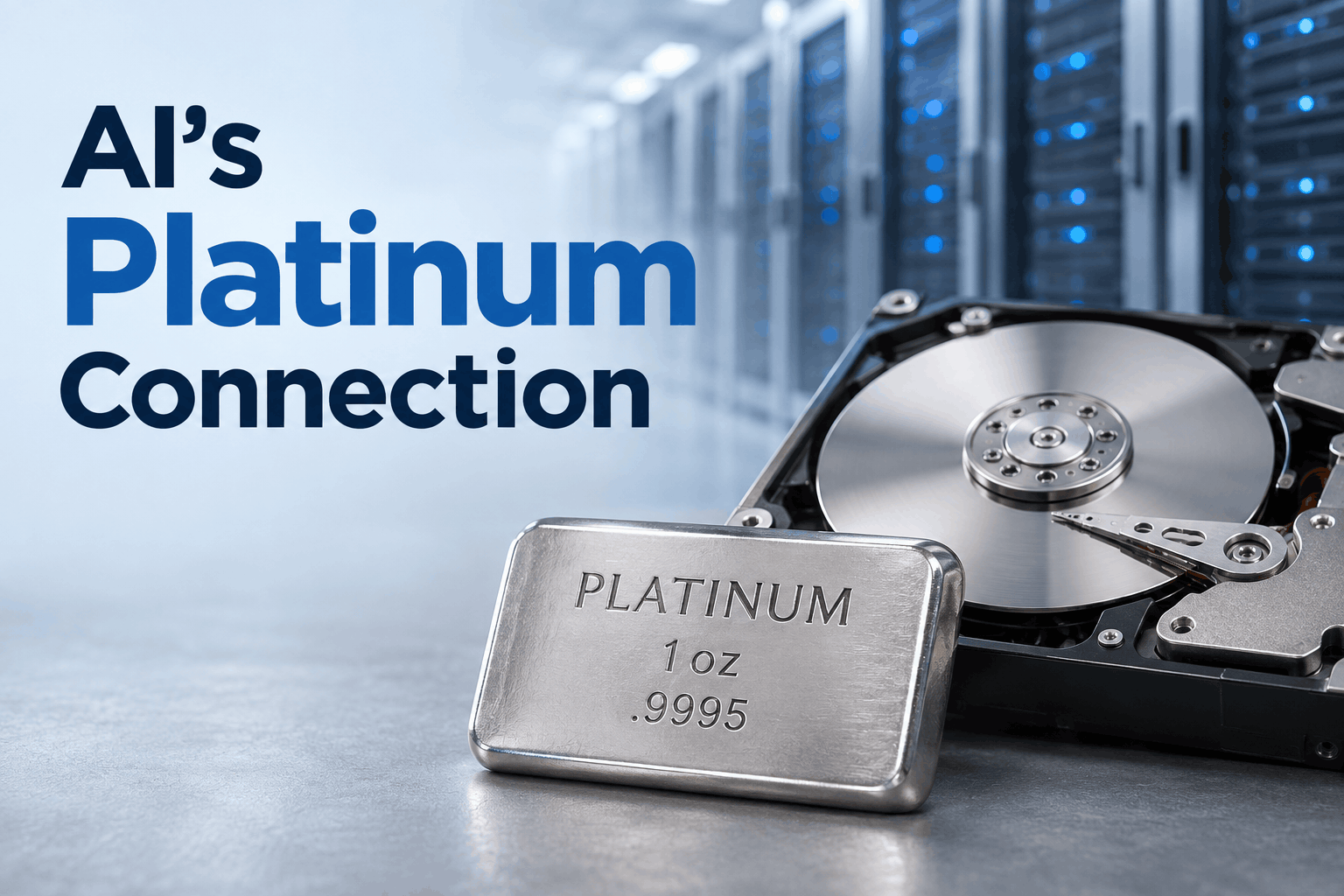
As artificial intelligence (AI) drives a massive expansion in data centers and digital storage capacity, platinum is emerging as a precious metal with growing industrial demand. For investors who traditionally buy gold coins and bars, this developing trend offers another reason to explore physical platinum.
Gold Investors May Be Overlooking Platinum's Growing Role in AI
For generations, investors have purchased physical gold coins and bars to preserve wealth, diversify their holdings, and maintain ownership of a tangible asset. Products such as American the Gold Eagle, the Canadian Gold Maple Leaf, and gold bullion bars remain popular choices among precious metals buyers.
However, investors focused exclusively on gold may be overlooking another precious metal with an increasingly important role in the global technology economy: platinum.
While gold is widely recognized as a monetary metal and store of value, platinum combines precious metal investment characteristics with a broad range of industrial applications. Its physical and chemical properties make it valuable in automotive manufacturing, medicine, chemical processing, electronics, and emerging technologies.
Now, the rapid expansion of AI and hyperscale data centers is creating another potential source of demand for platinum.
According to research from the World Platinum Investment Council (WPIC), AI-related data storage growth is helping drive increased platinum consumption in the electronics industry. As technology companies expand their digital infrastructure, demand for hard disk drives (HDDs) is strengthening industrial demand for platinum.
For investors already comfortable buying physical gold, this developing connection between AI infrastructure and platinum demand presents an opportunity to reconsider how they diversify their precious metals holdings.
AI Data Centers Are Creating New Demand for Platinum
Artificial intelligence requires enormous amounts of computing power, but it also depends on massive quantities of data storage.
Every AI model, enterprise application, cloud platform, and expanding digital service generates information that must be stored, retrieved, and managed.
Technology companies are responding by investing in new data centers, expanding existing facilities, and purchasing higher-capacity storage equipment.
Although most consumers associate AI infrastructure with advanced semiconductor chips and graphics processors, data storage is another critical component of this expansion.
One technology benefiting from this demand is the HDD.
Unlike solid-state drives (SSDs), which use semiconductor memory, HDDs incorporate platinum alloys within the magnetic recording layers of their storage platters.
These specialized platinum-containing materials help improve thermal and magnetic stability, allowing manufacturers to increase storage capacity and reliability.
As more data centers are constructed and existing facilities upgrade their storage systems, the resulting demand for HDDs creates additional industrial demand for platinum.
The connection is straightforward: expanding AI infrastructure requires more data storage, and certain high-capacity storage technologies require platinum.
World Platinum Investment Council Forecasts 19% Growth in Electrical Platinum Demand
The World Platinum Investment Council, established in 2014 by leading South African platinum producers, provides investment research covering global platinum supply, demand, and investment trends.
Its flagship Platinum Quarterly publication tracks developments across the platinum market, including industrial and investment demand for platinum.
According to the most recent WPIC market update, published on 9 September, electrical demand for platinum is forecast to increase by 19% year over year in 2026, reaching approximately 118,000 troy ounces.
2026 electrical platinum demand forecast
|
Metric |
WPIC forecast |
|
Annual demand growth |
+19% |
|
Total electrical demand |
118,000 troy ounces |
|
Major growth driver |
AI-related applications, including HDD storage |
This forecast highlights how AI-related infrastructure spending is translating into measurable industrial consumption of platinum.
While electrical applications represent only one segment of overall platinum demand, the projected growth demonstrates how the metal's industrial uses are evolving beyond traditional markets.
For buyers accustomed to evaluating gold primarily through inflation, interest rates, central-bank purchases, and currency movements, platinum introduces an additional consideration: demand generated by technological innovation.
Toshiba, Seagate, and Western Digital are seeing strong demand for HDDs
Major hard disk drive manufacturers are already responding to growing demand from cloud computing and artificial intelligence.
According to the WPIC update, Toshiba is investing in expanded HDD manufacturing capacity, targeting nearly double its annual production capacity by its full financial year 2027 compared with financial year 2025, measured by storage capacity.
The expansion focuses heavily on nearline HDDs, which are used by large businesses, cloud operators, and hyperscale data centers.
Nearline storage provides cost-efficient access to enormous amounts of information that do not require the immediate response times associated with high-performance SSDs.
The two other major HDD manufacturers are also responding to growing HDD demand.
- Seagate: Is increasing deployment of advanced high-capacity drives to hyperscale cloud customers supporting AI and data-center workloads.
- Western Digital: has reported strong nearline HDD shipment growth and longer-term customer commitments from major cloud operators.
The WPIC update also describes an HDD market experiencing tight supply, with substantial production commitments and some customers considering longer-term agreements extending into 2028.
For platinum investors, these developments are significant because increasing storage capacity supports demand for the specialized materials used in HDD manufacturing, including platinum.
Why Next-Generation Hard Drives Could Require More Platinum
One of the most important technological developments in the HDD storage industry is heat-assisted magnetic recording, commonly called HAMR.
HAMR technology allows manufacturers to increase the amount of data stored on a magnetic disk without proportionally increasing the drive's physical size or energy requirements.
This improvement is particularly valuable for hyperscale data centers, where storage capacity, energy efficiency, and operating costs are major considerations. In terms of HDD innovation, Toshiba is investigating 12-disk stacking technology alongside next-generation recording methods.
According to the WPIC, HAMR drives generally contain more platinum per unit than conventional non-HAMR hard drives.
This creates two potential drivers of future platinum demand.
First, expanding AI infrastructure can increase the number of HDDs deployed worldwide.
Second, the transition toward advanced recording technologies may increase the amount of platinum required in certain drives.
Consequently, platinum consumption could benefit from both growing storage requirements and changes in manufacturing technology.
Not all data storage technologies use platinum. SSDs, for example, do not contain platinum or other platinum-group metals in their storage media. Their faster performance makes them well suited for applications requiring extremely low latency.
However, high-capacity HDDs remain important for cost-efficient nearline storage, providing a distinct role within modern data-center infrastructure.
How Much Platinum Could AI Data Centers Require?
The scale of modern data centers helps explain why relatively small quantities of platinum in individual components can become meaningful when multiplied across thousands of facilities.
A single modern 3.5-inch hard drive platter may contain approximately 1 to 5 milligrams of platinum, depending on its design and recording technology. (Source: Scrap Metal Forum, “Burning Question: How Much Platinum Is in a Hard Drive Platter?”)
That may sound insignificant, but large-scale data centers can contain hundreds of thousands of physical storage drives.
Large hyperscale data centers operated by technology companies such as Google, Amazon, and Microsoft may house approximately 100,000 to more than 500,000 physical storage drives. This estimated range reflects discussions among data center engineers and IT professionals on platforms such as Quora, highlighting the enormous storage infrastructure required to support cloud computing and artificial intelligence. As AI workloads expand, the growing need for high-capacity HDD storage could create additional industrial demand for platinum, which is used in specialized magnetic recording components.
A single HDD can also contain multiple magnetic platters.
When manufacturers produce millions of drives, even small quantities of platinum used in individual components can contribute to industrial demand.
Based on preliminary estimates, approximately $150,000 of platinum per data center and suggests a potential U.S. market approaching $650 million in platinum requirements across thousands of facilities.
These dollar figures should be viewed as illustrative estimates rather than verified industry forecasts. Actual platinum requirements depend on the number of HDDs deployed, platinum content per platter, drive configurations, SSD adoption, metal prices, and data-center construction schedules.
Nevertheless, the underlying trend is worth watching: AI infrastructure growth is creating additional demand for advanced data storage, and some of that equipment uses platinum.
Why Gold Coin Buyers Should Consider Platinum Coins and Bars
Gold and platinum share several characteristics that appeal to physical precious metals investors.
Both are tangible physical assets that can be purchased in bullion form, held outside traditional financial markets, and stored for long-term ownership.
However, platinum has a greater industrial component, making its market more sensitive to changes in manufacturing activity, automotive production, technological developments, and changes in industrial supply chains.
Right now, both gold and platinum are being influenced by the same macroeconomic and geopolitical drivers that are impacting the entire precious metals complex, which include uncertainty around the timing and extent of future interest-rate moves, ongoing questions over the longer-term direction of inflation, and concerns surrounding rising sovereign debt burdens and currency valuations.
For investors who already own gold coins or gold bars, purchasing platinum bullion offers exposure to a precious metal that is also vital to a wide range of industrial uses.
|
Investment consideration |
Gold |
Platinum |
|
Traditional wealth preservation |
Widely recognized |
Less established |
|
Diverse industrial applications |
Relatively limited |
Significant |
|
AI-related HDD demand |
Limited direct exposure |
Significant |
|
Central-bank reserve demand |
Major market influence |
Much smaller role |
|
Bullion ownership options |
Coins and bars |
Coins and bars |
|
Market liquidity |
Generally deeper |
Less liquid than gold, but still a deep, liquid market with 5M oz traded each day in 2025 |
Platinum is not necessarily a substitute for gold. Instead, the two metals can serve different purposes within a diversified precious metals portfolio.
Gold buyers who already appreciate physical ownership may find platinum especially interesting because its demand is connected to industries that continue to evolve.
At the same time, platinum prices can be more volatile than gold prices, and growing industrial demand does not guarantee higher bullion prices.
Platinum Supply Is Another Factor Worth Watching
Platinum is a relatively rare precious metal, and its global mine production is concentrated in Southern Africa, which accounts for 78% of platinum group metal reserves.
This geographic concentration means the platinum supply chain can be affected by mining costs, energy availability, labor conditions, operational disruptions, and geopolitical developments.
Increasing platinum mine output may require substantial capital investment and long development timelines.
Platinum recycling also contributes to available supply, particularly through the recovery of metals from automotive catalytic converters.
Platinum’s strategic and economic importance is widely recognized, with the United States, European Union, and China, among others, recognizing its critical mineral status.
However, investors should recognize that platinum's overall market balance depends on much more than data centers. Supply from mined production and recycling needs to be considered alongside total demand from segments as diverse as automotive, jewelry, industrial , and investment.
Buying Physical Platinum: Coins Versus Bars
For investors already familiar with purchasing American Gold Eagles, Gold Buffalos, or Canadian Gold Maples, buying physical platinum can be a relatively straightforward extension of their precious metals purchasing strategy.
Platinum bullion is available in sovereign mint-issued coins and privately manufactured bars, with different premiums, sizes, and resale considerations.
Popular Platinum Coins
Government-issued platinum bullion coins offer recognizable designs, established mint reputations, and standardized precious metal content.


Produced by the United States Mint, these .9995 fine platinum bullion coins are recognizable to U.S. precious metals buyers.


Manufactured by the Royal Canadian Mint, these coins contain .9995 fine platinum and feature the iconic maple leaf design.


Issued by The Royal Mint, Platinum Britannias combine a recognizable sovereign bullion design with .9995 fine platinum.
Platinum Bars for Investors Focused on Metal Content
Platinum bars are another option for investors who prioritize the quantity of physical platinum purchased relative to the spot price.


A common format for investors seeking a full troy ounce of platinum, with products available from established precious metals refiners.

Smaller platinum bars, including 1-gram, 5-gram, and 10-gram formats, can provide a lower initial purchase cost, although premiums per ounce may be higher.
Investors comparing platinum coins and bars should evaluate dealer premiums, product recognition, resale liquidity, storage, and buyback options.
As with gold bullion, the total purchase price includes the prevailing platinum spot price plus any applicable dealer premium.
Why Buy Platinum From SD Bullion?
For investors who already purchase gold and silver, SD Bullion offers an opportunity to explore physical platinum through an established U.S. precious metals dealer.
SD Bullion provides a selection of platinum coins and bars from recognized sovereign mints and precious metals refiners, allowing customers to compare products based on weight, purity, availability, and pricing.
Customers can review current platinum spot prices and compare premiums before making a purchase.
SD Bullion also offers discreet, insured shipping and educational resources designed to help customers better understand precious metals markets.
For gold investors interested in diversifying beyond their existing holdings, platinum coins and bars provide a tangible way to gain exposure to a metal used in industrial technologies, including certain AI-related data storage applications.
The Bottom Line: AI Could Add a New Chapter to Platinum Demand
Gold will likely remain a cornerstone of physical precious metals ownership for many investors, supported by its longstanding monetary history and broad international recognition.
Platinum offers a different investment story.
Its industrial importance is increasingly connected to advanced technologies, and the expansion of AI data centers provides an example of how technological progress can influence precious metals consumption.
The World Platinum Investment Council's forecast of 19% growth in electrical platinum demand during 2026 illustrates this emerging opportunity.
Although platinum used in individual hard disk drives represents only a tiny quantity of metal, the enormous scale of global data storage requirements makes the trend worth monitoring.
For investors who already own gold coins and bars, the next precious metals purchase does not necessarily have to be another ounce of gold.
As artificial intelligence transforms the world's digital infrastructure, platinum coins and bars may deserve a closer look from investors seeking to diversify their physical precious metals holdings.
Explore the selection of platinum coins and platinum bars available from SD Bullion and compare current prices, premiums, and product options.
Sources: World Platinum Investment Council - WPIC® , platinum electrical demand forecasts and market commentary on AI-related nearline storage, HDD manufacturing, and HAMR technology, as provided in the source material (https://platinuminvestment.com/about/60-seconds-in-platinum/2026/10/20/hyperscaling-with-hard-disk-drives).
Disclosure: This article is for educational and informational purposes only and does not constitute financial or investment advice. Platinum prices are subject to market volatility, and future industrial demand does not guarantee price appreciation. Investors should consider their financial circumstances, risk tolerance, and investment objectives before purchasing precious metals.