Jump to: Historical Background | Design | Composition | Condition | Varieties and Errors | FAQs
The Kennedy half dollar was introduced in 1964 to honor former President John F. Kennedy after his assassination in 1963.
Later, in 1971, the U.S. Mint made a significant change by striking the coin in copper-nickel clad for the first time, eliminating its silver composition.
This transition marks a notable point in the coin's history, making it particularly interesting and worthy of attention.
Keep reading further to discover which aspects to look for when anticipating a 1971 half-dollar value.
Key Takeaways
- 1971 was the first year Kennedy Half-Dollars were minted in a Copper Nickel Clad;
- The 1971 Kennedy Half Dollar does not have any official error varieties besides the 1971-D Double Die Obverse FS-101 and FS-102, and they can be worth, respectively, around $500 to 850$ in uncirculated condition, according to the PCGS price guide.
Some Historical Background

Source || By Cecil Stoughton, White House
Within hours of John F. Kennedy's assassination in Dallas, Texas, on November 22, 1963, Congress expedited the approval of redesigning the half-dollar to honor the nation's fallen president. Mint Director Eva Adams contacted Chief Engraver Gilroy Roberts about depicting Kennedy on a larger silver coin.
By November 27, Jacqueline Kennedy had expressed her preference for the half dollar, not wanting to replace George Washington on the quarter.
To meet the January 1964 deadline, Roberts modified an existing bust of Kennedy while Frank Gasparro worked on the reverse design. Kennedy had previously approved both designs. Jacqueline and Robert F. Kennedy reviewed the trial strikes, with Mrs. Kennedy suggesting slight alterations to the hair.
Despite requests for a full or half figure, time constraints, and aesthetic considerations led to the final left-profile design.
The Reception Of The New Coin
In May 1969, the treasure got permission to remove the silver content from the half dollar and use the same copper-nickel-clad composition as the dime and quarter.
In 1970, uncirculated (non-proof) half dollars were struck only at the Denver Mint and available solely in mint sets. When the coins were inserted back into circulation in 1971, their popularity in daily usage did not grow. The explanation is that people were not accustomed to seeing them around.
However, in July 1971, Mint Director Mary Brooks revealed that the Treasury was holding 200 million of the new base metal half-dollars because commercial banks showed little interest in ordering them. Additionally, the public hoarded these coins as a reminder of the former president.
According to Brooks, the public hoarded over one billion silver Kennedy Half-Dollars.
Factors affecting the Kennedy Half Dollar value
When we talk about a coin's value, we are talking about its numismatic value, which will most of the time surpass its face value. This value is affected by the aspects below.
Design

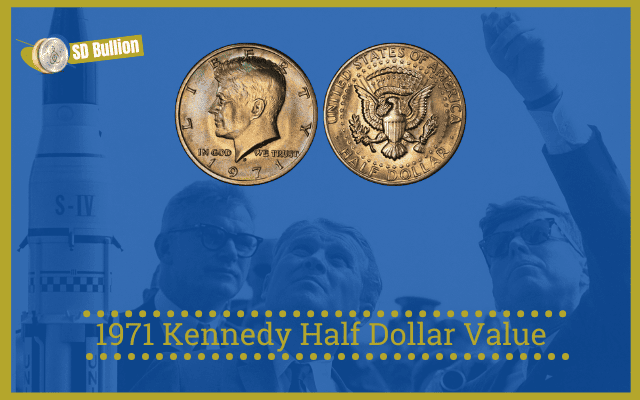
The coin's obverse, designed by Gilroy Roberts, displays a left-profile portrait of President John F. Kennedy. The inscriptions "LIBERTY" and the year "1971" surround the portrait, with the motto "IN GOD WE TRUST" inscribed below Kennedy's chin.
The reverse, designed by Frank Gasparro, depicts the Presidential Seal. At the center of the design, a heraldic eagle with a shield on its chest holds an olive branch and a bundle of 13 arrows in its talons. A ring of 50 stars encircles the eagle, symbolizing the states.
The inscriptions "UNITED STATES OF AMERICA" and "HALF DOLLAR" (50 cents) are arranged around the design, with the motto "E PLURIBUS UNUM" on a scroll above the eagle's head.
Composition
The composition of the Kennedy half-dollar has undergone several changes over the years.
In 1964, the coin was made of 90% silver and 10% copper. From 1965 to 1970, it featured an outer layer of 80% silver and 20% copper, clad to a core of 79% copper and 21% silver, resulting in a total composition of 60% copper and 40% silver.
Starting in 1971, the composition changed to an outer layer of 75% copper and 25% nickel, clad to a pure copper core, which falls into the type 3.
Condition of the Coin
The condition of a coin significantly influences its pricing, with well-preserved coins fetching higher values.
Collectors, dealers, and third-party grading services like PCGS use the Sheldon Scale, ranging from 1 to 70, to grade a coin's condition:

A coin graded 70 is in perfect, mint condition, while a coin graded 1 is barely identifiable. Higher-grade coins, especially if in uncirculated condition (graded between 60-70), are more desirable and bid higher prices in the market.
Varieties and Errors
1971-P 50C (Regular Strike)

Source || PCGS
The 1971-P Kennedy Half Dollar is common in most grades up to MS64. In MS65, they become somewhat harder to find. In MS66, they are scarce, with possibly 200 or fewer examples surviving. MS67 coins are very scarce, with fewer than ten known examples and none in higher grades.
An auction record was set on March 4, 2023, when an MS67 coin sold for $2,900 on eBay.
1971-D 50C (Regular Strike)

Source || PCGS
The 1971-D Kennedy Half Dollar is quite common, with hundreds of millions minted. Most of these coins likely still exist, stored in banks, vaults, or even in jars in people's homes as conversation pieces. However, they typically do not command a premium.
Only in MS67 condition do they gain value, with fewer than 1,000 examples known. In MS68 condition, they are exceedingly rare, with probably fewer than a dozen known, and none in higher condition.
A 1971-D Kennedy Half Dollar auction record was set on April 20, 2018, when a coin in MS61 condition was sold for $13,000 on eBay.
1971-S 50C, DCAM (Proof)
Source || PCGS
The 1971-S Proof Kennedy Half Dollars are easy to obtain and affordable up to PR69 condition without Cameo or Deep Cameo surfaces. With Cameo surfaces, they become scarce, starting at PR69 and higher.
Deep Cameo examples are very difficult to find in PR68 or higher, and PR69 Deep Cameo examples are even rarer and very expensive.
An auction record was set in 2019 when a PR69DCAM coin sold for $12,000 at Heritage Auctions.
1971-D DDO FS-101 And FS-102

Source || PCGS
Two recognized varieties of the Double Die variety of 1971-D Doubled Die Obverse Half Dollars exist.
They differ slightly in how the die is doubled and where the doubling shows up. On the FS-101, the doubling is most evident in the word TRUST, especially on the U, S, and T. On FS-102, the doubling is most evident on the I of IN.
Source || PCGS
The FS-101 1971-D 50C Doubled Die Obverse is the rarest of both. Because the coins can still be found in Mint Sets, many known examples are in high grade.
The FS-102 can reach $850 in MS67 condition (the highest graded by PCGS). In 2016, It fetched $470 in MS66 at Heritage Auctions.
The FS-101 can sell for as high as $500 in MS67 condition, and an example graded MS66 was sold for $176 in 2017 at Heritage Auctions.
FAQ
- What makes a 1971 half-dollar rare?What makes any coin rare is the number of specimens available in the market and the high demand among collectors. The 1971 Half Dollars from Philadelphia and Denver are accessible in circulated conditions and rare in Gem uncirculated conditions, especially above MS68 grade. The Denver business strike, however, tends to sell higher. An auction record for a 1971-D Kennedy Half Dollar business strike was set in 2018 when a coin in MS61 condition was sold for $13,000 at eBay, while the record price for a coin from Philadelphia is $2,900 in MS67 condition, set in 2023.
- Where can I sell or buy a 1971 Kennedy Half Dollar?Collectible coins, such as 1971 Kennedy Half Dollars, can be found at coin auctions, through private trades with collectors, or from reputable coin dealers. Coin shows and auctions are great for rare finds, but compare prices and check return policies. Flea markets and antique shows may have coins, but watch for inflated prices or problem pieces.
- Is a 1971 Kennedy Half Dollar worth more if it's graded?In short, yes. The coin-collecting community trusts graded coins, as respected third-party services like NGC and PCGS certify their condition and authenticity. As a result, dealers are often inclined to pay a premium for coins they know are genuine and in mint state condition.
- What mint marks should I look for on a 1971 Kennedy Half Dollar?Denver-minted Kennedy Half Dollars (identified by a “D” mint mark) often command higher prices at auctions despite Denver and Philadelphia coins being considered condition rarities above MS68. While Philadelphia coins were produced in smaller quantities, making them rarer, the historical appeal of the Denver Mint may contribute to the higher value of Denver coins.