



Palladium Spot Price

| Palladium Spot Prices | Today | Change |
|---|---|---|
| Palladium Price Per Ounce | $1,139.50 | +0.20 |
| Palladium Price Per Gram | $36.64 | +0.01 |
| Palladium Price Per Kilo | $36,635.78 | +6.43 |
Palladium Price Today
View the live palladium spot price per troy ounce, gram, and kilogram. You can also see the 24-hour price trend for each weight. Below, you'll find a full, interactive palladium price chart with historical pricing, and also view our popular palladium bullion product categories.
Metal Performance History
October 19, 2026 3:00 AM EST
| Time | Price | Change
|
Change % |
|---|---|---|---|
| 1 Day | $1,120.50 | +18.005 | +1.61% |
| 7 Days | $1,143.70 | -9.345 | -0.82% |
| 1 Months | $1,303.20 | -168.845 | -12.96% |
| 6 Months | $1,562.70 | -428.345 | -27.41% |
| 1 Years | $1,465.00 | -330.645 | -22.57% |
| 5 Years | $2,094.90 | -960.545 | -45.85% |
| 10 Years | $638.00 | +496.355 | +77.80% |
| 15 Years | $599.75 | +534.605 | +89.14% |
Palladium Spot Price & Palladium Price Information
Although not common historically, palladium prices have recently climbed higher than both platinum and even gold in terms of fiat US dollar prices ongoing.
Just like the gold spot price, the platinum spot price, or the ongoing silver spot price... the palladium bullion market has a palladium spot price too.
This palladium spot price is the over the counter cost of one troy ounce of pure .999 fine palladium bullion at that particular moment typically measured in fiat US dollars. The palladium spot price is a key input for final retail or wholesale palladium bullion product prices ongoing.
Since this value of palladium spot prices fluctuates with time, it is an invaluable factor to consider when making palladium bullion investments.
However, the palladium spot price is not the exact going rate of an ounce of palladium when you buy palladium bullion products.
Palladium bullion dealers and the palladium mints (e.g. US Mint, Royal Canadian Mint, etc.) who make palladium bullion products both usually charge a palladium bullion product premium added to the ongoing palladium spot price to maintain their operating businesses.
Not only does SD Bullion display the current spot price of palladium, but we also clearly highlight our all in palladium bullion price and dealer premiums to ensure transparency and reflect the fact that our palladium bullion prices are respectively low and super competitive in our industry.
What Is the Palladium Spot Price?
The palladium spot price is the current global market clearing price for one raw troy ounce (exactly 31.1035 grams) of .999 fine palladium, natively quoted in U.S. dollars.
Because global precious metals markets fluctuate constantly during trading hours based on real-time activity in derivatives markets, the spot price updates continuously. Investors use this live benchmark to gauge market fairness and evaluate physical retail products.
Over its historical trading cycles, the asset has experienced significant volatility, reaching an all-time recorded low of $164.00 per troy ounce in 1992 before surging to an all-time record high of $3,339.00 per troy ounce in March 2022 during a severe multi-year supply deficit. Physical palladium bullion products usually sell above this baseline spot price because mints and precious metal dealers add premiums to cover costs such as fabrication, distribution, secure shipping, and insurance.
As of Q1 2026, the Palladium Spot Price is fluctuating around $ 1.300,00. In the past year, it has peaked at $2.055,70 on January 28, 2026, and closed at $976 on May 30, 3035, the lowest for the period.
SD Bullion displays live palladium spot prices alongside current palladium bullion product pricing so buyers can transparently compare the spot baseline, the exact dealer premium, and the total cost before checkout.

Why are investors buying Palladium Bullion products?
The following short video covers general supply-demand investment factors for palladium ongoing.
100% FREE guide for palladium bullion buyers ➩ Bullion Buying eBook
What Does Palladium Spot Price Mean?
The palladium spot price represents the standard over-the-counter cost for an immediate transaction of one troy ounce of pure .999 fine palladium bullion. This price fluctuates constantly throughout market hours based on real-time activity in global derivatives markets. Investors tracking palladium bullion markets rely on the spot price as an invaluable metric to gauge entry points and judge retail market fairness.
To fully understand pricing structures before purchasing, investors use three key market terms:
- Spot Price: The baseline global market price for a raw troy ounce of the metal.
- Bid Price: The wholesale price a bullion dealer uses when you want to sell palladium bullion back to them.
- Ask Price: The retail retail price a bullion dealer uses when selling physical palladium bullion to you.
The gap between these two numbers is the bid-ask spread. A narrow spread indicates a highly liquid and competitive market, whereas a wider gap signals less efficiency.
Palladium Price Term
Meaning
Why It Matters
Spot Price
Current global market price for one troy ounce of raw .999 fine palladium.
Serves as the universal baseline for retail and wholesale asset valuation.
Bid Price
The price a bullion dealer offers to pay when buying palladium from a client.
Determines your immediate liquidation value when selling your metal.
Ask Price
The price at which a dealer offers physical palladium products for retail purchase.
Dictates your gross upfront capital acquisition cost.
Premium
The added charge over spot to cover manufacturing, refining, and distribution.
Affects your overall profit margin and cost efficiency.
Why Do Palladium Coins and Bars Cost More Than Spot?
Physical palladium coins and bars carry a higher retail cost than the paper spot price because of manufacturing, logistics, and wholesale market distribution expenses. Private mints and sovereign entities incur fabrication charges to refine raw .999 fine palladium into retail-ready bars or coins. Bullion dealers then add retail premiums to manage operational overhead, secure storage, vaulting logistics, and fully insured shipping to destination addresses. Even commercial metal dealers cannot buy raw palladium at the flat spot price.
To optimize investment capital, buyers often choose larger bars, such as 1 oz or 10 oz Valcambi palladium bars, which typically feature a lower premium per troy ounce compared to government-issued legal tender coins.
SD Bullion displays live palladium spot prices alongside current palladium coin and bar pricing so buyers can compare spot, premium, and total cost.
What Factors Move Palladium Prices?
Palladium is uniquely volatile because it acts primarily as an industrial commodity rather than a monetary asset.
Supply Factors
- Extreme Geographical Concentration: According to data from the U.S. Geological Survey (USGS) and the World Platinum Investment Council (WPIC), more than 80% of the world's physical palladium supply originates from just two countries: Russia and South Africa. This exposes the market to severe supply shocks from political volatility, trade sanctions, or infrastructure failures.
- Inelastic Mining Output: Palladium is rarely mined on its own. It is extracted as a secondary byproduct of industrial nickel mining in Russia and platinum mining in South Africa. Consequently, mine output cannot scale up rapidly to meet sudden demand spikes.
- Inventory Backstops: When physical deficits occur, warehouse stocks tracked by institutions like the New York Mercantile Exchange (NYMEX) and the London Bullion Market Association (LBMA) decline, which signals scarcity and pushes spot prices upward.
Demand Factors
- Automotive Dominance:According to SNS Insider, roughly 85% of global annual palladium output is consumed by the automotive market. Manufacturers utilize the metal to produce catalytic converters, which reduce harmful exhaust emissions from gasoline-powered vehicles.
- Environmental Regulation:A research from the World Bank has shown that stringent clean-air mandates in major global economies heavily dictate industrial purchasing patterns and manufacturing demand.
Who Sets the Palladium Spot Price?
The benchmark palladium spot price is primarily determined by continuous futures contract trading on the New York Mercantile Exchange (NYMEX), which is a division of the CME Group. Institutional buyers, mining companies, commercial manufacturers, and hedge funds trade these short-term futures contracts to discover value and hedge real-world exposure.
While the paper derivatives market on NYMEX and physical benchmarks from the London Bullion Market Association (LBMA) dictate daily price data, physical supply constraints can decouple paper trading from actual spot demand. The international market settles all contracts natively in U.S. dollars. Local global exchanges must convert the ongoing U.S. dollar pricing rate into domestic fiat currencies to facilitate regional bullion transactions across different international borders.

Confirmed SD Bullion orders lock in the quoted checkout price, so later spot-price movement does not change the order total.
How Has Palladium Performed vs. Gold, Platinum, and Silver?
Over long-term market cycles, palladium frequently acts as an aggressive performer among major precious metals due to its heavy industrial reliance and periodic supply constraints. While gold and silver serve primarily as traditional monetary hedges and inflation shields, palladium pricing reacts sharply to supply-demand imbalances within the global manufacturing sector.
Precious Metal
Primary Market Driver
Historical Performance Context
Palladium
Industrial auto-catalyst manufacturing and concentrated mining output.
Highly cyclical; has historically outperformed platinum and gold during severe supply deficits.
Gold
Central bank reserves, monetary asset allocation, and systemic inflation protection.
Exhibits lower industrial volatility; acts as a reliable long-term foundation for wealth preservation.
Platinum
Diesel automotive catalysts, jewelry fabrication, and heavy industrial applications.
Historically competed directly with palladium; subject to automotive engineering shifts.
Silver
Dual industrial applications (electronics, solar) and retail investment demand.
Highly volatile; heavily influenced by gold trends and macroeconomic manufacturing cycles.
Historically, during periods of extreme deficit, palladium prices have rapidly overtaken both platinum and gold. For example, during a historic supply squeeze in January 2001, palladium spot prices peaked at $1,094.00 per ounce, which was more than four times the price of gold and double the price of platinum at that exact moment.

Is Physical Palladium a Good Investment for Portfolio Diversification?
Adding physical palladium bullion to a precious metals portfolio is an effective way to diversify risk across a broader range of asset drivers. While traditional investments like gold and silver primarily safeguard wealth against monetary inflation and currency devaluations, palladium adds exposure to global industrial growth and automotive technology expansions. Proper capital asset allocation through multiple physical metals acts as a shield against sudden regulatory changes or supply shocks affecting any single commodity market.
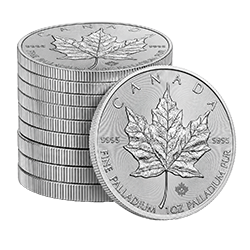
Investors can easily acquire physical palladium through liquid, globally recognized sovereign investment products. Popular options include the 1 oz American Palladium Eagle from the United States Mint and the 1 oz Canadian Palladium Maple Leaf produced by the Royal Canadian Mint. Both government-issued coins feature guaranteed .9995 pure fine content, carry official legal tender face values, and are highly eligible for inclusion in self-directed Precious Metals IRAs.
How SD Bullion Locks In Palladium Prices at Checkout
Orders placed through SD Bullion securely lock in the quoted price at checkout, meaning later spot market volatility will not alter your confirmed purchase price. Because precious metals markets operate with constant price movements, securing your target rate prevents unexpected changes to your order total.
Palladium Price Frequently Asked Questions
Compare live palladium prices and current SD Bullion palladium premiums before placing an order. All sales are legally final according to established industry market terms, shielding clients from downstream pricing changes while shipping orders via fast, fully insured delivery pathways. Compare live palladium prices and current premiums on SD Bullion’s palladium coins and bars category pages before placing your next order to ensure maximum cost efficiency.